
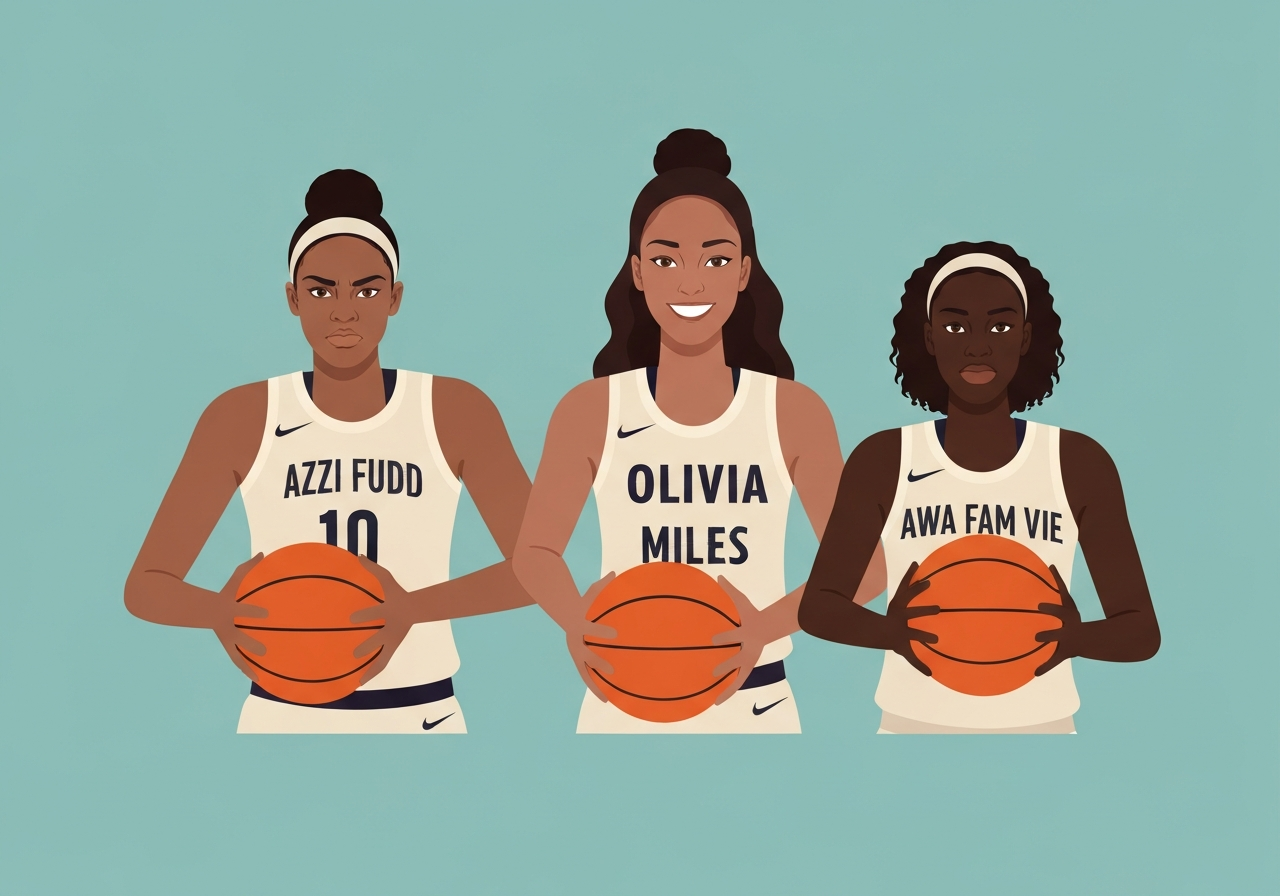
Lead: On Monday the Dallas Wings used the No. 1 overall pick in the 2026 WNBA Draft to select UConn guard Azzi Fudd, ending a draft-night mystery that had kept fans and front offices guessing. TCU guard Olivia Miles and 19-year-old Spanish center Awa Fam were the principal contenders for the top selection. The pick comes after a season in which the Wings finished 10-34, tying for the league’s worst record, and follows major changes from a new collective bargaining agreement that raised rookie pay. The 2026 WNBA regular season is scheduled to begin on May 8.
Key takeaways
- Dallas Wings selected Azzi Fudd No. 1 overall on Monday; the franchise finished 10-34 in 2025 and earned the top pick in the 2026 draft lottery.
- Azzi Fudd, 23, averaged 17.3 points per game in her final collegiate season at UConn, with a three-game closing stretch averaging 10.3 points and eight in the Final Four loss to South Carolina.
- Olivia Miles averaged a career-best 19.6 PPG for TCU in 2025-26 and has averaged 6.5 assists across her college career, projecting as a high-level playmaker.
- Awa Fam, 19, playing professionally for Valencia in Spain, averaged 9.2 points and 5.0 rebounds and measured 6-foot-6, giving her high upside as an interior talent.
- Under the new CBA, the 2026 top pick will earn a $500,000 rookie salary—substantially higher than last year’s top pick, Paige Bueckers, who earned $78,831 as a rookie.
- The WNBA is entering its 30th season amid labor concessions, an expansion draft earlier this month, and record rookie-market salary growth under the new agreement.
Background
The 2024 and 2025 drafts produced top selections that felt predetermined—Caitlin Clark to the Indiana Fever and Paige Bueckers to the Dallas Wings—bringing heightened attention to the 2026 draft as an open contest for No. 1. League-wide changes shaped the context: a protracted labor negotiation that concluded in March produced a new collective bargaining agreement that altered rookie pay and roster economics. An expansion draft and an early free-agency period also shifted team-building priorities ahead of the annual collegiate and international selection process.
Dallas entered the lottery after a 10-34 campaign, tied with Chicago for the league low in 2025, which set up a critical decision for their rebuild. Teams evaluated a deep mix of college-tested guards and younger international size, weighing immediate roster fit against long-term upside. Front offices had to balance the Wings’ present needs with the broader salary landscape and an expanded pool of free agents thanks to the CBA changes.
Main event
The draft concluded with the Dallas Wings announcing Azzi Fudd as the first overall pick. Fudd arrives with a reputation as a high-level 3-point shooter and a competent perimeter defender at the pro guard position. Her 17.3 PPG in her final season is the highest scoring mark she posted at UConn, though she cooled late in the NCAA tournament, averaging 10.3 points across her last three games.
Olivia Miles remained a leading alternative on draft boards; her 19.6 PPG at TCU and consistent playmaking—6.5 career assists per game—make her an attractive selection for teams that need a primary or secondary facilitator who can also finish at the rim. Miles is less of a pure shooter than Fudd but compensates with aggression, interior scoring, and free-throw production.
Awa Fam presented a different profile as the draft’s high-ceiling international option. At 19 and 6-foot-6, Fam combines interior scoring instincts and passing from the post while averaging 9.2 points and 5.0 rebounds in Spain’s top women’s professional league. Her age and relative unfamiliarity to U.S. college evaluators give her upside and risk: she could develop into a star or require longer seasoning in the WNBA environment.
The Wings’ selection reflects a choice to prioritize shooting and a pro-ready guard skill set for a team seeking offensive spacing and backcourt stability. The pick also arrives amid public interest in Fudd’s personal life—she and Paige Bueckers went public with a romantic relationship in July 2025—which some observers noted as background context but not a roster factor.
Analysis & implications
For the Wings, selecting Fudd addresses a clear need for perimeter shooting and veteran-less backcourt scoring. In modern WNBA schemes that prize spacing, a high-volume, efficient 3-point guard can transform offensive design and create lanes for interior players. Fudd projects to be a starter-level shooter early; her defensive competence at the guard spot gives the Wings a two-way floor role rather than a purely scoring specialist.
Olivia Miles represents an alternate model of impact: playmaking and downhill scoring. A team that already fields effective spot-up shooters might prefer Miles for her ability to create offense for others, initiate sets, and drive to the rim. Miles’ assist numbers indicate NBA-style court vision that should translate to WNBA playmaking responsibilities.
Awa Fam’s selection potential raises the classic high-upside-versus-readiness question. At 6-foot-6 with professional experience in Spain, she brings length and interior skill that could pay dividends as the league continues to value bigs who can pass, finish, and stretch. Teams assessing Fam must accept a possible multi-year development trajectory in exchange for a ceiling that could exceed many college prospects.
League-wide, the increased rookie pay under the 2026 CBA alters draft valuation. Top picks now command significantly higher guaranteed income, creating stronger incentives to find immediate contributors while also managing long-term cap implications. Expansion and a shifting free-agent market also mean teams may prioritize draft picks differently than in prior cycles.
Comparison & data
| Player | Age | Key stats (2025-26) | Height |
|---|---|---|---|
| Azzi Fudd (UConn) | 23 | 17.3 PPG (season); 10.3 PPG last 3 games | Guard |
| Olivia Miles (TCU) | — | 19.6 PPG (2025-26); 6.5 career APG | Guard |
| Awa Fam (Valencia, Spain) | 19 | 9.2 PPG; 5.0 RPG (Spain) | 6 ft 6 in |
The table highlights contrasting profiles: Fudd as a seasoned collegiate shooter, Miles as a high-usage playmaker, and Fam as an elite-size international prospect. Teams must weigh college production against age, positional scarcity, and projected translation to the WNBA’s defensive and physical demands.
Reactions & quotes
“We welcome Azzi to Dallas and believe her shooting and competitive experience will help accelerate our rebuild.”
Dallas Wings (team statement)
“This draft reflected a broader league reset—new pay structures and roster moves reshaped several teams’ priorities.”
League official (public statement)
“Awa Fam offers a rare combination of size and playmaking for her age, but teams should be patient as she adapts to the WNBA.”
Draft analyst (expert commentary)
Unconfirmed
- The precise degree to which Fudd’s late-season scoring dip affected evaluation versus her full-season 17.3 PPG is not publicly quantified by all teams.
- The timeline for Awa Fam’s potential impact in the WNBA—whether she debuts immediately as a rotation player or requires developmental time overseas—is still speculative.
- Details beyond the $500,000 base rookie salary for the No. 1 pick, such as bonuses or option structures, were not fully disclosed in public summaries.
Bottom line
Dallas’s choice of Azzi Fudd with the top pick signals a preference for pro-ready shooting and backcourt floor spacing as the franchise attempts to move out of a 10-34 season. Fudd’s collegiate track record and three-point skill set should translate into early rotational minutes and a clear offensive role.
The presence of alternatives like Olivia Miles and Awa Fam shows the draft offered distinct pathways: immediate playmaking, high-upside interior scoring, or established perimeter shooting. Teams and fans should expect a near-term focus on fit for the Wings and a broader season-long narrative about how the new CBA and expansion shape roster construction.