
Lead
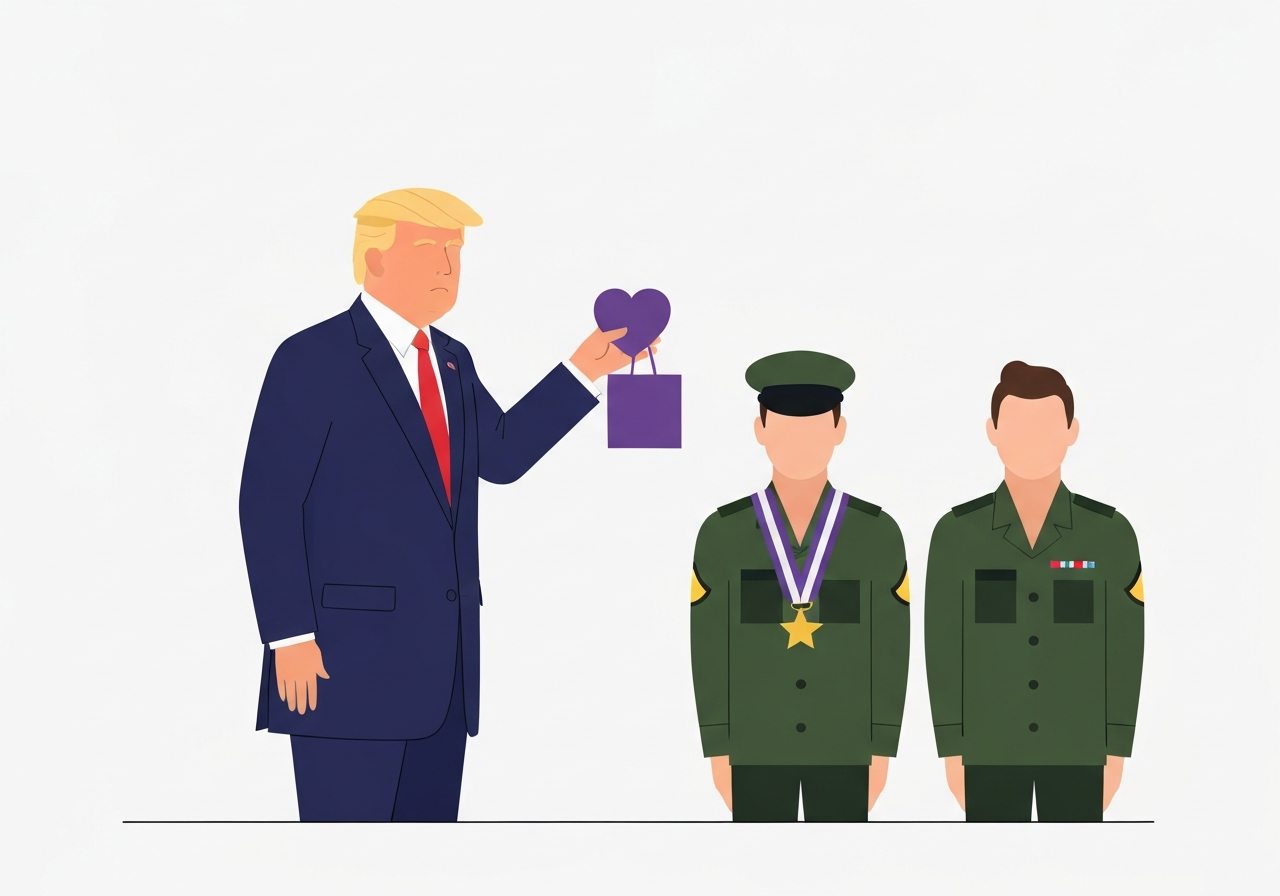
At the Feb. 24, 2026 State of the Union address, President Donald Trump presented a series of military and civilian honors on the House floor, including Purple Hearts, multiple Medals of Honor, the Presidential Medal of Freedom and a Legion of Merit. Recipients included Air Force Staff Sgt. Andrew Wolfe and the family of Army Spc. Sarah Beckstrom (posthumous Purple Heart), 100‑year‑old Navy Capt. E. Royce Williams (Medal of Honor), Chief Warrant Officer Eric Slover (Medal of Honor) and U.S. Olympic goalie Connor Hellebuyck (Presidential Medal of Freedom). The president and lawmakers recognized rescue personnel and veterans for actions spanning a 1952 aerial engagement to responses to disasters and recent battlefield operations. Families and honorees were brought into the chamber and acknowledged publicly during the address.
Key Takeaways
- President Trump presented Purple Hearts to Staff Sgt. Andrew Wolfe and posthumously to Army Spc. Sarah Beckstrom during the Feb. 24 State of the Union.
- Beckstrom, 20, died in a November 2025 ambush near the White House; Wolfe, 24, survived with critical injuries; an Afghan national arrested in that case pleaded not guilty earlier this month to federal charges.
- Connor Hellebuyck, goalie for the U.S. men’s Olympic hockey team, was announced as a recipient of the Presidential Medal of Freedom after helping the U.S. win Olympic gold on Feb. 18, 2026.
- Retired Navy Capt. E. Royce Williams, age 100, received the Medal of Honor for a 1952 dogfight in which he shot down four MiG‑15s in a prolonged engagement.
- Chief Warrant Officer Eric Slover was awarded the Medal of Honor for wounds sustained while piloting a Chinook during the operation that captured Nicolás Maduro in Venezuela.
- Petty Officer 2nd Class Scott Ruskan received the Legion of Merit for rescue work during the July 2025 Texas floods that killed more than 130 people, including many at Camp Mystic; he is credited with saving dozens, including an 11‑year‑old camper.
- The recognitions brought together veterans, victims’ families, first responders and Olympic athletes on the House floor, underscoring the administration’s emphasis on valor, sacrifice and national unity.
Background
The State of the Union is traditionally an occasion when presidents highlight national priorities and recognize notable citizens and service members. This year’s recognitions came against a backdrop of several high‑profile events: a deadly November 2025 attack near the White House that left a service member dead, catastrophic Texas flooding in July 2025, and a widely publicized operation in Venezuela that ended with the capture of former President Nicolás Maduro. Presenting awards in that setting is both ceremonial and political: honors elevate individual stories while signaling policy priorities to Congress and the public.
Military decorations like the Medal of Honor and Purple Heart carry legal and ceremonial weight; their public presentation can bring renewed attention to unresolved questions, such as judicial proceedings tied to violent attacks or the operational details of classified missions. The finalists for civilian honors—here represented by an Olympic athlete—reflect an administration choice to link international sporting triumphs to national pride. Families of the fallen and survivors were invited to the chamber, a practice aimed at personalizing the broader themes of sacrifice and service raised in the speech.
Main Event
During the address, Mr. Trump walked lawmakers through each recognition and introduced the honorees and their families. Staff Sgt. Andrew Wolfe, of the West Virginia National Guard, was presented a Purple Heart and seen with the medal pinned to his lapel; his fellow Guard member, Spc. Sarah Beckstrom, who died in the November 2025 ambush, was represented by her family, who received a posthumous Purple Heart. The administration noted that an Afghan national arrested in connection with that attack has pleaded not guilty to federal charges earlier this month.
Connor Hellebuyck and members of the U.S. men’s Olympic hockey team met with the president at the White House earlier on Feb. 24 before attending the address, where they were applauded by legislators on both sides of the aisle. Mr. Trump announced Hellebuyck would receive the Presidential Medal of Freedom in recognition of his role in the U.S. 2–1 victory over Canada in the Olympic gold‑medal game, the first U.S. men’s hockey gold since 1980.
Retired Navy Capt. E. Royce Williams, present in the chamber at age 100, received the Medal of Honor for actions during a 1952 aerial engagement off the Korean Peninsula in which he is credited with downing four Soviet MiG‑15s during a prolonged dogfight. The award recognizes a clash that had been secret for decades and has now been publicly acknowledged.
Chief Warrant Officer Eric Slover was honored for wounds suffered while piloting a helicopter during the operation in Venezuela that culminated in Maduro’s capture; the president described the injuries to Slover’s leg and hip and praised his focus on mission success. Separately, Petty Officer 2nd Class Scott Ruskan was singled out for the Legion of Merit for his role rescuing campers and other residents during the July 2025 Texas floods.
Analysis & Implications
Staging multiple award presentations during the State of the Union reinforces the administration’s narrative of strength, sacrifice and achievement. By pairing historical valor—such as Capt. Williams’s 1952 engagement—with recent operations and domestic rescues, the speech linked past military legacy to current policy priorities, including an assertive posture overseas and emphasis on first responders at home. Those narrative choices can harden public perceptions of competence in security and disaster response even as policy details remain contested.
The Maduro operation and Slover’s recognition carry diplomatic risk alongside domestic reward. Publicly honoring participants in a cross‑border capture raises questions about sovereignty, legal authority and intelligence cooperation; allies and adversaries will scrutinize the operation’s implications for regional stability. If key operational details remain classified, the administration may face pressure from Congress and international partners for additional information while balancing security concerns.
Presenting the Presidential Medal of Freedom to a recent Olympic hero is a low‑risk, broadly popular move that taps into national pride and bipartisan sentiment. It helps broaden the speech’s appeal beyond security themes and highlights a unifying cultural moment. Still, the juxtaposition of sports honors with wartime valor may prompt commentary about the comparative criteria for civilian and military awards and how the presidency chooses to allocate ceremonial spotlight.
Comparison & Data
| Award | Recipient | Incident/Context | Year |
|---|---|---|---|
| Purple Heart | Andrew Wolfe | Ambush near White House; survived | 2025 |
| Purple Heart (posthumous) | Sarah Beckstrom | Ambush near White House; killed | 2025 |
| Presidential Medal of Freedom | Connor Hellebuyck | Gold‑medal performance, Olympics vs. Canada | 2026 |
| Medal of Honor | E. Royce Williams | 1952 aerial engagement (MiG‑15s) | 1952 |
| Medal of Honor | Eric Slover | Wounded during Venezuela operation to capture Maduro | 2026 |
| Legion of Merit | Scott Ruskan | Rescues during July 2025 Texas floods | 2025 |
The table summarizes the awards highlighted during the address and places each recognition in a concise timeline. The grouped view shows the range from Cold War‑era combat recognition to recent disaster response and operational valor, illustrating the administration’s intent to link historical and contemporary acts of service.
Reactions & Quotes
Lawmakers and witnesses in the chamber responded with visible applause at several moments; family members were escorted to the floor and photographed alongside honorees. Veterans groups and some lawmakers praised the public recognition, while other commentators urged scrutiny where operational or legal questions remain. Below are brief excerpts from the address in context.
“With God’s help, Andrew has battled back from the edge of death.”
President Donald J. Trump
That remark accompanied Mr. Trump’s introduction of Staff Sgt. Andrew Wolfe and acknowledgement of Sarah Beckstrom’s family. The line underscored the personal recovery story and framed Wolfe’s survival as central to the presentation of the Purple Heart. Observers noted the humanizing effect when service members and families are visibly present during televised addresses.
“I’ve never seen a goalie play as well as Connor Hellebuyck.”
President Donald J. Trump
The president used that laudatory phrase when announcing Hellebuyck’s Medal of Freedom, linking the athletic achievement to national celebration after the Feb. 18 Olympic final. The comment received broad applause from both parties and was followed by lawmakers rising to honor the Olympic team’s success. For many viewers, the athletic award provided a unifying interlude in an otherwise policy‑driven speech.
“Tonight, at 100 years old, this brave Navy captain is finally getting the recognition he deserves.”
President Donald J. Trump
Mr. Trump introduced Capt. E. Royce Williams with that line before presenting the Medal of Honor for a long‑secret engagement. The remark highlighted the belated public acknowledgment of actions from the Korean War era and drew sustained standing ovations. Military historians said the presentation helps close a historical gap while prompting renewed interest in the classified episodes that delayed public recognition.
Unconfirmed
- Some operational details of the Venezuela capture remain classified and have not been independently verified in open sources.
- Specific motive, planning timeline and full evidentiary record regarding the November 2025 ambush near the White House have not been fully disclosed publicly.
- Numbers cited for rescues and fatalities during the July 2025 Texas floods have been reported across multiple outlets and may be subject to later revision as official tallies are finalized.
Bottom Line
The State of the Union presentations combined wartime valor, recent operational bravery and high‑profile civilian achievement into a single, televised narrative about sacrifice and national pride. The administration used the ceremony to honor a range of actors—from a centenarian World War II/Korean War pilot to a modern Olympic athlete—highlighting continuity across generations of service. Such public recognitions carry immediate political and emotional resonance but also raise policy and transparency questions when linked to ongoing investigations or classified operations.
Looking ahead, Congress and federal agencies may press for more information on the Maduro operation and the November 2025 ambush as legal and diplomatic processes continue. For the public, the ceremony reinforced familiar themes of heroism and resilience while prompting closer attention to how honors are awarded and the facts that underpin them.
Sources
- CBS News (news report; original coverage and photos)
- The White House (official statements and press resources)
- U.S. Department of Defense (official military releases and historical records)