
Lead
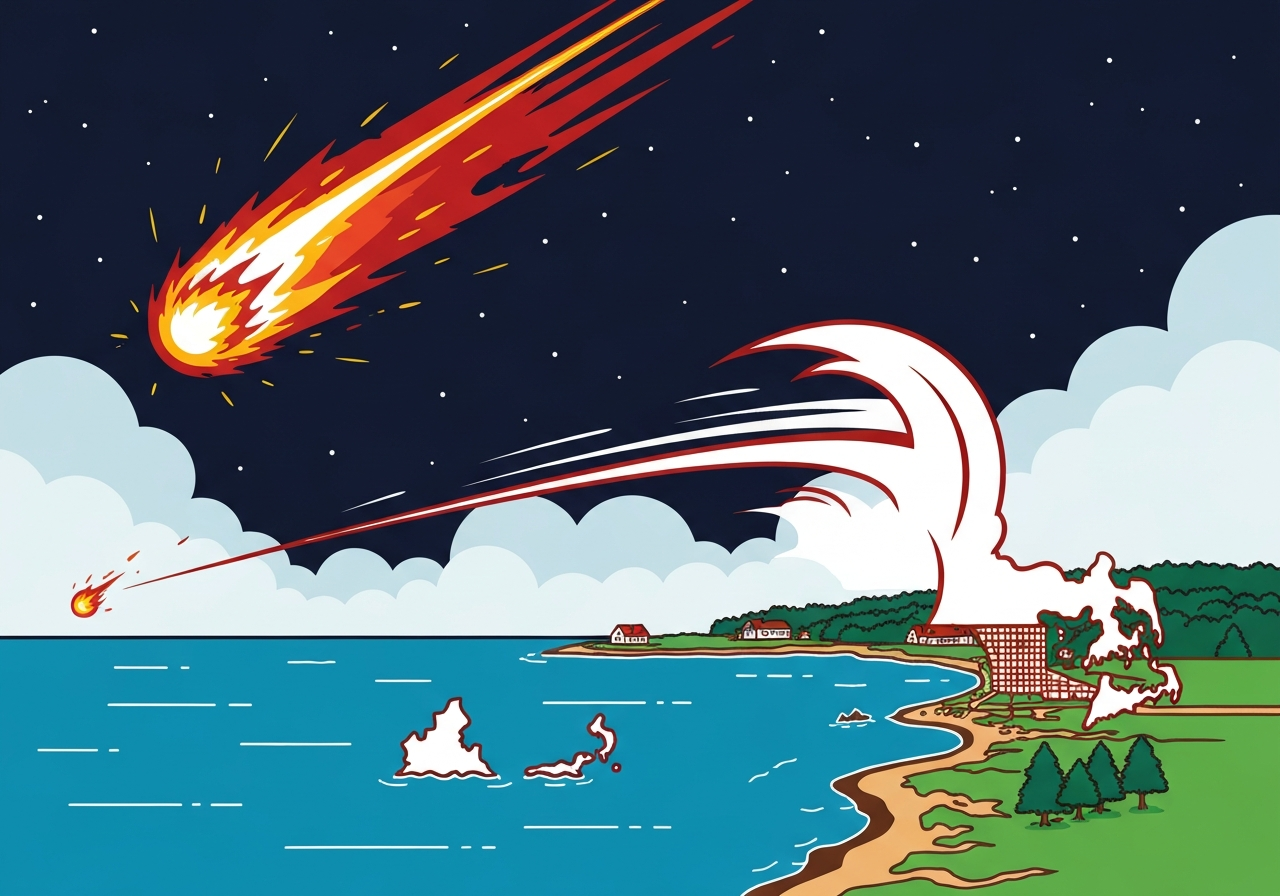
On May 31, 2026, at about 2:11 p.m. Eastern Time a meteor exploded over the waters off Massachusetts, producing a loud boom that was heard across much of the state and into neighboring states. NASA estimated the breakup released energy equivalent to roughly 300 tons of TNT, and preliminary tracking placed the fragmentation near 40 miles altitude over northeastern Massachusetts and southeastern New Hampshire. Satellite lightning data from NOAA and dozens of eyewitness reports helped scientists reconstruct the fireball’s path; NASA later said debris likely fell into the middle of Cape Cod Bay. The blast rattled windows, startled pets and prompted numerous calls to local newsrooms and authorities as researchers assess impact, recovery and implications for monitoring similar events.
Key Takeaways
- The event occurred on May 31, 2026 at about 2:11 p.m. ET and was heard widely across Massachusetts and parts of the Northeast.
- NASA estimates the breakup released energy equivalent to about 300 tons of TNT, producing an audible sonic boom.
- Fragmentation is reported at an altitude near 40 miles over northeast Massachusetts and southeast New Hampshire.
- NOAA satellite lightning signatures and eyewitness fireball reports were used to reconstruct the trajectory and entry point near the South Shore of Boston.
- NASA located a daytime bolide fall site in the middle of Cape Cod Bay where water depth is about 34 meters, reducing the likelihood of recoverable fragments.
- Dozens of public reports to WBZ and the American Meteor Society covered visual sightings from multiple states, improving scientific triangulation.
- Scientists note an uptick in high-profile fireballs and sonic boom reports in early 2026, but assess no broad impact threat to Earth.
Background
Meteors routinely enter Earth’s atmosphere at tens of thousands of miles per hour and typically burn up at high altitude, producing streaks of light often called fireballs. Larger objects can survive deeper into the atmosphere, generating shock waves comparable to supersonic aircraft and producing audible booms at ground level. The USGS distinguishes these atmospheric shock events from earthquakes by noting that sonic booms occur along a linear aerial path rather than from a single point on the ground.
Over the first months of 2026 scientists and monitoring groups documented several notable fireballs across North America, including events in Ohio and Texas in March and regional sonic boom reports in other states. Those earlier episodes, together with improvements in public reporting networks and remote sensing, have improved the ability to triangulate trajectories and estimate energy release. Agencies such as NOAA, NASA and the American Meteor Society routinely combine eyewitness accounts, radar and satellite data to establish entry vectors and possible fall zones.
Main Event
At roughly 2:11 p.m. ET on May 31, residents across eastern Massachusetts and neighboring states reported a sharp, sudden boom accompanied in many cases by a bright daytime fireball. WBZ-TV reported dozens of incoming calls from viewers describing rattled windows and shaken homes from Boston out to Ipswich and as far as Johnston, Rhode Island. The American Meteor Society received numerous preliminary reports describing a bright object traveling through the sky near 2 p.m.
NOAA satellite lightning and atmospheric sensors recorded a signature concurrent with the auditory reports, consistent with a high-energy bolide entering at high speed. NASA’s initial analysis indicated the object fragmented at about 40 miles altitude over northeast Massachusetts and southeast New Hampshire, releasing energy NASA estimated at about 300 tons of TNT. That energy is the primary cause of the strong shock waves heard on the ground.
Based on trajectory reconstructions and sensor data, NASA reported that fragments, if any survived, likely fell into the middle of Cape Cod Bay. NASA noted the local water depth at the projected fall site is roughly 34 meters, which complicates recovery and reduces the chance of recovering sizable meteorite fragments. Observers and video footage remain valuable, however, because brightness, duration and angle of travel help researchers infer composition and origin even when fragments are not recovered.
Analysis & Implications
Scientifically, a daytime bolide with a 300-ton TNT equivalent is a moderately energetic airburst but well below levels that produce widespread damage on land. The 40-mile fragmentation altitude kept the most destructive effects confined to pressure waves rather than ground impact. Still, the event underscores that even relatively small space objects can produce startling sonic effects over wide areas and can temporarily overwhelm local communications as residents report sounds and video to authorities and media.
The probable fall into a 34-meter-deep section of Cape Cod Bay highlights recovery challenges. Ocean falls are common because about 70 percent of Earth’s surface is water, substantially reducing meteorite recovery rates. When meteorites land at sea, researchers rely on rapid collection of eyewitness video, radar tracks and oceanographic models to narrow search areas, but water currents and depth quickly complicate physical recovery of fragments.
From a hazard-management and monitoring perspective the event reinforces the value of distributed reporting networks and multiagency sensor fusion. Satellite lightning products, regional infrasound arrays, seismic stations and public sighting databases together improve triangulation and energy estimates. The recent cluster of high-profile fireballs in early 2026 has sparked discussion among agencies about whether expanded sensor coverage or public alerting protocols are needed for airburst events that produce strong sonic effects.
Comparison & Data
| Parameter | Value |
|---|---|
| Event date and time | May 31, 2026, ~2:11 p.m. ET |
| Estimated energy | ~300 tons of TNT |
| Estimated breakup altitude | ~40 miles (approx. 64 km) |
| Probable fall location | Middle of Cape Cod Bay |
| Water depth at fall site | ~34 meters |
The table above summarizes primary numeric estimates derived from agency statements and sensor analyses. These figures help place the event among other atmospheric entries: it was substantially less energetic than large historic airbursts such as Chelyabinsk (2013) but similar in character to other regional daytime bolides that produced sonic booms and brief visual fireballs in 2026. Comparing dates and energy estimates helps researchers evaluate whether recent months show a true statistical rise in strong fireballs or if improved detection and reporting account for the apparent increase.
Reactions & Quotes
Authorities and experts issued brief statements to explain the observed phenomena and reassure the public while investigations continued.
We estimate the object fragmented at roughly 40 miles altitude and released energy on the order of several hundred tons of TNT, which explains the loud noise reported by many residents.
NASA (official statement)
The pressure waves you heard are produced by rapid air compression as the rock moves at very high speed and sometimes by pieces breaking apart under those forces.
Shauna Edson, Smithsonian National Air and Space Museum (astronomy educator)
Sonic boom events are registered along a line in the atmosphere rather than at a single point on the ground, which is why reports came from a wide swath of communities.
U.S. Geological Survey (scientific explanation)
Unconfirmed
- No meteorite fragments have been publicly confirmed recovered from Cape Cod Bay as of the latest agency statements.
- Any direct identification linking the object to a known asteroid or meteoroid stream remains pending and unconfirmed.
- Reports of structural damage or injuries associated with the boom have not been independently verified beyond initial media and public calls.
Bottom Line
The May 31, 2026 meteor produced a significant daytime bolide and a widely heard sonic boom but posed little risk of large-scale ground damage because it fragmented high in the atmosphere and likely deposited any surviving material into the waters of Cape Cod Bay. The event illustrates both the power of relatively small space rocks to create startling local effects and the limits of recovery when falls occur over water.
Moving forward, agencies will continue to analyze sensor data, eyewitness footage and any recovered material if found. The incident reinforces the value of coordinated monitoring networks that combine public reports, satellite products and ground-based sensors to rapidly estimate trajectory, energy and potential fall zones for timely public information and scientific study.
Sources
- CBS News (regional news report) — source article reporting initial eyewitness accounts and agency quotes.
- NASA (official agency) — agency analysis and public statements on bolide energy and fragmentation.
- NOAA (federal agency) — satellite lightning and atmospheric data used to locate the entry signature.
- American Meteor Society (citizen science/organization) — repository for eyewitness fireball reports and preliminary trajectory data.
- U.S. Geological Survey (federal scientific agency) — context on distinguishing sonic booms from seismic events.
- Smithsonian National Air and Space Museum (educational) — expert commentary on meteor physics and sonic boom generation.