
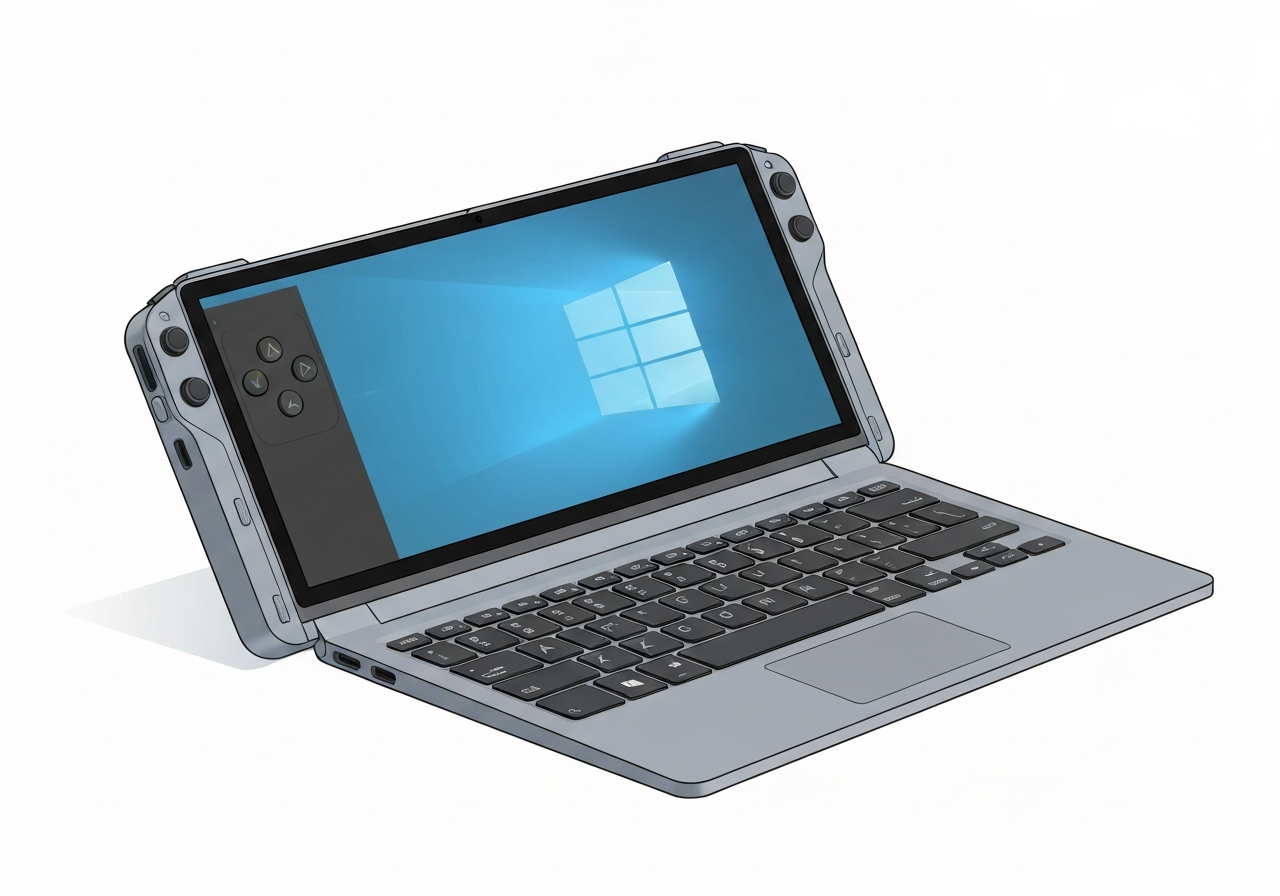
Lead: Leaked images and reporting indicate that Lenovo is developing a foldable gaming device, reportedly called the Legion Go Fold, that can function both as a handheld gaming PC and as a Windows laptop. The screen is said to use POLED technology and fold on a central hinge, expanding from 7.7 inches to 11.6 inches. Detachable controllers and a snap-on keyboard create multiple usable configurations, while reported internals include an Intel Core Ultra 7 258V CPU, 32GB of RAM and a 48 Whr battery. Lenovo is expected to present the unit as a concept at Mobile World Congress (MWC) in Barcelona next week, although commercial availability is not confirmed.
Key Takeaways
- The device, reportedly named Legion Go Fold, appears as a single POLED panel with a central hinge allowing sizes of 7.7″ folded and 11.6″ unfolded.
- Four primary form factors are described: handheld folded, handheld unfolded, vertical split-screen handheld, and attached-to-keyboard laptop mode.
- Detachable controllers can mount in folded or unfolded modes; the right-side controller reportedly supports an “FPS Mode” acting as a vertical mouse.
- The right controller is said to include a small display for performance metrics and settings, and can function as a touchpad.
- Leaked specification claims include an Intel Core Ultra 7 258V CPU, 32GB RAM and a 48 Whr battery; these remain unconfirmed by Lenovo.
- Sources indicate Lenovo may showcase the prototype or concept at MWC Barcelona next week; no launch date has been provided.
- If authentic, the design merges handheld console ergonomics with a full Windows experience, a rare combination in current PC hardware.
Background
Foldable displays have steadily moved from smartphone experiments into broader device categories, with manufacturers exploring foldable tablets and hybrid PCs as manufacturers chase portability without sacrificing screen area. Gaming-focused hardware has traditionally prioritized raw performance and cooling over extreme portability, but recent entrants such as handheld Windows gaming PCs have narrowed that gap. Lenovo’s Legion line targets PC gaming with distinct hardware and software choices; a foldable form would mark a significant design departure for the brand.
Previous products like the original Legion Go and compact Steam Deck-style devices demonstrated demand for portable Windows gaming. Hardware makers have experimented with detachable controllers and modular accessories—approaches aimed at giving users multiple interaction modes without committing to a single chassis. At trade shows such as MWC, vendors often present concept devices to gauge industry and consumer reaction before deciding on production ramps or revisions.
Main Event
The leak centers on photographs of a device showing a centrally hinged POLED display that folds to a 7.7″ configuration and unfolds to roughly 11.6″. Images depict the panel attached to a traditional laptop keyboard in one arrangement and to gamepad-like controllers in others. The hinge appears integrated mid-panel rather than at an edge, enabling both compact handheld use and a larger, tablet-like canvas when fully opened.
Controllers shown in the leaks attach in multiple positions and include a right-hand module with a secondary display. That small screen reportedly surfaces system telemetry—CPU/GPU workload, thermals and quick-setting toggles—and the module can flip functionally into a touchpad or vertical-mouse posture for FPS play. The leaked visuals also show the controllers being usable whether the main screen is folded or unfolded, suggesting a design that emphasizes accessory flexibility.
Reported specifications accompanying the images list an Intel Core Ultra 7 258V CPU, 32GB of RAM and a 48 Whr battery. Those figures imply a focus on a high-performance portable Windows experience but also hint at battery life compromises relative to larger gaming laptops. According to reporting, Lenovo plans to label the unit a concept device at MWC, signaling that it may be a technology demonstrator rather than an immediate production model.
Analysis & Implications
If the Legion Go Fold is genuine, it represents an attempt to converge multiple device categories: the handheld console, the tablet, and the clamshell laptop. For consumers this could mean greater versatility—one device serving couch play, on-the-go handheld sessions, and desk-based productivity—reducing the need to buy separate hardware for different contexts. For developers and PC game publishers, wider adoption of unusual aspect ratios and input modes could complicate optimization and UI layout considerations.
From an engineering standpoint, combining a foldable POLED display, detachable controllers, and Windows compatibility raises significant thermal, durability and software-integration challenges. Windows was not designed natively around foldable or detachable controllers, so Lenovo would likely need custom drivers, firmware and software layers to deliver a smooth experience. Battery capacity at 48 Whr suggests trade-offs between raw performance and usable run time; cooling constraints for an Intel Core Ultra-series chip in a thin, folding chassis will be a central engineering hurdle.
Market positioning is also key. The Legion Go Fold would be competing with purpose-built handheld gaming PCs and high-performance ultraportables. Pricing will determine whether it appeals to enthusiasts as a premium niche or can scale into a broader audience. As a concept shown at MWC, Lenovo can solicit feedback, refine ergonomics, and test the market appetite before committing to mass manufacture—if it chooses to do so.
Comparison & Data
| Mode | Screen Size | Primary Input |
|---|---|---|
| Folded handheld | 7.7″ | Attached controllers |
| Unfolded handheld | 11.6″ | Attached controllers / touch |
| Vertical split | 7.7″/11.6″ split | Controllers / touch |
| Laptop mode | 11.6″ (keyboard attached) | Keyboard + trackpad or controllers |
The table summarizes the four reported configurations visible in the leaks and clarifies the intended inputs for each mode. The reported 48 Whr battery and Intel Core Ultra 7 258V positioning suggest performance closer to ultraportable gaming PCs than to low-power ARM handhelds; in practice, thermals and sustained frame rates will determine real-world suitability for long gaming sessions.
Reactions & Quotes
WindowsLatest reported that Lenovo intends to present the unit as a concept at MWC in Barcelona next week, framing the device as an experimental design rather than a confirmed retail product.
WindowsLatest (media)
The Verge’s coverage highlighted the multiple attachable configurations shown in the leaks, noting the right controller’s small display and the device’s mid-panel hinge as the most distinctive design elements.
The Verge (media)
Industry observers caution that concept reveals often differ from shipping products, and that foldable-display durability, thermal management and software integration will be decisive for any potential commercial release.
Industry commentary (trade analysts)
Unconfirmed
- The exact battery life under gaming load is unknown and not confirmed by Lenovo.
- The internal specifications (Intel Core Ultra 7 258V, 32GB RAM, 48 Whr) are reported by leaks and remain unverified by an official announcement.
- Images and accompanying metadata have not been independently authenticated; the design details could change before any public showing or release.
Bottom Line
The leaked Legion Go Fold, if authentic, would be one of the most ambitious attempts yet to fuse a Windows gaming PC with foldable-display portability and modular controls. It signals growing interest among vendors in multi-mode hardware that adapts to play and productivity, but it also exposes complex engineering and software challenges that could delay or prevent a commercial launch.
Readers should treat the specifications and images as provisional until Lenovo offers official confirmation. The expected MWC presentation will be the best near-term opportunity to see whether Lenovo frames the device as a long-term product roadmap or as an exploratory concept intended primarily to gather feedback.
Sources
- The Verge — news media reporting on leaked images and details
- WindowsLatest — technology news outlet cited for MWC concept report