
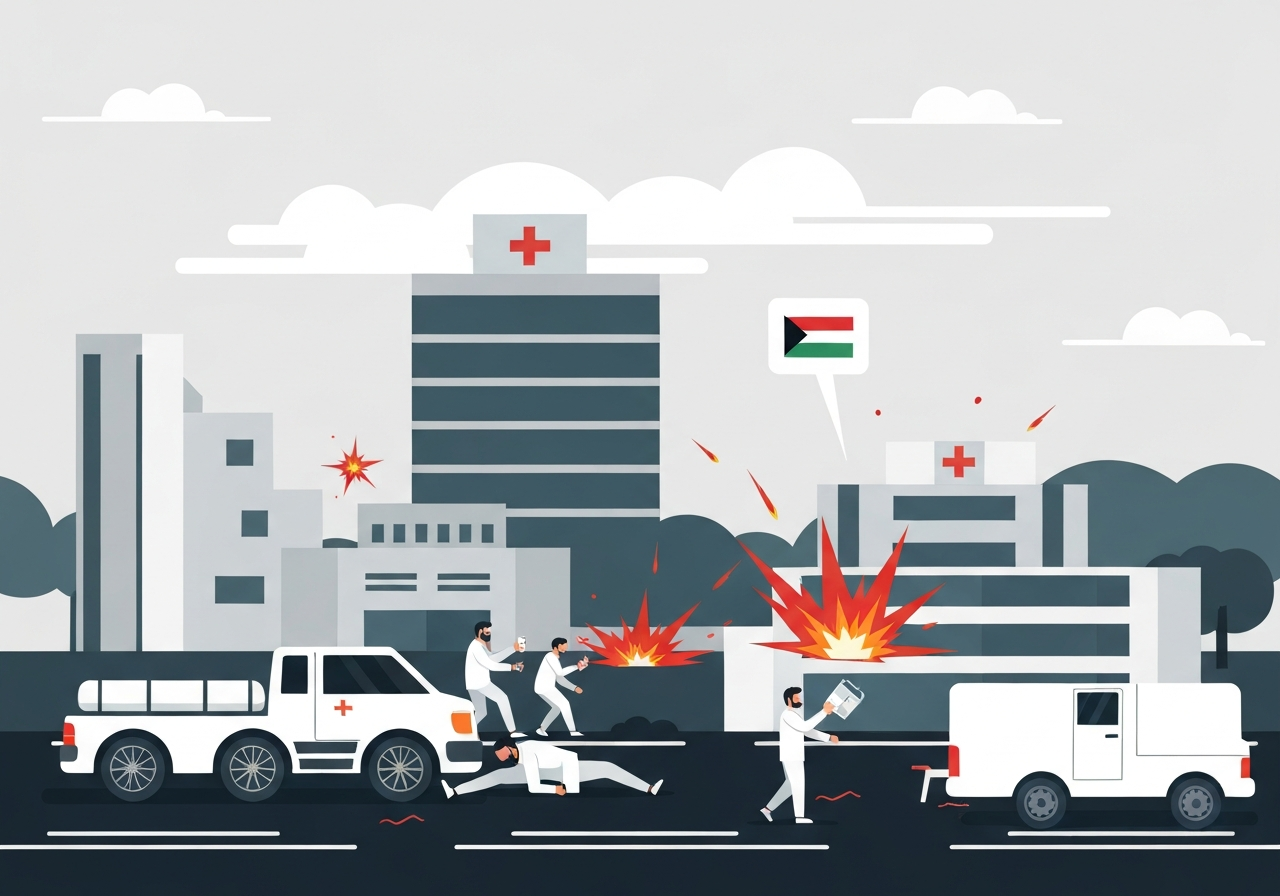
Rescue teams in southern Lebanon said Israeli forces carried out a sequence of strikes on 16 April 2026 that repeatedly hit ambulances and medical personnel responding to an earlier airstrike near Mayfadoun, killing four medics and wounding six. Witnesses and local health authorities described an initial strike followed by three additional hits on rescue vehicles — a pattern rescuers have long feared — which prompted the new term “quadruple tap.” The attack also coincided with separate strikes near the governmental hospital in Tebnine that damaged the emergency department and injured hospital staff. Lebanese officials and the World Health Organization called for urgent protection of health workers and facilities; Israel has offered limited public justification for the strikes.
- Four medics were killed and six wounded on 16 April 2026 after consecutive strikes on ambulances near Mayfadoun, southern Lebanon, according to local medical sources.
- Three of the killed medics were affiliated with the Islamic Health Association (IHA) or Amal-linked corps; one was with the Nabatieh emergency services organisation.
- Since the Israel–Hezbollah war began on 2 March 2026, Israeli attacks have killed 91 healthcare workers and wounded 214 in Lebanon, official tallies show.
- Video from the scene shows rescuers loading injured people when a second blast struck; subsequent strikes hit evacuating ambulances, prompting the new descriptor “quadruple tap.”
- Tebnine governmental hospital was struck within hours of the ambulance attacks, injuring 11 hospital workers and damaging the emergency department, the WHO reported.
- The Lebanese ministry of health said paramedics are being treated as direct targets, while Israel has accused Hezbollah of misusing medical infrastructure without presenting public evidence.
Background
The Israel–Hezbollah confrontation that began on 2 March 2026 has rapidly expanded the zone of active combat into southern Lebanon, bringing repeated airstrikes, artillery fire, and cross-border exchanges. Medical teams and ambulance services in the border governorates have been operating under sustained threat as hospitals and transport vehicles have repeatedly come under fire. Historically, rescue personnel are protected under international humanitarian law as non-combatants, a status meant to safeguard ambulances, hospitals and their staff regardless of political or militia affiliations. Yet patterns of so-called double-tap strikes — an initial attack followed by a second strike after rescuers arrive — have been reported for years in other conflicts and have become a recurrent fear among Lebanese responders in this campaign.
Local emergency networks in southern Lebanon include volunteer and party-affiliated services such as the Islamic Health Association (IHA), Amal-linked medical corps, and municipal and regional services like the Nabatieh emergency organisation. Those units regularly operate in tandem during mass-casualty events but differ in resources and protective capacity. The growing frequency of incidents involving medical teams has strained referral pathways: some hospitals near the border have been damaged or rendered partially inoperable, forcing transfers to more distant facilities. International agencies, including the WHO, have repeatedly urged that humanitarian and medical access be kept safe and uninterrupted as combat operations continue.
Main Event
On the afternoon of 16 April 2026 a localised Israeli airstrike struck a target in or near the city of Mayfadoun in southern Lebanon. Several nearby ambulances and civilian rescuers — many from the IHA — arrived to evacuate casualties from that initial blast. According to witnesses and medical sources, a second strike landed as medics were loading the wounded into vehicles, wounding and incapacitating responders on site.
As crews attempted to move their injured colleagues into other ambulances, two further strikes hit evacuation vehicles. Video recorded at the scene shows rescuers carrying bloodied colleagues and attempting to extract a motionless driver from an ambulance whose rear window had been shattered by shrapnel. The sequence of an initial strike followed by three additional hits on rescuers has been described by local actors as a “quadruple tap.”
Among those killed was Fadel Sarhan, 43, a paramedic survived by an eight-year-old daughter; colleagues and neighbours described him as caring and well known in his community. In total the incident killed four medics and wounded six, drawn from three separate ambulance services. Hours later, nearby Nabatieh and Tebnine also experienced strikes: an ambulance in Tebnine was struck leaving two medics critically injured, and the governmental hospital near Tebnine sustained damage that injured 11 staff and impaired its emergency department, per WHO reporting.
Analysis & Implications
The targeting of medical personnel and infrastructure — whether deliberate or incidental — has severe operational and humanitarian consequences. When ambulance crews are killed or ambulances destroyed, the immediate effect is a diminished capacity to evacuate and treat casualties, which raises mortality for civilians and combatants alike. Repeated attacks create a climate of fear that can deter responders from attending to scenes, extending the time wounded people spend without care and complicating medical logistics across the region.
Politically, the incidents amplify international scrutiny of Israel’s conduct of operations and of Hezbollah’s presence in southern Lebanon; accusations that medical assets are being used for military purposes have been made by Israeli authorities but, in the cases cited by Lebanese officials and international observers, public evidence has not been presented. That lack of transparent, verifiable justification weakens the legal and diplomatic position of any party asserting military necessity to justify strikes that impact protected personnel and facilities.
For health systems, the strikes risk cascading failure. The reported injury of 11 hospital workers and damage to Tebnine’s emergency department diminishes immediate capacity for trauma care in a high-casualty environment. International agencies may face greater logistical and security barriers to delivering medical supplies and staff rotations, particularly if hospitals are repeatedly damaged or if evacuation corridors are unreliable. The WHO’s public appeals underscore the risk to population health if health infrastructure continues to be impaired.
Comparison & Data
| Event | Date | Reported casualties / damage |
|---|---|---|
| Ambulance strikes near Mayfadoun (“quadruple tap”) | 16 April 2026 | 4 medics killed, 6 wounded |
| Tebnine governmental hospital strikes | 16 April 2026 | 11 hospital workers injured; emergency department damaged; ambulance hit, 2 medics critically injured |
| Cumulative healthcare worker toll in Lebanon | Since 2 March 2026 | 91 healthcare workers killed, 214 wounded |
These figures, drawn from local medical sources, the Lebanese ministry of health and WHO reporting, show both the immediate human cost of a single multi-strike incident and the broader cumulative impact since the conflict escalated in early March. The concentration of casualties among responders raises distinct legal and operational concerns compared with general civilian casualty figures.
Reactions & Quotes
“Paramedics have become direct targets, pursued relentlessly in a blatant violation that confirms a total disregard for all norms and principles established by international humanitarian law.”
Lebanese Ministry of Health (official statement)
“I reiterate the call for the immediate protection of healthcare facilities, health workers, ambulances and patients. There must be safe, sustained and unhindered humanitarian access across Lebanon.”
Tedros Adhanom Ghebreyesus, World Health Organization
“We have to go to places to rescue people, but then we get double tapped… But we will stay and keep going, we will not leave.”
Abbas Atwi, head of IHA emergency department in Nabatieh (local responder)
Unconfirmed
- Claims by Israeli authorities that ambulances or hospitals were being used by Hezbollah to move fighters or weapons have been made but, in the incidents described here, no publicly available evidence has been presented to verify those assertions.
- Attribution of intent in the ambulance strikes (whether deliberate targeting of medics or misidentification) remains subject to investigation and independent verification.
Bottom Line
The 16 April 2026 strikes near Mayfadoun and subsequent hits on ambulances and Tebnine hospital mark a concerning escalation in the risk faced by medical personnel in southern Lebanon. Four medics killed, multiple injured, and damage to the only remaining public hospital in parts of the south reduce immediate life-saving capacity and heighten humanitarian need. Repeated attacks on health workers, whether intentional or due to flawed targeting, carry heavy legal and moral implications and will likely intensify international pressure for clearer operational safeguards and independent investigations.
For civilians and responders alike, the critical questions are whether belligerents will respect the protected status of healthcare and whether international monitoring can document incidents rapidly and impartially. The pattern of strikes has immediate tactical effects on rescue operations and a wider strategic effect on the conflict’s humanitarian footprint; restoring safe medical access will be essential to reduce avoidable deaths as the crisis continues.
Sources
- The Guardian (international news outlet) — original reporting on the incident and eyewitness accounts.
- World Health Organization (international organization) — commentary and reporting on damage to Tebnine hospital and appeals for protection of health services.
- Lebanese Ministry of Public Health (official government) — public statements and casualty tallies for health workers in Lebanon.