
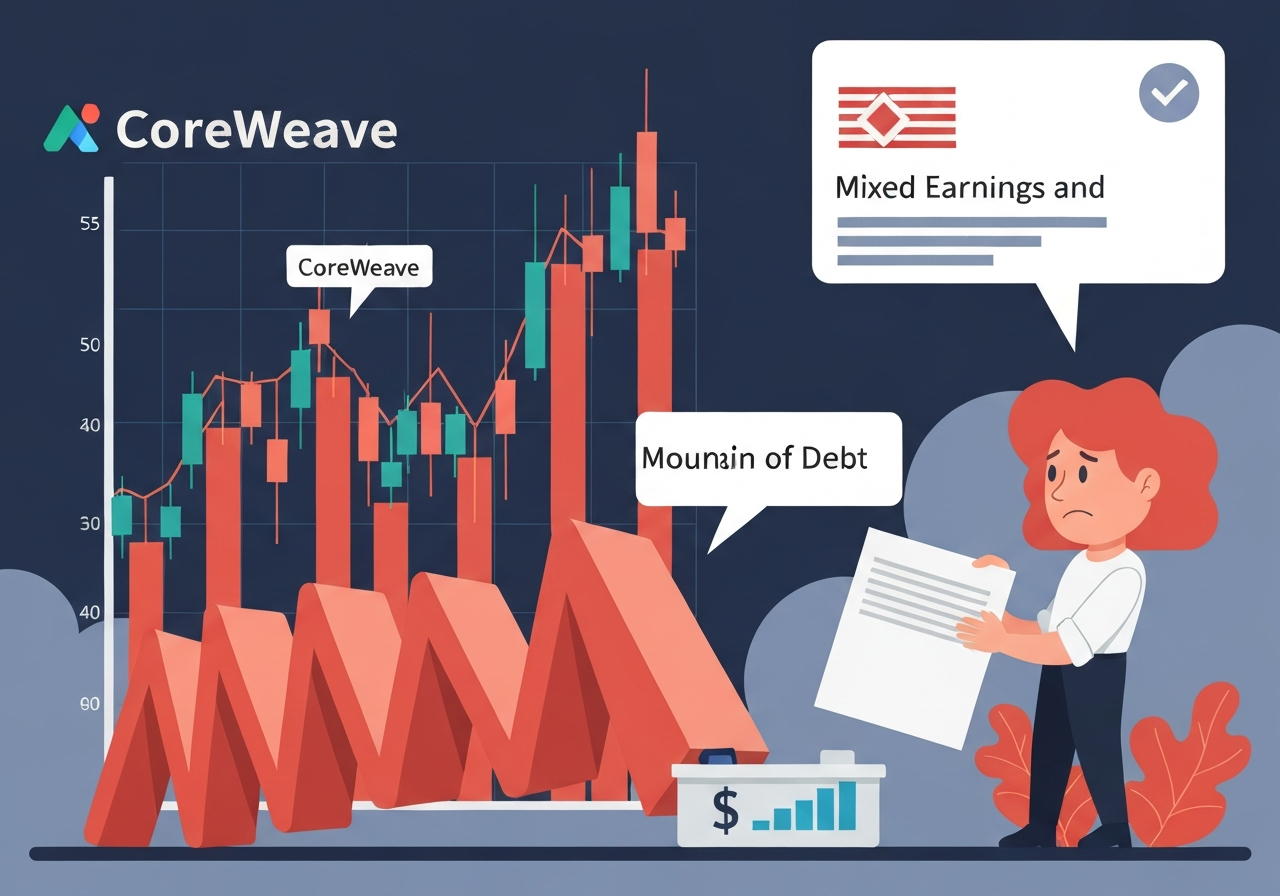
Lead: Shares of CoreWeave fell after the company reported mixed quarterly results and drew attention to a sizable debt burden, according to Barron’s. The report said investors interpreted the combination of uneven operational results and heavy leverage as a reason for caution. The move came on the heels of the firm’s earnings disclosure and accompanying commentary about capital needs. Market reaction reflected concerns about growth sustainability amid rising financing requirements.
Key Takeaways
- Following the earnings release, CoreWeave shares declined as investors weighed mixed performance metrics and questions about the firm’s leverage, per Barron’s reporting.
- Barron’s highlighted the company’s substantial outstanding debt as a focal point for market concern, amplifying volatility in the stock.
- Revenue and profitability signals in the quarterly update were described as uneven: some operating metrics improved while others fell short of investor expectations.
- Analysts and investors cited the capital-intensive nature of GPU infrastructure as a reason the debt load matters for future cash flow and growth flexibility.
- Market commentary emphasized the need for clearer guidance on margin expansion and cash-generation timelines before sentiment can stabilize.
- Short- and mid-term investor focus will likely center on cash burn, refinancing options, and the timing of breakeven for core workloads.
Background
CoreWeave operates a specialized publicly traded cloud provider focused primarily on GPU-accelerated compute for AI, animation, and other high-performance workloads. The business model is capital intensive because GPU hardware and data-center capacity require large up-front and ongoing investments. Since demand for AI compute has surged, companies like CoreWeave have pursued aggressive capacity build-outs to capture market share from larger hyperscalers and traditional cloud providers.
That growth strategy typically involves a mix of equity and debt financing; as a result, leverage levels and access to credit markets are key variables for investors. For asset-heavy providers, the timing of hardware deployment, utilization rates, and contract terms with large customers determine near-term cash flow. Prior quarters showed rapid revenue expansion for many GPU-cloud specialists, but translating top-line growth into consistent free cash flow has proven uneven across the sector.
Main Event
The recent quarterly disclosure—covered in Barron’s—presented a blend of encouraging and concerning signals. Operationally, the company reported certain growth metrics that suggested continued demand for its GPU services, but other indicators failed to convince investors that the firm is on a clear path to sustained profitability. Barron’s framed the release as “mixed,” stressing that the combination of ambiguous near-term margins and leverage drove the market response.
Investors focused on the firm’s balance sheet after Barron’s noted a substantial debt position that could constrain strategic options if revenue growth slows or capital markets tighten. Market participants told reporters they were seeking detail on covenants, maturities, and refinancing plans—items that influence leverage risk but were not fully detailed in the coverage. The stock reaction reflected that uncertainty: trading volumes and price movement signaled a reassessment of the company’s risk profile.
CoreWeave’s leadership has previously emphasized customer wins and capacity expansion as the route to scale, but the latest disclosure prompted questions about execution speed and cost control. Observers noted that while the company services premium, high-growth AI workloads, its profitability depends on sustaining high utilization and favorable pricing in a competitive market. The interplay between capital intensity and competitive pricing pressures remains central to investor concerns.
Analysis & Implications
Heavy leverage in a capital-intensive business raises two broad risks: refinancing exposure and constrained operational flexibility. If CoreWeave must refinance at higher rates or on more onerous terms, interest expense could squeeze margins and slow reinvestment in growth. Conversely, if the company can refinance on acceptable terms or burn down debt through stronger cash generation, that would materially reduce long-term risk and restore investor confidence.
Market access and investor sentiment will shape the company’s strategic choices over the coming quarters. Increased financing costs or reduced appetite among lenders could push management to prioritize free-cash-flow generation over aggressive capacity expansion, potentially slowing revenue growth. That trade-off matters for customers, who may face slower rollout of new capacity or higher pricing if CoreWeave seeks to bolster unit economics.
Competitive dynamics also influence outcomes: hyperscalers and other specialized providers can affect pricing, availability, and contractual leverage. If CoreWeave maintains differentiated service levels—latency, specialized GPU types, or tailored support—it may defend contracts and margins better than generalist clouds. However, differentiation must translate into durable pricing power to offset the cost of capital embedded in the balance sheet.
Comparison & Data
| Factor | CoreWeave (as reported) | Typical Hyperscaler |
|---|---|---|
| Business focus | GPU-specialized cloud for AI and HPC | Broad cloud services across compute, storage, and platform |
| Capital intensity | High — fleet of GPUs and data-center capacity | High, but diversified across services and customers |
| Balance-sheet risk | Elevated attention due to reported debt load | Generally more diversified financing sources |
The table summarizes qualitative differences and why leverage receives outsized attention for GPU-focused providers. CoreWeave’s growth prospects are tied closely to utilization of specialized hardware and pricing in niche workloads, making debt servicing a critical operational consideration.
Reactions & Quotes
Barron’s reported that investors reacted to the earnings release by focusing on the combination of uneven results and elevated leverage.
Barron’s (financial news)
Market commentators highlighted the capital intensity of the GPU cloud segment and noted that high debt amplifies sensitivity to utilization swings.
Market analysts (reported by Barron’s)
Public discussion emphasized the need for clearer guidance on cash flow and refinancing plans before sentiment can stabilize.
Investor community commentary (reported by Barron’s)
Unconfirmed
- The precise outstanding principal, maturity schedule, and covenant terms of CoreWeave’s debt were described in Barron’s but should be verified against official filings and the company’s investor materials.
- Specific analyst ratings or price-target changes referenced in secondary coverage require direct confirmation from the issuing research houses.
- Any reported intra-day percentage price moves or exact trading volume spikes cited in summaries should be checked against market data sources for accuracy.
Bottom Line
CoreWeave’s latest quarterly disclosure triggered a market reassessment because it combined mixed operational signals with notable leverage. That combination shifts the near-term debate from pure growth to the sustainability of that growth under existing financing constraints. Investors will watch for clearer guidance on cash flow, margin expansion, and refinancing plans as the main indicators that sentiment can normalize.
For stakeholders, the critical next steps include monitoring official filings, management commentary on capital strategy, and utilization trends for GPU capacity. If the company can demonstrate a credible path to stronger free cash flow or secure favorable refinancing, much of the leverage concern should recede; absent that, valuation and stock volatility are likely to remain elevated.
Sources
- Barron’s — Financial news coverage of CoreWeave’s earnings and market reaction