
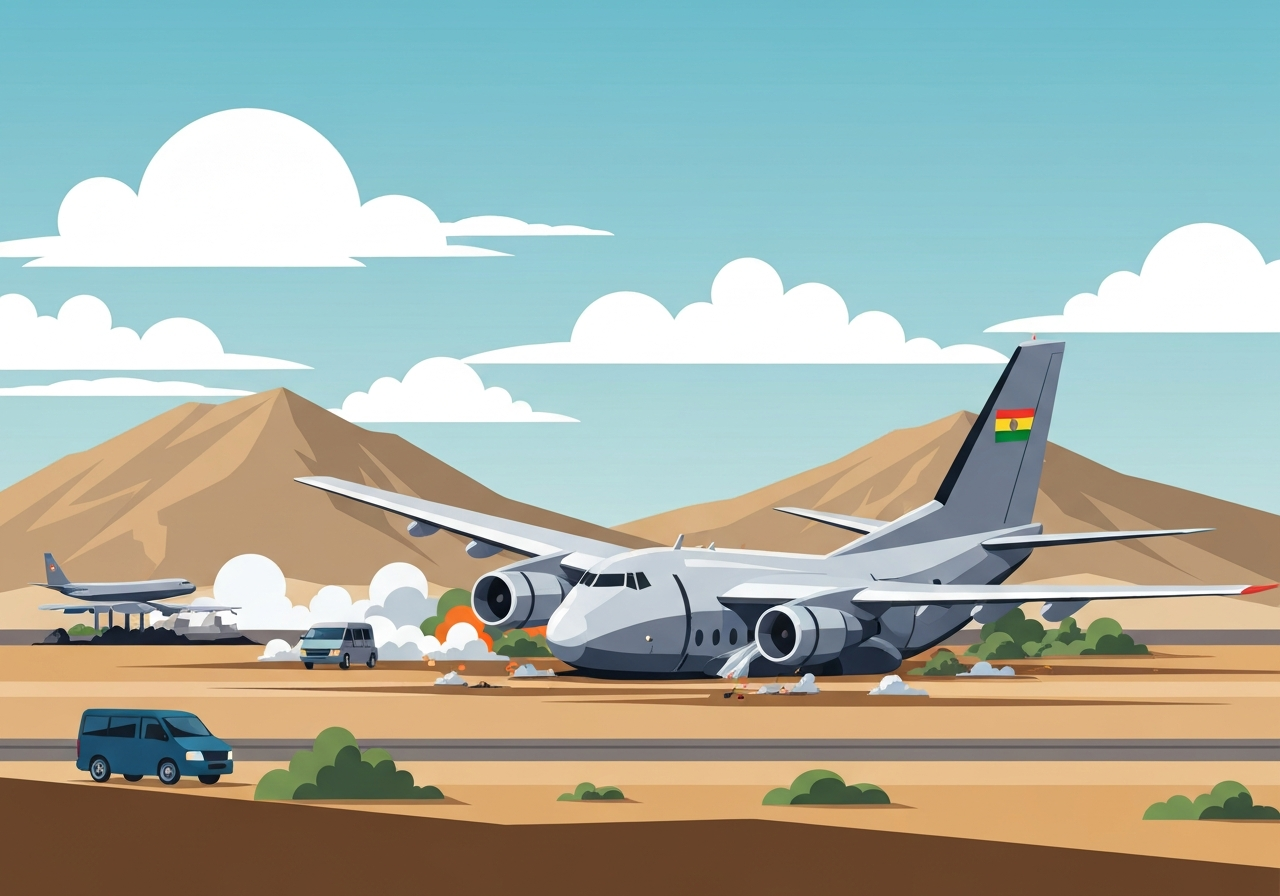
At least 11 people were killed on Friday evening when a Bolivian Air Force C-130 cargo aircraft skidded off the runway at El Alto International Airport and struck vehicles on a nearby motorway. The accident occurred at 18:20 local time (22:20 GMT) as the plane arrived from Santa Cruz; the airport was briefly closed and authorities opened an investigation. Officials said the aircraft had been carrying banknotes destined for the Central Bank of Bolivia and warned the public not to collect the notes because they carry no purchasing power. Local media and eyewitnesses reported injured passengers and bystanders; emergency services moved victims to hospitals.
Key takeaways
- At least 11 people died in the crash at El Alto International Airport on Friday evening; the toll may be revised as investigations continue.
- The aircraft involved was a Bolivian Air Force C-130 Hercules arriving from Santa Cruz at 18:20 local time (22:20 GMT).
- Authorities say the plane skidded off the runway and hit vehicles on a nearby motorway; video from the scene shows heavily damaged cars.
- The defence ministry confirmed the C-130 was transporting banknotes to the Central Bank of Bolivia and cautioned the public that the notes had no legal purchasing power.
- Witness footage and reports indicate people approached the wreckage to try to take banknotes; officials urged bystanders to stay away while investigations proceed.
- Emergency services closed the airport temporarily and launched an official probe into the cause of the accident.
Background
El Alto International Airport serves La Paz and its neighbouring city El Alto and is one of Bolivia’s busiest high‑altitude airfields. Operations there can be challenging because the airport sits above 4,000 metres, where thin air affects aircraft performance; these environmental factors have factored into past incidents in the region. Military transport flights, including those using the C-130 Hercules, routinely move personnel, equipment and sensitive cargo such as currency between major cities. Transporting banknotes by air to central banks is a standard practice in many countries because of speed and security, but it requires strict ground control and post‑flight procedures to prevent public interference.
Bolivia’s Air Traffic Control Authority reported the flight had originated in Santa Cruz and was on final approach when the aircraft left the runway. Local and national authorities coordinate responses to aviation accidents, involving the defence ministry, aviation regulators and law enforcement. Past aviation incidents in Bolivia and the Andean region have highlighted the need for thorough investigations to determine whether mechanical failure, pilot error, environmental conditions or ground handling contributed to accidents. Families of victims and local communities often seek rapid answers; officials must balance transparency with the procedural demands of an official probe.
Main event
According to official statements and media accounts, the C-130 was arriving at El Alto at about 18:20 local time (22:20 GMT) when it left the runway and came to rest partially off the airfield. Eyewitness video and photos circulating on social media show the aircraft on its belly and multiple vehicles with severe damage on the adjacent motorway. The defence ministry later confirmed the aircraft was a C-130 Hercules and that it had been carrying banknotes for the Central Bank of Bolivia, but the ministry did not immediately provide casualty figures.
Responders rushed injured people to hospitals after the crash; at least 11 fatalities have been reported so far. Emergency crews and police secured the perimeter, and the airport temporarily suspended operations while teams worked to clear the scene and begin a technical inspection. Authorities also issued a public advisory warning citizens not to collect or attempt to use any banknotes found at the scene, saying such notes carried no purchasing power and that removing them could constitute a criminal act.
Local witnesses described chaotic scenes as people gathered near the wreckage; some media reports said members of the public tried to pick up banknotes scattered around the site. Officials repeatedly asked the public to remain clear to allow investigators and salvage teams to operate safely. An official investigation has been opened to establish the immediate cause of the runway excursion and whether mechanical issues, weather, runway conditions, or human factors played a role.
Analysis & implications
The immediate priority for investigators is to establish the proximate cause of the runway departure. At high‑altitude airports such as El Alto, aircraft engines and lift behave differently than at sea level, increasing the margin for error during landing and rollout; investigators will examine performance data, crew communications and runway friction measurements. If mechanical failure is identified, repair and maintenance records for the C-130 fleet will be scrutinized; if operational factors are implicated, the Bolivian Air Force may review training, approach procedures and load management protocols.
The presence of government currency as cargo complicates both the operational response and the public reaction. Banknotes on a crash site attract onlookers and opportunistic collection, creating safety risks and potential legal issues. The defence ministry’s assertion that the notes had no purchasing power aims to deter looting and limit the downstream economic or criminal consequences of dispersed currency, but it also raises practical questions about how valuable state assets are secured during transport.
Politically, the accident is likely to prompt scrutiny of military logistics and oversight in Bolivia. Opposition figures and civil society may press for transparent, timely disclosure of findings and for accountability if procedural lapses are discovered. Internationally, aviation safety bodies and manufacturers may monitor the probe if technical faults emerge; any systemic findings could influence regional flight safety guidance for high‑altitude operations.
Comparison & data
| Time (local) | Event |
|---|---|
| 18:20 | Aircraft arrived at El Alto from Santa Cruz; runway excursion reported. |
| 18:30–19:00 | Emergency response and perimeter control; airport temporarily closed. |
| Evening | Official confirmation of C-130 involvement and cargo (banknotes); investigation opened. |
The table above outlines the reported timeline on the night of the accident. Investigators will add technical timestamps from flight recorders and air traffic control logs to build a precise sequence. Casualty figures currently stand at a minimum of 11 fatalities; authorities have not released a final count of injured. Comparing this event to previous regional military transport incidents underscores the recurring operational challenges of mountainous, high‑altitude airports.
Reactions & quotes
Officials issued immediate operational warnings and appealed for calm, framing the recovery as both a security and public‑safety priority.
“The public is asked to stay away and allow the authorities to do their work.”
Bolivian Defence Ministry (official statement)
The ministry’s advisory was intended to prevent interference with the scene and to deter attempts to collect banknotes. Authorities emphasized legal consequences for removing government property and cautioned that scattered currency could be invalid or otherwise unusable.
“My sister told me that she was in the car when the plane crashed… the plane’s tire fell on the car, and my sister was injured.”
Relative of an injured person, cited by Reuters
Eyewitness accounts relayed through news agencies describe traumatic impacts on motorists and bystanders on the motorway adjacent to the airport. Journalists at the scene captured footage of damaged vehicles and emergency crews transporting victims to nearby hospitals.
Unconfirmed
- Exact final death toll beyond the reported minimum of 11 is not yet publicly confirmed and may change as authorities complete their accounting.
- The precise technical cause of the runway excursion—whether mechanical failure, pilot error, weather or runway condition—has not been confirmed by investigators.
- The total value and denomination of banknotes carried on the flight, and whether any were successfully removed from the site before authorities secured it, remain unverified.
Bottom line
The crash of a Bolivian Air Force C-130 at El Alto on Friday evening has resulted in at least 11 deaths and left communities seeking answers about how a routine transport flight ended in tragedy. Immediate priorities are victim care, securing the crash site, and conducting an impartial technical investigation to determine cause and responsibility. The presence of banknotes as cargo added urgency to securing the scene and introduced legal and logistical complications as people reportedly approached the wreckage.
In the coming days investigators should release flight data, maintenance records and witness statements that will clarify what happened in the minutes before the runway departure. Policymakers and military authorities will face questions about transport protocols and safety practices at high‑altitude airports. For affected families and the public, clear, timely disclosure will be essential to restore confidence and to ensure any necessary changes are implemented.
Sources
- BBC — (news)
- Bolivian Ministry of Defense — (official statement/agency site)
- Reuters — (news agency; eyewitness reporting cited)