
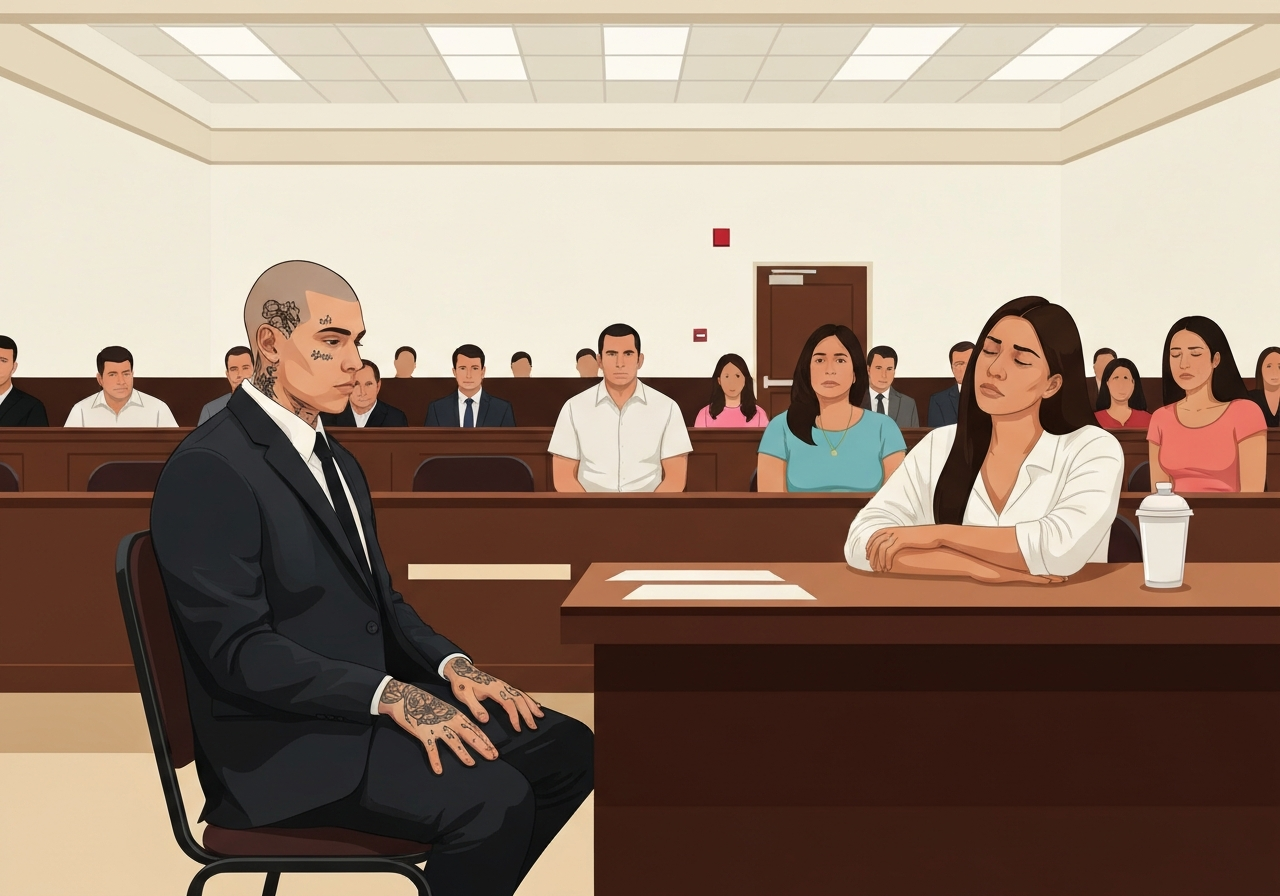
Alt-pop singer D4vd, legal name David Burke, pleaded not guilty Monday to first-degree murder and related charges after the dismembered body of 14-year-old Celeste Rivas Hernandez was discovered in an apparently abandoned Tesla, officials said. The Los Angeles County District Attorney’s Office charged the 21-year-old with first-degree murder, lewd and lascivious acts with a person under 14 and mutilating a body; his attorney entered not guilty pleas and a judge ordered he remain held without bail. Authorities say the case grew from a months-long, largely secret grand jury investigation and the charging documents include detailed allegations about sexual abuse and post-mortem mutilation. The filing also alleges special circumstances that could make Burke eligible for the death penalty, though prosecutors have not said whether they will seek it.
Key Takeaways
- D4vd (David Burke), 21, was booked on first-degree murder, lewd and lascivious acts with a person under 14 and mutilating a body; he pleaded not guilty and remains held without bail.
- The victim, Celeste Rivas Hernandez, was reported missing in 2024 at age 13; prosecutors allege she was killed on or about April 23, 2025, at age 14.
- The victim’s dismembered and decomposed remains were found in a Tesla towed from the Hollywood Hills on Sept. 8; court papers describe a cadaver bag with a head, torso and severed limbs.
- Prosecutors allege an ongoing sexual relationship beginning Sept. 2023 and continuing through Sept. 2024 when the victim was under 14; California law carries especially severe penalties for sexual abuse of children under 14.
- Special circumstances listed in the complaint include lying in wait, committing a crime for financial gain and murdering a witness, any of which could make the defendant eligible for capital punishment.
- D4vd continued touring after the vehicle was towed but canceled later shows; he was arrested at a Hollywood residence and arraigned in Los Angeles County Superior Court.
- The defense has asked for a prompt preliminary evidentiary hearing; prosecutors say they are prepared to present evidence collected during a secret grand jury probe.
Background
David Burke, known professionally as D4vd, rose rapidly on social platforms and streaming services after viral success in 2022 and record deals with major labels. His music—an amalgam of indie rock, R&B and lo-fi pop—attracted a large Gen Z audience; his debut EPs and a growing touring schedule followed. The charging documents and public statements tie the timeline of alleged sexual abuse to the period from September 2023 to September 2024, when prosecutors say the victim was under the age threshold that triggers enhanced penalties in California.
The case remained under a grand jury investigation for months before public disclosure, a sequence that officials say was necessary given the sensitive facts and potential ongoing inquiries. The family reported the girl missing in 2024 from Lake Elsinore, roughly 70 miles southeast of Los Angeles; prosecutors allege she was en route to Burke’s Hollywood Hills home when she was killed. The investigation combined forensic examination of the vehicle, witness interviews and subpoenas that reached members of Burke’s family in Texas, steps that together produced the charges lodged this spring.
Main Event
On arraignment Monday in Los Angeles County Superior Court, Burke appeared behind glass in a custody area wearing black clothing while his public defender entered not guilty pleas on all counts. The Los Angeles County District Attorney, who described the case as “a parent’s nightmare,” said investigators found a cadaver bag inside a 2023 Tesla Model Y that had been towed from the Hollywood Hills on Sept. 8; detectives partially unzipped a bag and found a head and torso, and medical examiner teams later found severed arms and legs.
Prosecutors allege the killing occurred on or about April 23, 2025, and that the victim was later dismembered; a second black bag was found beneath the first with additional remains, according to court filings. Authorities say the singer was arrested at a Hollywood residence and that investigators developed evidence over several months before seeking indictment and arrest. The complaint also alleges the sexual relationship between Burke and the victim began when she was under 14, a fact that the prosecutor emphasized as central to the case.
The complaint includes special circumstances of lying in wait, committing a crime for financial gain and murdering a witness in an investigation, each of which elevates the legal exposure of the defendant. Prosecutors told the court they are ready to present the evidence collected during the grand jury matter; defense counsel requested a preliminary evidentiary hearing as soon as possible given prior secret proceedings and media reporting.
Analysis & Implications
Legally, the charges combine homicide counts with sexual-offense and mutilation allegations, producing a complex prosecution whose proof must encompass both identity and motive as well as forensic causation. The addition of special circumstances is significant because it preserves the option, at least procedurally, of seeking capital punishment—although California has not carried out executions in many years and prosecutors must decide whether pursuit of the death penalty is warranted and likely to survive legal challenge.
The case also illustrates how digital fame can intensify scrutiny and investigatory pressure: D4vd’s rapid rise on social media and international touring schedule created an online footprint that both attracted attention and complicated public perception. His label relationship changed last year, and touring plans were canceled after reports surfaced tying him to the investigation, underscoring reputational and commercial fallout that frequently follows criminal allegations against public figures.
For investigators, the use of a secret grand jury—followed by a public indictment—reflects a desire to protect witness testimony and investigative leads while building a forensic case. That process can delay public disclosure but aims to reduce the risk of compromised evidence; defense counsel has objected to secrecy and asked for early evidentiary review. Ultimately, the case will turn on physical forensics, witness credibility and the prosecution’s ability to show that the defendant’s conduct meets the legal elements of the charges filed.
Comparison & Data
| Date/Event | Detail |
|---|---|
| Sept. 2023–Sept. 2024 | Alleged period of continuous sexual abuse of the victim, per complaint |
| 2024 | Family reported the girl missing at age 13 |
| On or about April 23, 2025 | Prosecutors allege this is when the killing occurred; victim age 14 |
| Sept. 8 (year as reported) | Vehicle towed from Hollywood Hills; remains discovered in Tesla |
| Arraignment date (Monday) | Burke pleaded not guilty and remains held without bail |
The table places key public dates from court filings and the district attorney’s statements side by side; those public milestones frame the investigation but do not substitute for evidence that will be tested at preliminary hearings and trial. The court has temporarily sealed certain autopsy details, meaning forensic specifics on cause and time of death remain limited in public records pending court direction.
Reactions & Quotes
“We believe the actual evidence will show David Burke did not murder Celeste Rivas Hernandez.”
Blair Berk, lead defense attorney
The defense emphasized its expectation that evidence will ultimately exonerate the defendant and requested an early evidentiary hearing after months of secret grand jury activity.
“Celeste, a 14-year-old at that time, went to Mr. Burke’s house in the Hollywood Hills. She was never heard from again.”
Nathan Hochman, Los Angeles County District Attorney
The district attorney framed the case as a tragic loss and stressed the seriousness of the charges and the investigative work that led to them.
“We’ll be very happy to put on the evidence that we’ve collected.”
Beth Silverman, Deputy District Attorney
Prosecutors signaled readiness to present the grand jury-developed evidence at a preliminary hearing and trial, while declining at this stage to reveal sealed forensic findings.
Unconfirmed
- No official cause of death has been released publicly because autopsy details remain sealed; public filings do not specify the forensic cause.
- Prosecutors have not yet announced whether they will seek the death penalty; the presence of special circumstances preserves that option but is not a decision to pursue it.
- Some timeline elements reported in media accounts rely on court filings and law-enforcement statements; additional witness testimony and forensic results may alter or refine those details as proceedings continue.
Bottom Line
This prosecution combines homicide, sexual-offense and mutilation allegations against a high-profile, young artist and will test forensic proof, witness credibility and statutory aggravators in state court. The presence of special circumstances increases the case’s stakes and will shape pretrial strategy for both sides, including discovery requests, defense challenges to grand-jury secrecy and prosecutorial decisions about potential sentencing requests.
For the public and the music industry, the case raises difficult questions about accountability, how allegations affect careers and how investigations into crimes involving young people are handled in a digital era. Readers should expect a protracted court process with sealed forensic details, preliminary hearings and likely motions practice before any trial produces a fuller public record of the evidence.
Sources
- Associated Press (news report)
- Los Angeles County District Attorney’s Office (official/local prosecutor information)