
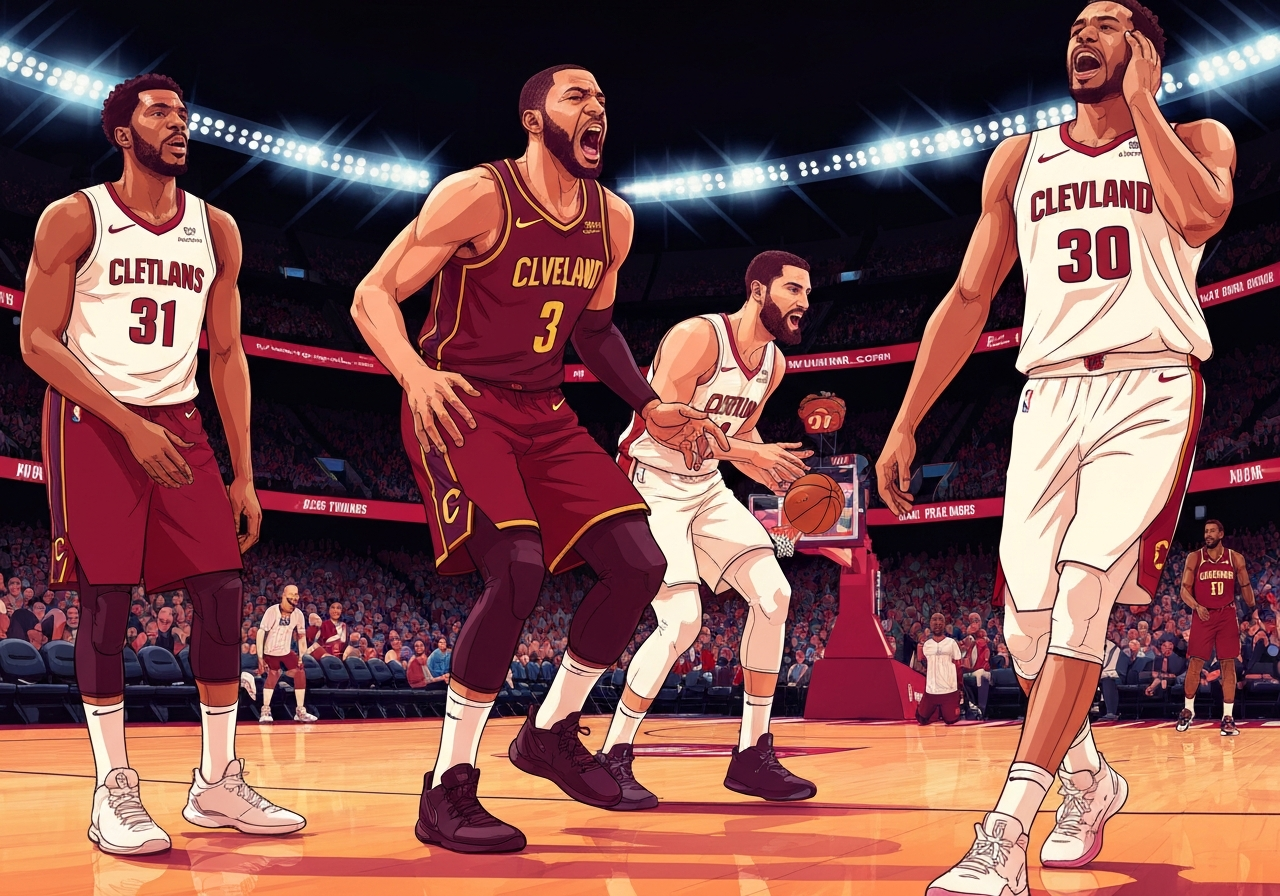
Short-handed Cleveland saw a chance to cap a strong February undone in a chaotic overtime at Little Caesars Arena on Friday, Feb. 28, 2026, as the Detroit Pistons edged the Cavs 122-119. The Cavs rode an 8-3 month surge into the matchup but were missing key starters and could not close out a late rally despite holding a lead late in regulation. The game featured a lengthy arena malfunction, a reversed foul call that ignited the crowd and a tense overtime in which Detroit finished stronger. The loss halted Cleveland’s momentum and left the team and staff searching for answers after a performance many described as ‘‘crazy.’’
- Cleveland lost 122-119 in overtime to Detroit on Feb. 28, 2026, despite six Cavs finishing in double figures and Jarrett Allen scoring 25 points on 10-of-12 shooting.
- Jalen Duren paced the Pistons with 33 points and 16 rebounds; Cade Cunningham finished with 25 points, 10 rebounds and seven assists.
- The Cavs were missing Donovan Mitchell (groin), James Harden (thumb), Dean Wade (ankle), Keon Ellis (ankle) and Max Strus (offseason foot surgery).
- A malfunction at Little Caesars Arena disrupted the third quarter — a horn blared and the scoreboard/clock failed for roughly 15 minutes, delaying play and warmups.
- A coach challenge late in regulation overturned an offensive-foul ruling and awarded Cleveland a free throw and possession, triggering intense crowd reaction and a close finish.
- Cleveland committed late-game miscues — free-throw splits and a turnover in the final seconds of regulation — that allowed Detroit to force overtime.
Background
The Cavs entered the game riding a February stretch that improved their record and raised expectations in the Eastern Conference. A makeover at the trade deadline and internal adjustments left Cleveland with a deeper rotation, and February’s 8-3 ledger suggested the group was gaining cohesion. Detroit arrived as the East’s top seed, boasting a season-long run of consistency and home-court momentum at Little Caesars Arena. The matchup was promoted as a showcase between ascending and established East teams, and both sides played with playoff-style physicality and intensity.
Injuries and roster availability shaped the narrative before tipoff: Cleveland was notably undermanned on the wing and at point guard with several rotation pieces inactive, forcing role players into expanded minutes. Detroit had its own load-management and minute considerations but retained core contributors such as Cade Cunningham and Jalen Duren. The result was a game that tested depth, in-game adjustments and bench production. With standings implications for both clubs, the contest carried outsized significance for seeding and confidence as the regular season progressed.
Main Event
Cleveland opened aggressively, building a 13-point lead early in the second quarter despite its depleted lineup. Detroit responded with an 11-0 run to cut the margin to two by the mid-second, and the half closed with the Cavs ahead by four. After halftime, a technical failure inside the arena caused a protracted stoppage: the horn and scoreboard malfunctioned, blaring repeatedly and pausing the flow of the third quarter for about 15 minutes. Players warmed up again once the issue was addressed, and Detroit emerged with a one-point lead when the quarter ended.
The Cavs regrouped in the fourth, with reserves like Tyrese Proctor and Thomas Bryant helping push Cleveland back in front by seven early in the period. Detroit rallied late; with Cade Cunningham fouling out around two minutes left, the Pistons closed the gap and forced an endgame sequence that began with a challenged call. What initially appeared to be an offensive foul on Jaylon Tyson was reversed after a coach challenge to an away-from-the-play foul on Detroit, resulting in one free throw and possession for Cleveland and an explosive reaction from the crowd.
In the last minute, Cleveland could not convert. Evan Mobley and Craig Porter Jr. split crucial free throws, and Tyson fouled Pistons reserve Daniss Jankins on a desperation three with 4.6 seconds remaining; Jankins made all three free throws to tie the game. Out of timeouts, Dennis Schroder rushed the floor and lost the ball on a final attempt, sending the contest to overtime. Detroit opened the extra period on a 6-0 run; Cleveland answered with five straight, keeping the margin to one until Tobias Harris’ baseline fadeaway gave Detroit a three-point cushion with 21.5 seconds left. A missed 3 by Sam Merrill and a final missed 3 by Evan Mobley sealed the Pistons’ victory.
Analysis & Implications
The loss exposes how a short-handed roster can still compete but remain vulnerable in high-leverage moments. Cleveland’s depth produced six scorers in double figures, underscoring the team’s improved balance since the trade deadline. Yet late-game execution — free-throw consistency, turnover avoidance and rim protection with Jarrett Allen fouling out — proved decisive. The Cavs’ inability to close a game they controlled leaves questions about situational execution and bench roles when primary scorers are absent.
For Detroit, the win reinforced the Pistons’ standing as the conference’s front-runner and highlighted Jalen Duren’s ability to dominate the interior with 33 points and 16 rebounds. Cade Cunningham’s near triple-double (25/10/7) demonstrated the Pistons’ two-way core can carry the team in tense finishes. The game also illustrated how midgame disruptions — whether technical malfunctions or momentum swings fueled by crowd noise — can alter the rhythm and potentially influence officiating and decision-making.
Looking forward, Cleveland must address late-clock execution and free-throw reliability if it hopes to convert close losses into signature wins against top opponents. Coaching adjustments on end-of-game substitution patterns and challenge usage could be critical; the overturned call late in regulation gained national attention and altered possession. For the Pistons, sustaining consistent bench scoring and defending without fouling will be key if they want to maintain home dominance and protect their conference position.
| Player | Team | Points | Rebounds | Assists |
|---|---|---|---|---|
| Jalen Duren | Detroit | 33 | 16 | — |
| Cade Cunningham | Detroit | 25 | 10 | 7 |
| Jarrett Allen | Cleveland | 25 | 9 | — |
| Evan Mobley | Cleveland | 23 | 12 | 4 |
| Sam Merrill | Cleveland | 20 | — | — |
The table highlights the main stat lines that shaped the result: Duren’s interior scoring and board work, Cunningham’s all-around impact, and Cleveland’s balanced scoring led by Allen and Mobley. Those numbers show why the game swung on a few late possessions rather than a single dominant performance. The Cavs’ bench production kept them competitive, but missed late attempts and the loss of interior defense when Allen fouled out were decisive.
Reactions & Quotes
Head coach Kenny Atkinson framed the loss bluntly, emphasizing the competitive stakes and missed opportunities before and during the finish. He refused to settle for consolation and pointed to specific moments that cost Cleveland the game.
‘There’s no moral victories.’
Kenny Atkinson, Cleveland head coach (postgame)
Fill-in starter Jaylon Tyson highlighted effort and team resolve, noting that despite absences the Cavs competed hard and will study the mistakes. His remarks reflected pride in the group’s fight while acknowledging the sting of coming up short.
‘Liked our fight.’
Jaylon Tyson, Cavs starter
Evan Mobley, after finishing with 23 points and 12 rebounds, called it an unpredictable contest and stressed the fine margins that separated a win from a loss. His comments were tempered by frustration over missed late chances.
‘Crazy game.’
Evan Mobley, Cavs forward
- Whether the arena horn and scoreboard malfunction materially affected the officiating or player focus enough to change the final outcome remains unproven and is open to interpretation.
- Claims that the reversed foul call directly altered the game’s result are plausible but not definitively provable; multiple possessions and late free throws factored into the final sequence.
Bottom Line
This defeat underlines how margin-of-error games can define a team’s trajectory even during a strong month. Cleveland demonstrated depth and fight without several starters, but late-game execution and situational composure were lacking in definitive moments. The Cavs will head to Brooklyn for the next game with lessons about free-throw stability, turnover control and substitution management hanging over the roster.
For Detroit, the win reinforced the Pistons’ poise in close contests and the value of their interior and playmaking duo. The game will be remembered for its strange interruptions and dramatic finish, but in the standings it counts the same as any hard-fought road victory: a boost for Detroit and a stinging missed opportunity for Cleveland.
- Cleveland.com game report — local journalism coverage and boxscore recap