
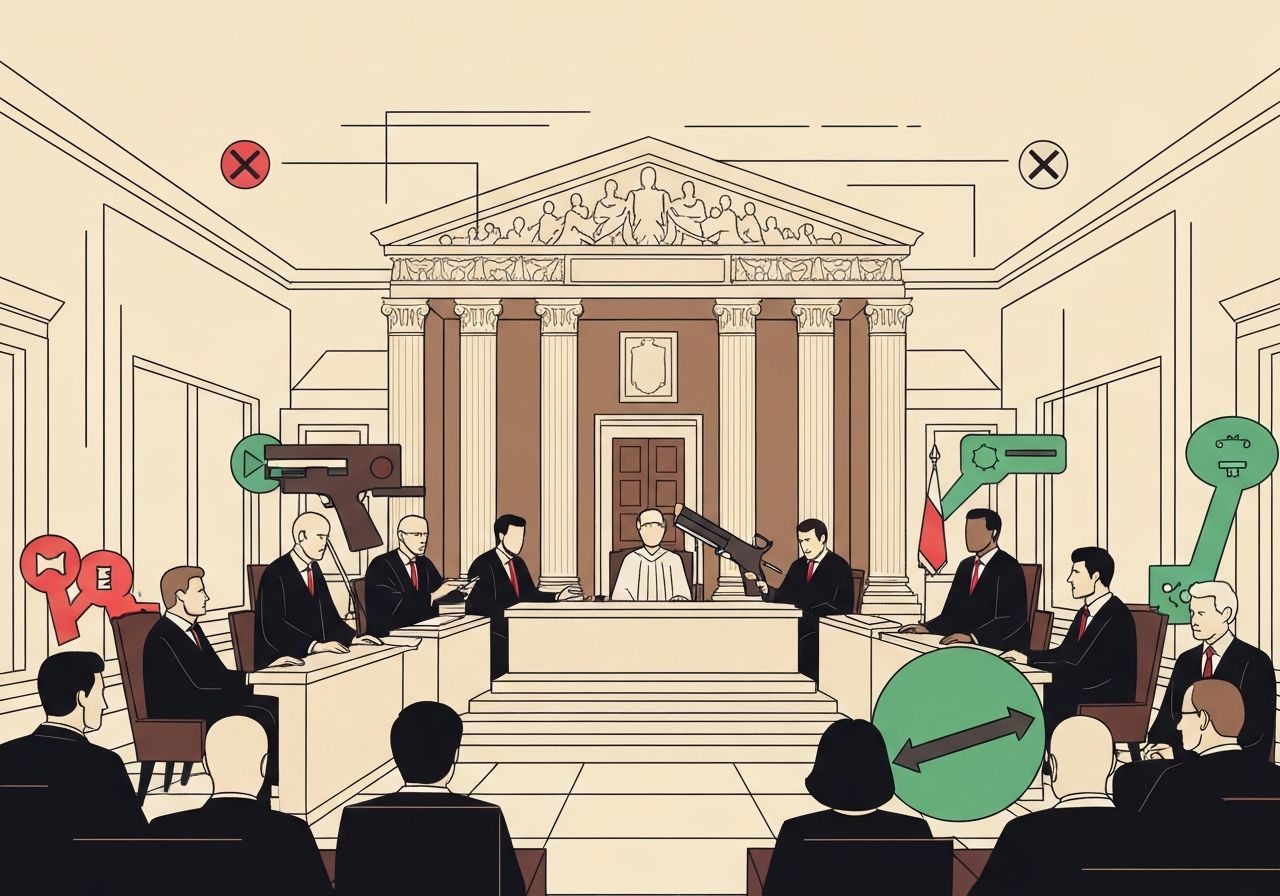
Lead: The Supreme Court on Monday heard arguments over a federal statute that bars frequent users of illegal drugs from possessing firearms, a dispute that tests the Second Amendment in the post-Bruen era. The case stems from the 2022 FBI search of a Dallas-area home and a 5th U.S. Circuit Court ruling that tossed an indictment against Ali Danial Hemani. The Justice Department is defending the law even as it has taken different positions on other gun restrictions, and the outcome could reshape enforcement standards for drug-use-based firearms prohibitions.
Key Takeaways
- The law at issue prohibits firearm possession by those who are frequent users of illegal drugs; the Supreme Court heard oral argument on Monday.
- An appeals court in the 5th Circuit vacated the indictment of Ali Danial Hemani after the court said prosecutors failed to show he was impaired at the time of arrest.
- Hemani was subject to an FBI search in 2022 that turned up a handgun, marijuana, and cocaine; he is a dual U.S.-Pakistan citizen and has been accused by the government of ties to Iranian entities without related criminal charges.
- The Justice Department, through Solicitor General D. John Sauer, argues habitual drug users are “dangerous persons” who may be temporarily disarmed under historical practice.
- Hunter Biden was convicted under the same statute in June 2024 and later pardoned by President Joe Biden, illustrating recent high-profile enforcement and political sensitivity.
- The Supreme Court’s 6-3 conservative majority and its 2022 Bruen decision recognizing a right to bear arms outside the home have spurred renewed legal challenges to firearm restrictions.
Background
Legal challenges to drug-user disarmament statutes come amid a broader wave of cases testing limits on gun regulation since the Supreme Court’s 2022 decision that emphasized historical tradition in assessing firearms laws. Lower federal courts are split over how to apply that historical test, producing conflicting standards on whether and how the government can disarm people deemed dangerous because of substance use. The federal statute predates recent state-level shifts on marijuana, creating friction between changing state policies and an unchanged federal prohibition on the drug.
The government has argued that legislatures historically have authority to temporarily remove firearms from individuals who pose safety risks, pointing to precedents that allow disarmament for those subject to restraining orders and similar measures. Opponents counter that the statute is vague, that regular marijuana use is widespread in states that have legalized it, and that mere allegation of frequent use should not strip a person of the right to keep a firearm in the home for self-defense. The split among circuits has made the issue a natural candidate for Supreme Court review.
Main Event
At Monday’s argument, Solicitor General D. John Sauer urged the justices to uphold the federal prohibition as consistent with historical practice permitting temporary disarmament of dangerous people. The government framed a habitual drug user as someone who presents a risk to community safety and therefore falls within traditional exceptions to firearm possession rights. The 5th Circuit, however, had earlier held that prosecutors must do more than allege regular use; they must show the defendant was under the influence when the firearm possession was discovered.
Hemani’s defense lawyers argued the statute is impermissibly vague, providing no clear standard for what counts as an ‘unlawful user’ of drugs. They emphasized that millions of Americans consume marijuana regularly, often legally under state law, and that regular consumption alone does not equate to addiction or dangerousness warranting disarmament. In Hemani’s 2022 case, FBI agents found a handgun plus marijuana and cocaine during a search of his Dallas-area home; prosecutors did not present evidence showing he was impaired at the time firearms were found.
The case arrives as the court is already considering other firearm matters, including a January argument over a Hawaii law limiting carrying firearms onto certain private properties and a separate question about whether nonviolent felons may be barred from possession. The court declined to take up a new challenge this week about nonviolent felonies, while continuing to weigh how broadly Bruen should be applied to modern regulations.
Analysis & Implications
If the Supreme Court endorses the 5th Circuit’s requirement that the government show contemporaneous intoxication, prosecutors across the country could face a higher evidentiary bar in drug-related firearms prosecutions. That would narrow one avenue for federal disarmament and could lead to dismissals of pending charges that rest primarily on allegations of habitual use rather than proof of impairment at the time of possession.
A ruling that upholds a broader standard would validate federal and state efforts to treat habitual illegal drug use as a public-safety basis for temporary disarmament, potentially expanding the scope of who can be disarmed without individualized proof of contemporaneous impairment. Such an outcome could chill gun ownership among people who use substances frequently but not dangerously, raising federalism questions where state law permits marijuana use while federal law remains prohibitory.
The political context matters: the Justice Department’s decision to defend the statute here, even as it has backed other challenges to firearms rules, highlights an inconsistent posture that may reflect prosecutorial priorities or litigating strategy rather than a settled policy. The court’s ruling could also affect enforcement choices by federal agencies and local prosecutors, and it may influence Congress if the justices narrow or broaden the reach of existing federal statutes.
Comparison & Data
| Court / Source | Standard Applied |
|---|---|
| 5th U.S. Circuit Court (appeals) | Requires proof defendant was under influence at the time of arrest |
| Government (DOJ position) | Argues habitual use alone can show dangerousness allowing temporary disarmament |
| Supreme Court (Bruen, 2022) | Uses history and tradition test for firearm restrictions, expanded rights outside the home |
Those contrasts show why the Supreme Court’s guidance is pivotal: a uniform standard would resolve splits among circuits and change prosecutorial practice. Data on prosecutions under the statute are limited in the public record, but the Hemani and Hunter Biden matters illustrate how the law has been applied recently in high-profile situations.
Reactions & Quotes
Department of Justice officials framed their defense in public filings and at argument as aligned with historical practices limiting arms for those who threaten community safety. Observers note the government’s stance is central to whether courts defer to legislative judgments about dangerousness.
History and precedent establish that legislatures may temporarily restrict the possession of firearms by those who threaten the safety of the community.
Solicitor General D. John Sauer, filing for the government
Defense counsel and civil-liberties advocates emphasized vagueness and the prevalence of marijuana use as reasons the statute should not be applied broadly without clearer standards. They argued the law risks disarming people who pose no immediate danger and that federal criminal law should not penalize conduct sanctioned by many states.
The statute fails to define what an unlawful user is and would sweep millions of state-legal consumers into disarmament without historical precedent.
Hemani’s legal team (defense filing)
Advocates for gun-rights protections and some legal scholars cautioned that an expansive reading of the law could undermine Second Amendment protections recognized in recent Supreme Court decisions. Others pointed to public-safety concerns, arguing that habitual drug use can correlate with elevated risks that legislatures have authority to address.
A careful balance is required to protect core constitutional rights while allowing disarmament of individuals who demonstrably threaten others.
Independent legal scholar (commentary)
Unconfirmed
- The government has asserted ties between Hemani and Iranian entities; those links have not resulted in public criminal charges and remain unproven in court records available to the media.
- Public filings did not include evidence showing Hemani was under the influence at the precise time the firearm was recovered; the absence of such proof was central to the 5th Circuit ruling.
- The Justice Department’s broader pattern of supporting some gun-rights challenges while defending this statute may reflect litigation strategy rather than a settled enforcement doctrine.
Bottom Line
The Supreme Court’s decision in this case will determine whether federal prosecutors must meet a contemporaneous-intoxication standard to enforce the drug-user firearms ban or may rely on proof of habitual use to justify temporary disarmament. A ruling for the government would validate a broader enforcement tool; a ruling for Hemani could restrict prosecutions and prompt legislative or policy responses.
Given the court’s conservative majority and the doctrinal emphasis established in Bruen, the justices may choose a narrow ruling that resolves the circuit split without sweeping statements about the statute’s nationwide reach. Observers should watch for whether the court ties its reasoning to historical analogues or establishes a clear evidentiary rule for modern prosecutions.
Sources
- NBC News (media/press)