
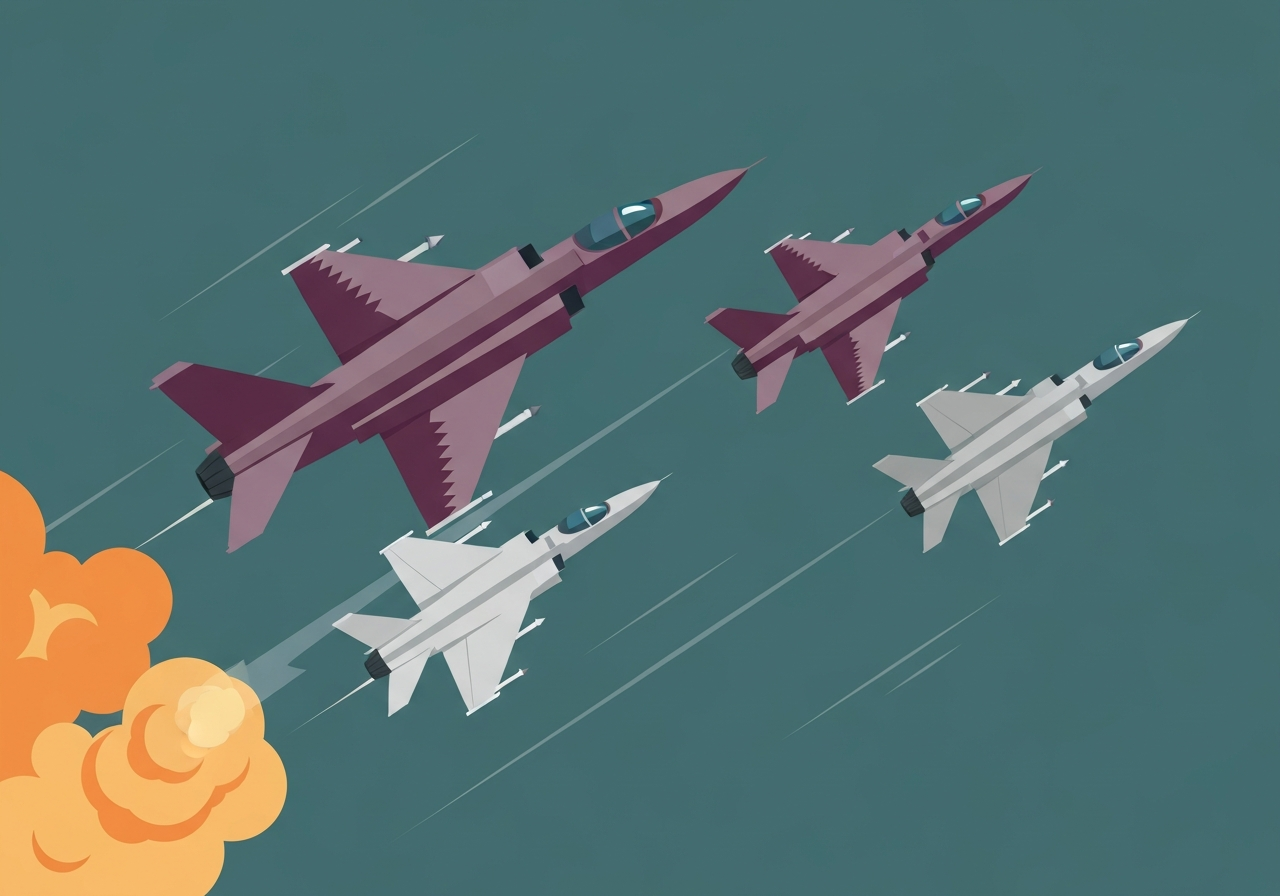
Qatar said on March 2, 2026, that its air defenses shot down two Iranian Su-24 fighter jets after they entered Qatari airspace, part of a broader series of cross‑border strikes and interceptions across the Gulf since U.S. and Israeli air operations on Saturday. The Qatari defense ministry gave few operational details but said the action followed attacks on civilian infrastructure, including an attempted strike on Doha International Airport. Gulf partners and U.S. forces in the region reported drone and missile activity in Bahrain, Iraq, Jordan and the UAE, with at least one civilian fatality in Bahrain. Governments in the region issued a joint condemnation of the Iranian strikes and emphasized continued air‑defense cooperation.
Key Takeaways
- Qatar reported shooting down two Iranian Sukhoi Su‑24 fighter jets on March 2, 2026, after the aircraft reportedly came from Iranian direction.
- Since U.S. and Israeli airstrikes on Saturday, Iran has launched multiple drone and missile strikes across the Gulf, striking ports and infrastructure in several countries.
- In Bahrain, a vessel in port was struck by two unknown projectiles; crew were evacuated and a separate interception incident in Salman Industrial City caused debris that left one dead and two seriously injured.
- Three armed drones were intercepted and shot down over Erbil Airport in northern Iraq, where U.S. forces are present; origins of those drones remain under investigation.
- Commercial operations at Dubai’s Jebel Ali port briefly disrupted but have since resumed; authorities continue heightened security and are coordinating regional defenses.
- Seven governments — the United States, Bahrain, Jordan, Kuwait, Qatar, Saudi Arabia and the UAE — issued a joint statement condemning the Iranian missile and drone attacks as a “dangerous escalation.”
Background
Tensions in the Gulf escalated after airstrikes by the United States and Israel on Saturday, prompting Iranian officials and proxies to signal retaliatory action. Prior to the exchanges, Iranian spokespeople had warned that U.S. bases in the region could be struck; that rhetoric raised concern among Gulf states and NATO partners about a rapid widening of hostilities. The region hosts a dense array of U.S. military facilities and critical commercial infrastructure, including major ports and airports that handle global energy and cargo traffic.
Over the past decade, Iran and Gulf states have engaged in periodic tit‑for‑tat strikes, often using proxies and unmanned systems that complicate attribution and escalation control. Modern layered air defenses in the Gulf — integrating national systems and allied cooperation — have, so far, limited mass casualties and infrastructure loss despite repeated attacks. Nonetheless, incidents at commercial ports, airports and near civilian shipping lanes raise the prospect of supply‑chain and insurance shocks for energy and trade routes passing through the region.
Main Event
Qatar’s defense ministry announced on Monday that it had intercepted and shot down two Su‑24 jets that approached Qatari airspace. The ministry provided limited operational detail and did not disclose the time, exact location of the intercept, or the fate of the pilots. Qatari officials later told international media the strikes targeted civilian infrastructure in Doha, including an attempt against the international airport, prompting the defensive response.
Separately, the United Kingdom Maritime Trade Operations (UKMTO) reported a strike on a vessel at the port of Bahrain by two unidentified projectiles; the blaze was extinguished, and the crew evacuated without further reported casualties from that ship. Bahraini authorities confirmed an interception over Salman Industrial City left debris that fell on a different vessel, causing a fire with one fatality and two serious injuries.
In northern Iraq, security sources said three armed drones were shot down over Erbil Airport, where U.S. forces are based. Officials in Dubai said operations at Jebel Ali port briefly halted but have since resumed. U.S. embassies across the region issued repeated security alerts urging citizens to avoid nonessential travel and be alert to possible missile, drone, or air‑to‑air activity.
Analysis & Implications
The interception of manned Iranian Su‑24s — if independently confirmed — represents a significant escalation compared with the predominantly unmanned or cruise‑missile strikes that have characterized recent exchanges. Shooting down combat aircraft increases the risk of direct state‑to‑state confrontation and complicates efforts to de‑escalate. It also raises questions about how regional airspace will be policed and whether combining defensive fire with diplomacy can prevent inadvertent wider war.
For Gulf economies, repeated attacks on ports, shipping, and logistics hubs threaten immediate disruptions to trade and raise freight and insurance costs. Jebel Ali’s temporary disruption illustrates how even short interruptions at key nodes ripple through global supply chains. Energy markets are sensitive to these developments; sustained attacks or a further military widening could push oil and gas prices higher and prompt strategic reserve releases or rerouting of shipments.
Strategically, the joint statement by Gulf states and the United States underscores an intention to present a unified defensive posture, deter further strikes, and preserve freedom of navigation. That unity, however, faces tests: member states balance security ties with Iran against economic ties, and varying threat perceptions could complicate a coordinated long‑term response. International legal and diplomatic channels will be tested as states seek to attribute responsibility and marshal punitive or defensive measures without triggering broader conflict.
Comparison & Data
| Incident | Date | Location | Type | Casualties |
|---|---|---|---|---|
| Qatar intercepts Su‑24s | Mar 2, 2026 | Qatari airspace / Doha | Manned fighters shot down | No confirmed onboard casualties reported by Qatar |
| Vessel struck in Bahrain port | Mar 2, 2026 | Bahrain port | Two unknown projectiles | Crew evacuated; vessel remains in port |
| Debris from interception | Mar 2, 2026 | Salman Industrial City, Bahrain | Missile interception debris | 1 dead, 2 seriously injured |
| Drones shot down over Erbil Airport | Mar 2, 2026 | Erbil, Iraq | Armed drones | No reported ground casualties |
The table above summarizes the incidents reported on March 2, 2026. While the chronology shows multiple parallel events, attribution and chain‑of‑command determinations remain in flux; authorities continue to investigate weapon origins and delivery vectors. The pattern — manned aircraft, missiles, and drones used in quick succession — indicates a multi‑domain approach that strains national and allied defensive systems.
Reactions & Quotes
Qatari officials framed their action as a defensive necessity after what they described as attempted strikes against civilian infrastructure.
“We cannot allow such attacks to go unanswered.”
Qatari foreign ministry spokesperson (reported to international media)
A joint statement from seven regional governments and the United States framed the strikes as an unjustified escalation that threatened regional stability and sovereignty. The statement emphasized coordinated air‑defense cooperation that reduced potential harm to civilians.
“A dangerous escalation that violated the sovereignty of multiple countries.”
Joint statement — U.S., Bahrain, Jordan, Kuwait, Qatar, Saudi Arabia, UAE
The U.S. diplomatic presence echoed cautionary language to citizens and emphasized continued monitoring of the security environment.
“We are monitoring the situation and will provide updates on security measures.”
U.S. embassy regional alert
Unconfirmed
- Independent confirmation of the nationality, mission intent, and pilot status of the two Su‑24s downed by Qatar remains pending; Qatar provided only a brief official notice.
- Attribution for the three drones shot down over Erbil Airport and for some projectile strikes in Bahrain has not been publicly verified by an independent third party.
- Details on whether downed aircraft carried armaments or were en route from specific Iranian bases have not been released and remain subject to investigation.
Bottom Line
The reported downing of two Iranian Su‑24 fighters by Qatar marks a dangerous intensification in a rapidly unfolding regional crisis. Though layered air defenses and allied coordination have so far limited broader destruction, the involvement of manned combat jets raises the stakes for miscalculation between states and could prompt further military or diplomatic reprisals.
For now, the immediate priorities for Gulf governments and partners are to stabilize airspace management, accelerate forensic attribution of attacks, and sustain protective measures for civilians and commerce. International and regional diplomacy will be critical in the coming days to translate tactical defenses into a strategic de‑escalation that prevents the conflict from widening.