
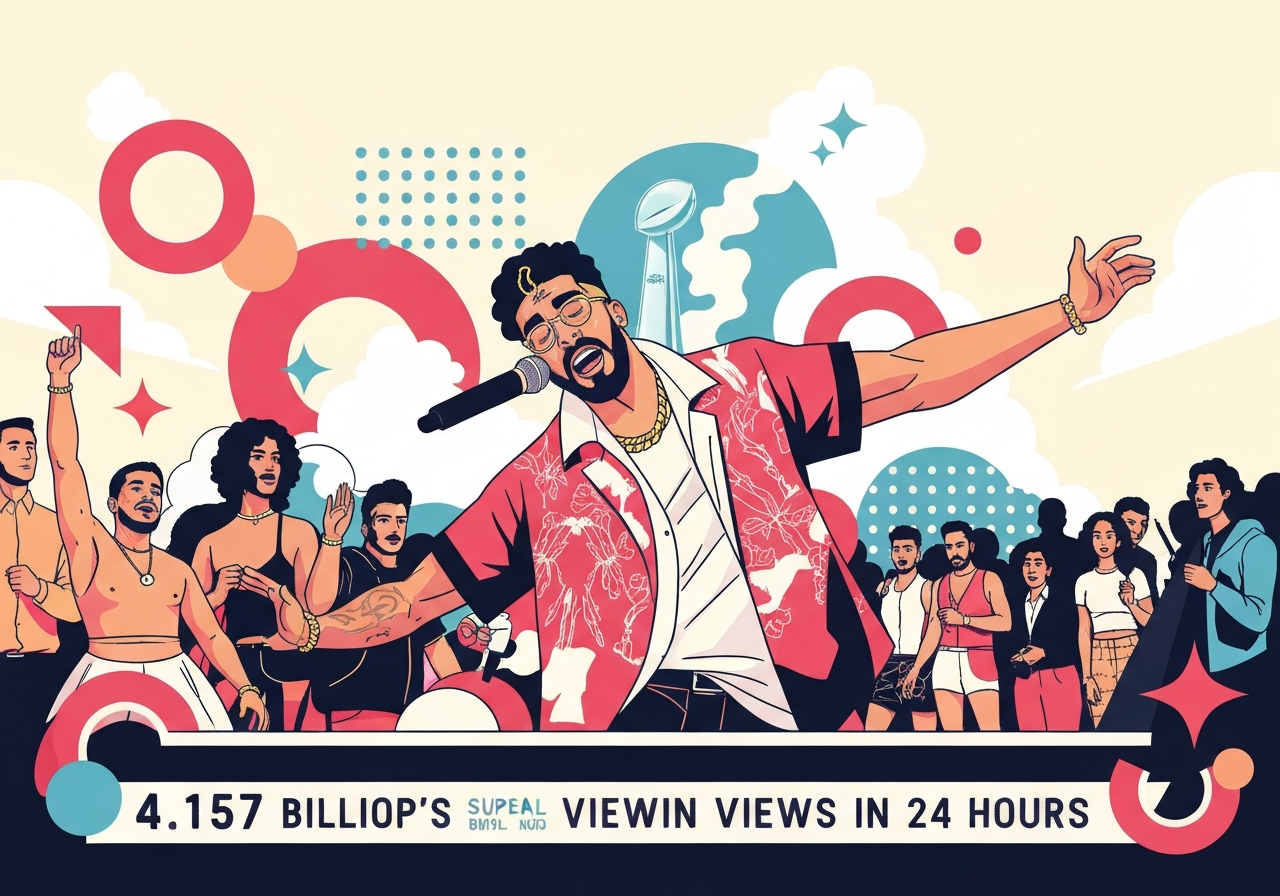
Lead: Roc Nation, the producer of the Super Bowl LX halftime show, reported that Bad Bunny’s performance attracted 4.157 billion global views in the first 24 hours after the broadcast. The tally, Roc Nation said, combines U.S. broadcast, international broadcast, YouTube and other digital properties. The company called the figure a record audience, while U.S. television measurement showed an average halftime audience of 128.2 million viewers, down from 133.5 million the prior year. The precise breakdown of platforms and independent verification were not disclosed.
Key Takeaways
- Roc Nation reported 4.157 billion worldwide views for the Bad Bunny Super Bowl LX halftime show within 24 hours of the performance.
- The 24-hour total reportedly aggregates U.S. broadcast, global broadcast, YouTube and digital properties; Roc Nation did not publish a platform-by-platform breakdown.
- Roc Nation described the 24-hour total as a record audience for a Super Bowl halftime performance.
- U.S. television data show the halftime segment averaged 128.2 million viewers, a decline from 133.5 million the previous year.
- It is not known whether an independent body verified the 4.157 billion figure or the methodology used to combine disparate platforms.
- The reported number highlights the scale of cross-platform reach but raises questions about comparability with traditional TV-only metrics.
Background
The Super Bowl halftime show has become one of the most-watched pop-culture moments worldwide, increasingly delivered across linear television and online platforms. In recent years, producers and rights holders have emphasized digital distribution—live streams, platform clips and social video—to capture global audiences beyond single-network broadcasts. Roc Nation produced the Super Bowl LX halftime set, enlisting Bad Bunny in a performance designed for both the live stadium and global digital audiences. Historically, audience measurement for the Super Bowl has relied on established TV ratings services; combining those with platform-specific counts introduces methodological challenges. Networks, producers and advertisers now routinely report multi-platform reach to reflect changing consumption habits, but standardization remains limited.
Advertisers and the NFL closely track halftime viewership because it informs sponsorship valuations and ad demand tied to the broader event. The Super Bowl itself continues to draw exceptionally large television audiences despite year-to-year fluctuations; halftime viewership is a key metric for demonstrating cultural impact. Producers such as Roc Nation aim to maximize both live spectacle and shareable digital moments, which can drive substantial post-game traffic on social and video platforms. The interplay between broadcast averages and short-window digital totals is central to how success is claimed and monetized.
Main Event
On the night of Super Bowl LX, Bad Bunny headlined the halftime show produced by Roc Nation. Shortly after the broadcast, Roc Nation released a figure it said represented the total global views in the first 24 hours: 4.157 billion. The company stated that the number includes U.S. broadcast, international broadcast, YouTube and its other digital properties but did not publish a line-item breakdown for those channels. Roc Nation framed the tally as a record audience for a Super Bowl halftime performance, signaling strong worldwide engagement.
At the same time, measured U.S. television viewership for the halftime segment averaged 128.2 million viewers. That figure is a decline from last year’s halftime average of 133.5 million, demonstrating a modest drop in linear-TV audience despite the large multi-platform total. Industry watchers noted that year-to-year TV fluctuations can reflect NFL viewership shifts, competing programming, or changes in how viewers access highlights and clips online. The disparity between a falling TV average and an expansive digital total illustrates the evolving media landscape for tentpole live events.
Roc Nation’s announcement prompted immediate attention because a 4.157 billion 24-hour total, if taken at face value, would eclipse typical single-platform measures. The company did not publish underlying methodology—such as whether short-form clips, replays and partial views were included—leaving analysts to interpret the number cautiously. Rights holders and measurement firms increasingly seek unified metrics, but differences in counting (e.g., unique viewers vs. total views, length-of-view thresholds) can yield very different totals. For advertisers and rights negotiators, the metric matters for pricing and strategy, but comparability and transparency are also essential.
Analysis & Implications
The report underscores how producers and platforms can amplify a live performance’s footprint by distributing moments across multiple channels. A multi-billion 24-hour total signals successful global distribution and high clip virality, which can translate into greater brand exposure and longer tail engagement after the event. For the NFL, the result supports continued emphasis on global markets and cross-platform packaging of marquee content. However, the economic value of platform-aggregated totals depends on clarity about what is counted and whether viewers are unique or repeat counts.
From an advertising perspective, digital views do not always substitute cleanly for linear TV impressions, which are measured in standardized commercial ratings and sold against guarantees. Advertisers may prize reach and engagement demonstrated by digital metrics, but most still rely on independently audited TV ratings for media buys during the Super Bowl. If producers and platforms can prove consistent, auditable cross-platform measurement, it could shift how premium inventory is valued; without that, comparisons remain imperfect and negotiations may be conservative.
The announcement also elevates reputational stakes for measurement transparency. Large headline totals can generate positive headlines and perceived success, but they also invite scrutiny from media analysts and measurement firms. Independent verification—by an auditor or third-party measurement service—would strengthen the claim and make it more actionable for partners. Absent that, stakeholders will treat the figure as an indicator of scale, not a definitive, apples-to-apples replacement for standardized TV metrics.
Comparison & Data
| Metric | Reported Figure | Notes |
|---|---|---|
| 24-hour global views (Roc Nation) | 4.157 billion | Aggregated across broadcast, YouTube and digital properties per Roc Nation |
| U.S. TV halftime average (measured) | 128.2 million | Down from 133.5 million in prior year |
The table contrasts Roc Nation’s 24-hour global total with the measured U.S. television average for the halftime show. The 4.157 billion figure is an aggregate reach metric reported by the producer, while the 128.2 million figure is a traditional TV audience measure derived from Nielsen-style sampling. Comparing the two highlights differences in scope (global vs. U.S.) and measurement methodology (platform aggregation vs. standardized TV rating). Stakeholders should interpret platform-aggregated totals as complementary to, not direct replacements for, audited TV ratings until methodologies are harmonized.
Reactions & Quotes
Roc Nation positioned the figure as evidence of unusually large global engagement for the halftime performance and emphasized the multi-platform distribution strategy that delivered the audience. The company framed the total as a record for a Super Bowl halftime show but did not release granular data or invite an independent audit at the announcement time.
“a record audience”
Roc Nation (producer statement)
Media coverage and industry commentators noted the headline figure while pointing out that reporting methods vary across platforms. Observers highlighted that the traditional TV measure showed a small decline, even as the multi-platform total rose dramatically in Roc Nation’s release. That contrast prompted questions about how to reconcile legacy ratings with platform-driven reach numbers.
“very good for NFL business”
NBC Sports (media report)
Unconfirmed
- Whether the 4.157 billion total has been independently audited or verified by a third-party measurement firm is not confirmed.
- The detailed breakdown by platform (how many views came from U.S. broadcast, international broadcast, YouTube, or Roc Nation’s digital properties) was not released.
- It is unclear whether the figure represents unique viewers or total view events, and whether short partial views were counted toward the total.
Bottom Line
Roc Nation’s reported 4.157 billion views in 24 hours for Bad Bunny’s Super Bowl LX halftime show highlights the growing importance of cross-platform distribution for live entertainment. The number signals strong global engagement and the potency of shareable performance moments, but lacks the methodological transparency needed to equate it directly with audited TV ratings. For rights holders and advertisers, the key takeaway is that multi-platform reach can amplify perceived impact, yet commercial decisions will still hinge on standardized, verifiable metrics.
Moving forward, stakeholders should press for clearer reporting standards and independent audits when large aggregate totals are used to support commercial claims. Observers should watch whether producers and platforms publish methodology details or invite third-party verification; such steps would make large multi-platform totals more meaningful for advertisers, rights negotiators and researchers tracking the evolving economics of live sports and entertainment.
Sources
- NBC Sports (media report)
- Roc Nation (producer / official organization)