
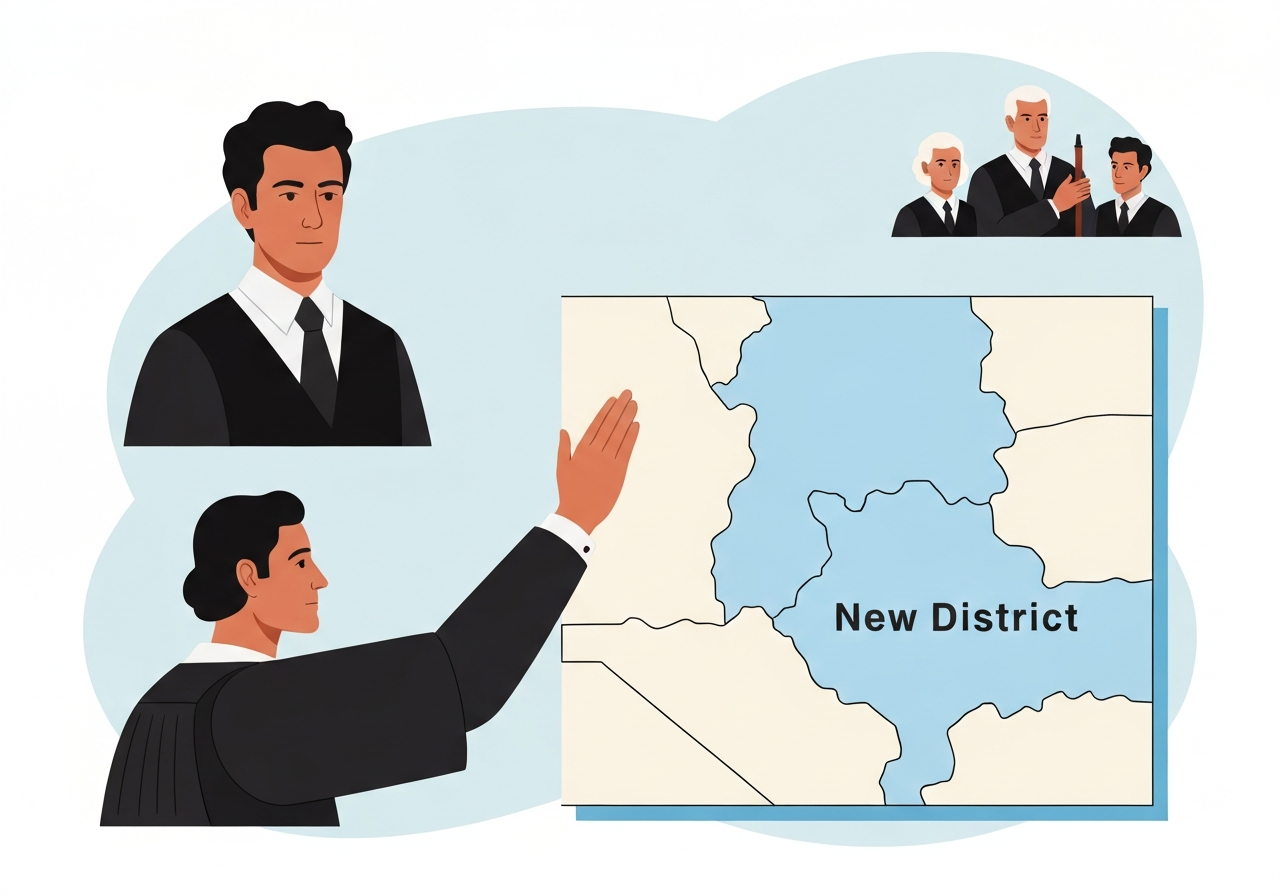
Lead: On March 2, 2026, the U.S. Supreme Court issued an emergency, unsigned order leaving in place New York’s existing congressional map, preserving the 11th District held by Representative Nicole Malliotakis. A lower state judge had ruled the map unlawfully diluted Black and Latino voting strength and ordered a redraw; the Court’s temporary stay blocks that change while appeals proceed. The decision contains no recorded vote or explanation and most likely allows the current boundaries to be used for the upcoming midterm elections. The ruling is the latest high-profile midcycle redistricting dispute to reach the justices’ emergency docket.
Key Takeaways
- The Supreme Court issued an unsigned emergency order on March 2, 2026, keeping New York’s current congressional map in effect pending appeal.
- The dispute centers on New York’s 11th Congressional District — Staten Island and parts of southern Brooklyn — the only Republican-held district in New York City.
- A state judge had found the map diluted Black and Latino voters and ordered new lines; the Supreme Court’s stay prevents immediate redrawing.
- Representative Nicole Malliotakis filed the emergency application asking the justices to block the state-court remedy that could have endangered her seat.
- The Court’s order included no vote tally or written reasoning, a common practice for emergency stays, leaving legal arguments to the appeals process.
- The ruling is temporary but makes it probable that the existing map will govern candidate filings and campaigning in the midterm cycle.
- The case joins a string of midcycle redistricting challenges on the justices’ emergency docket amid increased partisan map-drawing nationwide.
Background
The legal fight traces to a trial-court finding that parts of New York’s congressional map unlawfully diminished the influence of Black and Latino voters in and near New York City. Plaintiffs argued the configuration prevented minority communities from electing candidates of their choice, a claim grounded in the Voting Rights Act and constitutional equal-protection principles. A state judge concluded the lines required correction and ordered a plan that, if implemented, would alter the 11th District boundaries.
The 11th District is politically and demographically distinct: it covers Staten Island and southwestern Brooklyn neighborhoods and has been the lone Republican-held U.S. House seat inside New York City. Republicans, worried about losing a narrow House majority nationally, viewed the state-court order as a threat to that seat. The case arrived on the Supreme Court’s emergency docket as appeals of the state ruling began, reflecting the Court’s recent willingness to intervene in midcycle map disputes.
Main Event
Representative Nicole Malliotakis promptly asked the Supreme Court to halt the state judge’s redrawing order, arguing that immediate changes would disrupt the electoral process and harm incumbents and voters alike. On March 2, the justices granted a temporary stay — an unsigned order leaving the existing map intact while litigation continues in the lower courts and on appeal. The stay does not resolve the underlying legal questions about whether the map unlawfully diluted minority voting strength; it simply maintains the status quo for now.
The Court’s order included no recorded vote count or accompanying opinion, as is typical for emergency actions. That lack of published reasoning leaves the lower-court ruling’s merits unresolved and forces the case back into the appellate pipeline. Legal observers say the absence of explanation complicates strategic planning for both challengers and incumbents because it provides no clear guidance on the Court’s view of the legal standards at issue.
Practically, the stay means candidate filing deadlines, campaign strategies, and local election administration are likely to proceed under the current district lines. Election officials and political operatives generally prefer certainty; an emergency stay reduces immediate disruption but raises the prospect of change later if appeals succeed. The stay also intensifies pressure on appellate courts to act quickly because of upcoming electoral timelines.
Analysis & Implications
The Supreme Court’s temporary preservation of the map carries immediate political consequences: it increases the likelihood that the 11th District will remain configured as a Republican-leaning seat through the midterms. Given the razor-thin House majority Republicans hold nationally, keeping a contested seat in play has strategic importance for both parties. Campaign resources and messaging will be allocated with the Court’s stay in mind, potentially altering competitive dynamics in New York and beyond.
Legally, the order underscores the Court’s pivotal gatekeeping role in midcycle redistricting disputes. Emergency stays do not signal final views on statutory or constitutional claims, but they can shape the pace of litigation and the practical impact of remedies ordered by trial courts. Observers caution that a later, full merits decision could still require significant map changes, producing disruption after ballots are already set or even after elections are held.
There are broader civil-rights and governance implications. Plaintiffs who argue that maps dilute minority voting power may now face a lengthier path to relief. Civil-rights groups could intensify litigation efforts, seeking faster appellate timelines or alternative remedies. Conversely, state actors and incumbents will likely use the stay to argue for electoral stability and the avoidance of last-minute boundary changes.
Comparison & Data
| Item | Current (Stayed) | State Court-Ordered Change |
|---|---|---|
| District | NY-11 (Staten Island, parts of S. Brooklyn) | Adjusted boundaries to increase minority opportunity (specific lines in state ruling) |
| Party Control | Republican (Nicole Malliotakis) | Could become more competitive for Democrats |
| Effect on 2026 Midterms | Map likely used for filings/campaigns | If implemented, could alter candidate calculations late in cycle |
The table summarizes the immediate contrast between the map preserved by the Supreme Court stay and the remedy a state judge ordered. While the stay preserves the status quo, the trial-court remedy was designed to create a district configuration that plaintiffs say would better reflect Black and Latino voting strength. The practical effect depends on the timing of appeals: if higher courts reject the stay later, changes could be ordered at a time that complicates ballots and administration.
Reactions & Quotes
[Paraphrase] The congresswoman said the Court’s action prevented voters in Staten Island and southern Brooklyn from losing the ability to elect representatives aligned with their values.
Representative Nicole Malliotakis (R-N.Y.) — public statement
[Paraphrase] Civil-rights advocates criticized the stay, arguing that the state judge’s finding identified real dilution of minority voting power that warrants timely correction.
Voting-rights organizations — public statements
[Paraphrase] Legal analysts noted the unsigned nature of the order leaves open major legal questions and shifts the battle to the appeals process where final resolution may come months later.
Legal analysts (commentary)
Unconfirmed
- Whether the Supreme Court’s private conference vote split along predictable ideological lines has not been disclosed; the stay included no vote tally or signed opinion. (Unconfirmed)
- Precise effects of any future appellate ruling on filings and ballots for the 2026 midterms remain uncertain until higher courts reach a merits decision. (Unconfirmed)
Bottom Line
The Supreme Court’s March 2, 2026 emergency stay prevents immediate implementation of a state-court-ordered redraw that a judge found diluted minority votes, preserving the 11th District’s existing boundaries for now. While this outcome favors the incumbent Republican on short notice, it does not settle the core legal questions about vote dilution or the appropriate remedy.
Expect continued litigation in the appellate courts and heightened political maneuvering as campaigns plan under the current map. The ultimate resolution — whether the stay is lifted or the state-court remedy affirmed — will determine the district’s lines and could have ripple effects for similar midcycle redistricting disputes nationwide.