
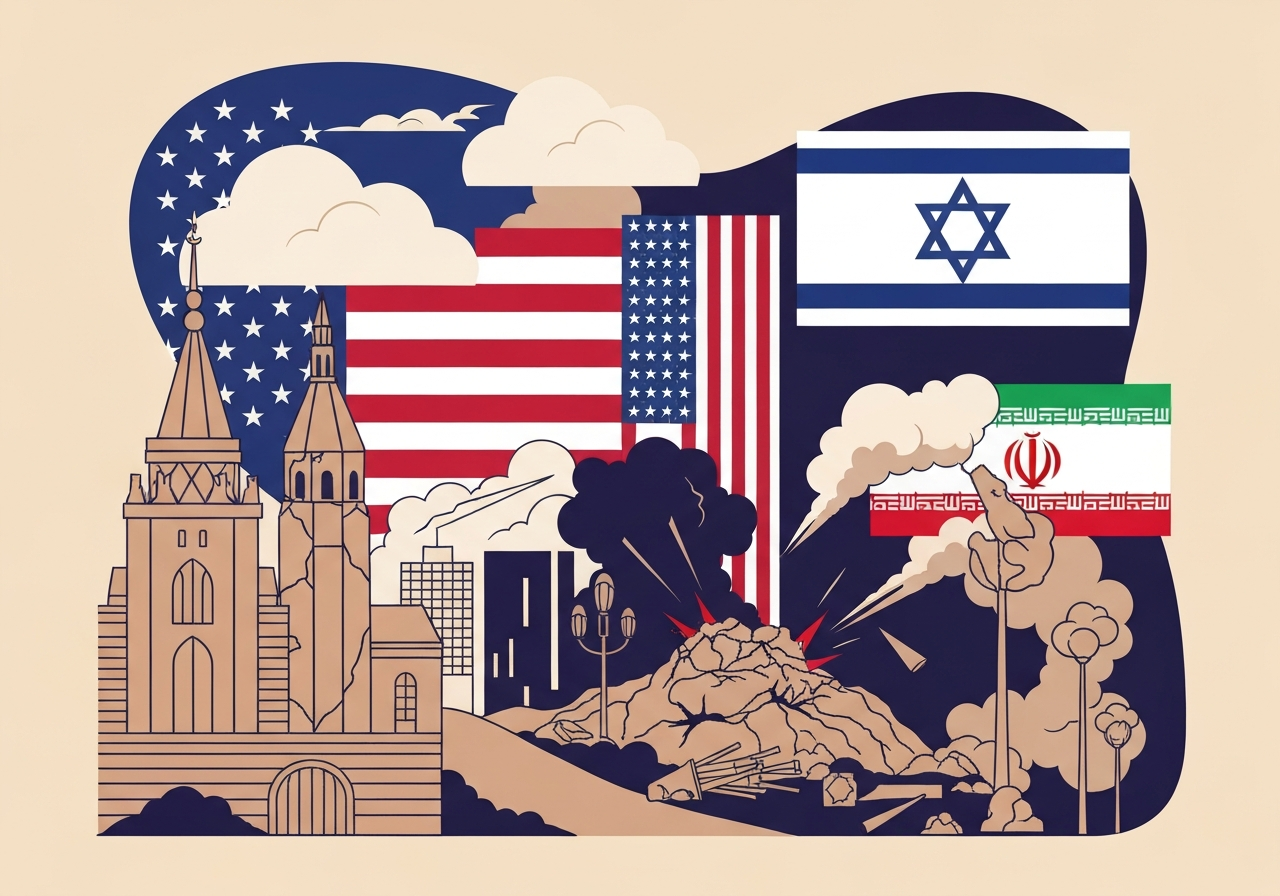
Lead
US and Israeli operations against Iran have intensified, prompting regional retaliations and civilian dislocations across the Middle East. On Tuesday the US ordered non-emergency staff and families to leave Bahrain and Jordan, after a similar directive for Iraq on Monday. Israel issued fresh evacuation warnings for multiple locations in Lebanon as military preparations continue. Officials on both sides say the campaign will persist for an extended period, though leaders disagree over its likely duration.
Key takeaways
- The US State Department ordered non-emergency personnel and family members to depart Bahrain and Jordan on Tuesday, having issued the same order for Iraq on Monday.
- At least 11,000 flights into, out of and within the Middle East were cancelled since Saturday, affecting more than 1 million passengers, according to Cirium.
- The US embassy compound in Riyadh was struck by two drones, producing a small fire and material damage; no injuries have been reported in initial accounts.
- Iran’s Islamic Revolutionary Guard Corps (IRGC) claimed a large drone-and-missile attack on the US air base at Sheikh Isa in Bahrain, alleging 20 drones and three missiles were used.
- The Israeli military publicly stated it was conducting strikes targeting locations in Tehran and Beirut simultaneously, while US Central Command reported destruction of Iranian Revolutionary Guard command and control facilities.
- Israeli prime minister Benjamin Netanyahu said the campaign “may take some time” but insisted it would not become an open-ended, years-long conflict.
- Governments are organising evacuations: airlines and charters have repatriated citizens, including a chartered flight carrying 127 Italians from Oman to Rome.
Background
The current campaign began with coordinated US and Israeli air operations against Iranian targets over the weekend, an escalation that has produced swift Iranian reprisals against assets and partners across the region. Tensions built over years of mutual hostility—US sanctions, Israeli strikes on Iran-linked facilities, and Tehran’s support for proxy forces such as Hezbollah—set the stage for rapid escalation once strikes began.
Regional host states hosting US forces, including Bahrain, Jordan and Iraq, have been drawn into the fallout: Washington has repeatedly adjusted travel advisories and ordered non-essential departures as a precaution. Airspace and commercial routes have been disrupted both by direct attacks and by airlines suspending services amid security concerns, compounding the humanitarian and logistical challenges.
Main event
This week saw a cluster of developments. The State Department posted travel updates on Tuesday ordering non-emergency government personnel and families to depart Bahrain and Jordan and reiterated an order for non-emergency departures from Iraq issued on Monday. The move follows reports of strikes and counterstrikes that have raised the perceived risk to diplomatic missions and foreign staff.
Saudi authorities reported drone strikes on the US embassy in Riyadh early on Tuesday; officials described two drones causing a limited fire and superficial damage, with no immediate reports of casualties. Observers noted black smoke over Riyadh’s diplomatic quarter and local media circulated images of flames at the compound.
On the military front, the IRGC released a statement, carried by state media, claiming a dawn attack on the US air base at Sheikh Isa, Bahrain, alleging the use of 20 drones and three missiles and asserting the base’s main command was destroyed. US and allied sources have acknowledged strikes across a range of Iranian military infrastructure; US Central Command posted that facilities tied to the IRGC’s command and control, air defences and launch sites were struck.
Meanwhile Israel issued evacuation warnings in Lebanon, including alerts for southern Beirut neighbourhoods, citing imminent military action in those areas. Hezbollah reported launching drones toward northern Israel, part of a broader pattern of cross-border activity that has increased civilian alarm and displacement in border zones.
Analysis & implications
The immediate effect is a sharp escalation in regional risk: diplomatic missions and foreign personnel are being moved out of perceived danger zones, and commercial aviation is adjusting routes or suspending services. That disruption carries economic costs—airlines, airports and freight operators face losses while states managing citizen returns confront logistical strain.
Strategically, the campaign aims to degrade Iran’s ability to project power via missile, drone and proxy networks. US and Israeli statements about targeting IRGC command-and-control and launch facilities are consistent with that objective, but degrading those capabilities takes time and risks prompting further reprisals that could expand the theatre of conflict.
Politically, leaders are framing the timeline differently. Prime Minister Benjamin Netanyahu rejected the notion of a years-long war, while US political leadership has indicated an open-ended willingness to continue operations until stated objectives are met. The divergence matters: limited, time-bound campaigns and long-term occupations produce different domestic political dynamics and regional alignments.
Absent a credible de-escalation channel, the risk of accidents, miscalculation or third-party involvement remains high. Shipping routes such as the Strait of Hormuz are sensitive flashpoints; threats to commercial navigation would amplify global economic impacts, particularly on energy markets, even if the waterway remains formally open.
Comparison & data
| Metric | Reported figure |
|---|---|
| Flights cancelled since Saturday | 11,000+ |
| Passengers affected (Cirium) | >1,000,000 |
| Reported charter evacuees (example) | 127 Italians |
| Countries urged for departure (US list) | 14 countries |
The numbers above underline both the scale and the human consequences: cancelled flights have stranded travellers and complicated evacuations, while country-level advisories reflect a broad geographic footprint of concern. These data points also provide a baseline to monitor whether the disruption is stabilising or worsening as operations continue.
Reactions & quotes
Official and political responses have been strong and varied, from military assertions to calls for citizen departures. Below are representative statements with context.
“It may take some time, but it will not take years.”
Benjamin Netanyahu, Israeli prime minister (on Fox News)
Netanyahu used this line to push back against narratives of an open-ended regional war, framing Israel’s objectives as decisive rather than endless. His remarks were offered while Israel and US forces described further strikes against Iranian military infrastructure.
“U.S. forces have destroyed IRGC command-and-control sites, air-defence systems, and launch locations during sustained operations.”
US Central Command (official social media post)
Centcom’s post summarised military effects according to US assessments; such claims are a routine part of operational messaging but require independent verification for full confirmation on the scale and permanence of damage.
“Our naval forces carried out a large-scale drone and missile attack at dawn on the US air base in Sheikh Isa.”
IRNA reporting IRGC statement (state media)
Iranian state media published the IRGC’s account of the strike on Sheikh Isa; the claim includes detailed counts of munitions used and asserted damage to the base’s command complex. Open-source and third-party verification of those precise effects has not been publicly confirmed.
Unconfirmed
- Claims that US or allied strikes killed Supreme Leader Ali Khamenei: no independent or credible confirmation of that claim has been found; it should be treated as unverified.
- IRGC assertions that the Sheikh Isa base’s “main command headquarters” was destroyed: official US and independent damage assessments have not publicly corroborated the specific scope of destruction claimed by the IRGC.
- Reports that the Israeli Air Force is simultaneously and continuously striking both Tehran and Beirut in extensive waves: operational claims have been made in public channels, but independent confirmation of simultaneous, sustained strikes in both capitals at the scale described is incomplete.
Bottom line
The military campaign by the US and Israel against Iranian targets has triggered immediate regional reverberations: diplomatic facilities have been struck or threatened, governments have ordered personnel departures from multiple host countries, and civilian travel and commerce face significant disruption. The situation remains dynamic, with official claims about battlefield effects and damage requiring independent verification.
For policymakers and civilians alike, the near-term priority is de-escalation channels and humanitarian planning—protecting diplomats and civilians, maintaining key sea lanes and supply chains, and ensuring accurate, verifiable public reporting. The next days will show whether the campaign achieves its tactical aims without widening into broader, prolonged conflict.
Sources
- The Guardian (live updates) — media
- U.S. State Department travel advisories — official
- U.S. Central Command statements — military/official
- IRNA reporting of IRGC statement — Iranian state media
- Agence France-Presse coverage — news agency
- Cirium aviation analytics (flight cancellation data) — industry analytics