
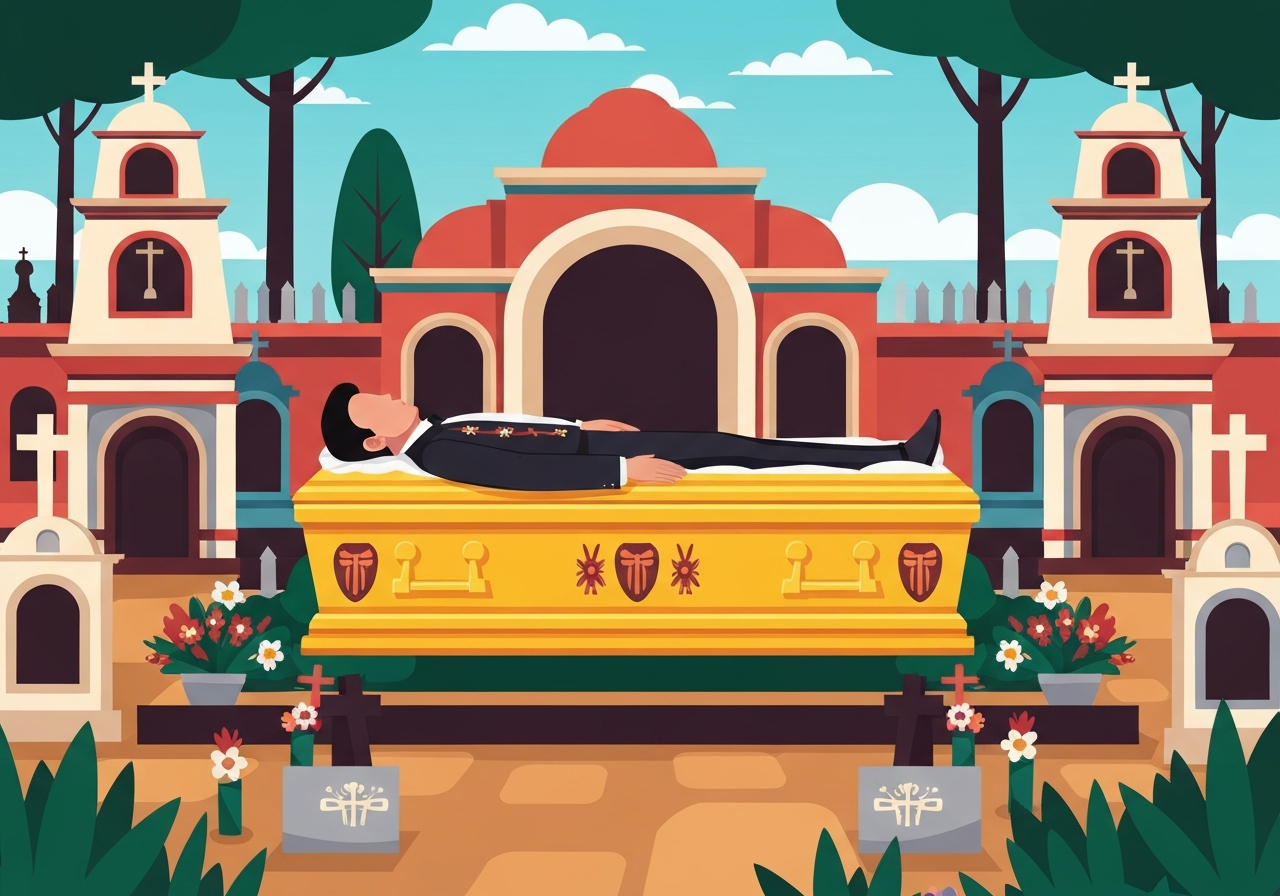
Lead: Nemesio Oseguera Cervantes, known as “El Mencho,” was buried Monday in a cemetery in Zapopan, a suburb of Guadalajara, after Mexican forces killed him just over a week earlier. The funeral featured a shiny golden casket, oversized floral wreaths and a heavy military presence as dozens walked the procession under black umbrellas while a banda played. A federal official, speaking anonymously, confirmed the burial site; the Attorney General’s Office declined to disclose the location for “security reasons.” The death certificate, obtained by The Associated Press, records multiple bullet wounds and notes the body was autopsied in Mexico City before being released to the family.
Key Takeaways
- Nemesis Oseguera Cervantes (“El Mencho”) was buried Monday in Zapopan, Guadalajara; an anonymous federal official confirmed the site.
- The funeral included a golden casket, very large flower wreaths and visible military deployment; dozens accompanied the procession, many with black umbrellas and banda music.
- The death certificate lists bullet wounds to the chest, abdomen and legs; an autopsy was done in Mexico City and the body was handed to family on Saturday.
- Defense Secretary Ricardo Trevilla described an operation in Tapalpa, Jalisco, where El Mencho and two bodyguards were wounded and later died en route to a hospital.
- The killing triggered retaliatory violence across roughly 20 Mexican states; authorities report more than 70 deaths between the military operation and subsequent clashes.
- The Attorney General’s Office cited security concerns for not confirming burial details; certificates also noted burial to preserve potential future forensic evidence.
- Supporters and local culture quickly produced narcocorridos and other myth-making responses following the leader’s death.
Background
The Jalisco New Generation Cartel (CJNG) grew from a regional trafficking group into one of Mexico’s most powerful criminal organizations over the past decade, expanding operations across Mexico and into international markets. Its rise has coincided with escalating clashes with state forces and rival groups, making the cartel a central focus of Mexico’s security strategy. High-profile operations against cartel leaders have historically provoked waves of retaliation, and El Mencho’s death followed that pattern: authorities reported violent reprisals across many states after the operation.
Funeral rites for major cartel figures in Mexico often blend private mourning with public spectacle. Lavish crypts, narcocorrido ballads and symbolic imagery can amplify a leader’s reputation among supporters; this practice is visible in cemeteries known for elaborate mausoleums and in popular culture. Mexican authorities balance the need for transparency with security imperatives, frequently restricting information about burial locations to prevent further violence or grave-site attacks.
Main Event
Mexican forces killed Oseguera Cervantes in an operation just over a week before the burial; Defense Secretary Ricardo Trevilla said the leader and two bodyguards were badly wounded during a gunfight outside a Tapalpa, Jalisco, residence and all three died while being transported to a hospital. The death certificate, made available to journalists, records bullet wounds to the chest, abdomen and legs and notes burial as the next step—a procedural allowance that preserves the possibility of future forensic examination.
Authorities increased security around a funeral home beginning Sunday as large, unnamed wreaths arrived. Some floral arrangements featured a rooster motif; supporters have sometimes referred to Oseguera Cervantes using rooster imagery and nicknames such as the “Lord of the Roosters.” On Monday, dozens joined a procession in Zapopan under sunny skies, with a military presence nearby and regional banda music accompanying the ceremony.
The Attorney General’s Office issued a short statement saying the body underwent an autopsy in Mexico City and was returned to family custody on Saturday but declined to verify the burial site, citing security reasons. A federal official familiar with the case—who requested anonymity because they were not authorized to speak—confirmed the burial took place in Zapopan. Government officials have said security operations continue to target other CJNG leaders amid the violence that followed the killing.
Analysis & Implications
El Mencho’s death removes a central figure in the CJNG but is unlikely to end the cartel’s operations. Leadership vacuums in organized criminal groups often trigger internal power struggles or rapid succession, which can increase localized violence as rivals and lieutenants jockey for control. The reported pattern of retaliatory attacks across roughly 20 states and the government’s count of more than 70 deaths illustrate the immediate security fallout and the difficulty of containing contagion effects after a high-profile strike.
Operationally, the government’s choice to publicize limited details while withholding burial location reflects a trade-off between transparency and preventing further attacks or grave-site disturbances. The death certificate’s notation that burial was permitted to allow for later forensic work signals an intent to preserve evidence chains, yet it also limits public verification and fuels speculation about how authorities will use postmortem findings in prosecutions or intelligence-gathering.
Politically, the episode could intensify scrutiny of security policy at both state and federal levels. Critics may question whether targeted strikes sufficiently reduce cartel capacity or merely shift violence patterns, while proponents will point to the removal of a top target as a concrete achievement. International partners monitoring organized crime and drug trafficking will watch developments closely, particularly any cross-border shifts in trafficking routes or alliances.
Comparison & Data
| Name | Cartel / Group | Post-death note |
|---|---|---|
| Ignacio Coronel | Sinaloa (assoc.) | Lauded in local mausoleums; part of cemetery legend |
| Arturo Beltrán Leyva | Beltrán Leyva | Interred in prominent crypts tied to past kingpins |
| Nazario Moreno | Knights Templar | Reported dead in 2010; confirmed killed again in 2014 |
| Heriberto Lazcano | Zetas | Body reportedly stolen in 2012 after death |
| Amado Carrillo Fuentes | Juárez | Died during medical procedure; circumstances remain notable |
Patterns across these cases show a mixture of lavish memorialization, disputed reports and, in some instances, interference with remains. Such outcomes complicate forensic and judicial processes and can contribute to the mythologizing of criminal figures. Authorities face the dual challenge of securing evidence for prosecutions while preventing funerals from becoming rallying events.
Reactions & Quotes
“We will not confirm the burial location for security reasons,”
Attorney General’s Office (brief statement)
“The cartel leader and two bodyguards were badly wounded in a gunfight,”
Defense Secretary Ricardo Trevilla (official account of the operation)
“There were large wreaths without names and people gathered with umbrellas while a band played—there was an unmistakable public display,”
Federal official (anonymized)
Each statement above frames different institutional priorities: the Attorney General emphasizes security constraints, the defense ministry describes the tactical outcome, and a federal source provides on-the-ground detail about the ceremony and its symbolism.
Unconfirmed
- The precise grave coordinates and the identities of those who arranged the golden casket have not been publicly verified beyond the anonymous official’s account.
- A full, state-by-state breakdown of the more than 70 reported deaths tied to the operation and reprisals has not been released by authorities in a consolidated official report.
Bottom Line
El Mencho’s burial in Zapopan closes a chapter on one of Mexico’s most wanted cartel leaders but opens another of uncertain duration: a likely period of jockeying for influence within the CJNG and elevated risk of localized violence. The immediate death toll and spread of retaliatory attacks underline how removing a top figure can produce short-term instability even as it may degrade organizational command over time.
For citizens and policymakers, the key questions are whether follow-up operations can contain further violence, how forensic and judicial processes will secure evidence for prosecutions, and whether broader strategies will reduce the cartel’s capability rather than simply displacing it. Observers should watch for public security updates, leadership announcements from the CJNG, and official forensic or prosecutorial disclosures in the coming weeks.
Sources
- Associated Press — news report summarizing the operation, death certificate details and burial reporting
- Attorney General’s Office (FGR) — official statements and procedural context (official)
- Secretariat of National Defense (SEDENA) — institutional account of military operations (official)