
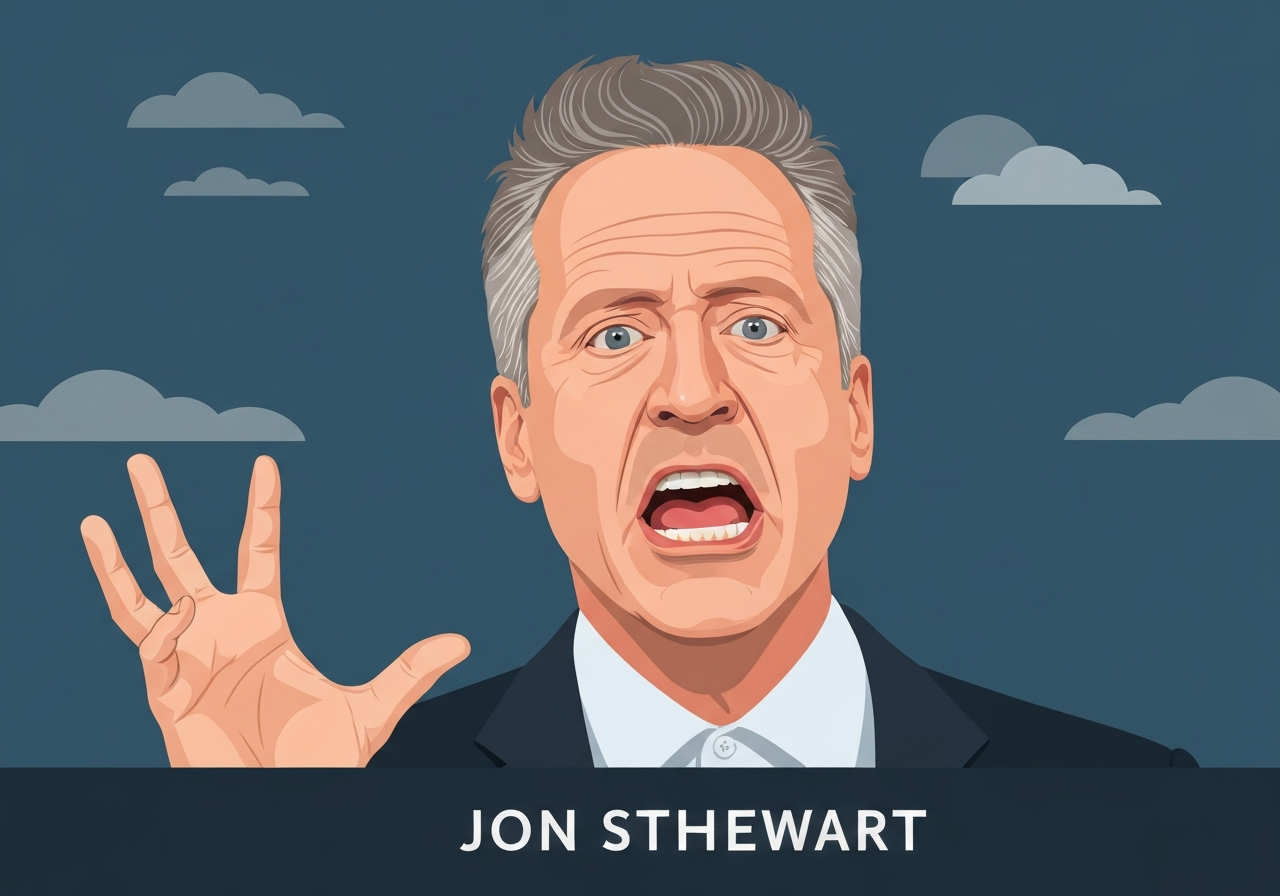
Lead: On Monday’s episode of The Daily Show, host Jon Stewart launched a blistering opening monologue condemning President Donald Trump’s recent military strike on Iran. Stewart criticized what he described as chaotic messaging from the White House and the absence of prior congressional authorization for the operation. The segment centered on the strike named “Operation Epic Fury,” the reported killing of 86-year-old Ayatollah Ali Khamenei, and the broader diplomatic fallout that has followed. Stewart warned the public was being dragged into a conflict with unclear aims and an uncertain timeline.
Key Takeaways
- Jon Stewart used Monday’s Daily Show monologue to sharply criticize President Trump’s handling of the Iran strike and the administration’s public communications following the attack.
- The military action labeled “Operation Epic Fury” was launched on Friday and, according to reports, targeted Iran’s missile production, naval capabilities and nuclear infrastructure.
- Iran’s Supreme Leader, Ayatollah Ali Khamenei, was reported killed; he was described as 86 years old in initial media accounts.
- The operation has been linked to significant infrastructure damage in Iran and the deaths of four U.S. service members, per public reporting.
- President Trump has said the campaign could last weeks and has not ruled out deploying U.S. ground troops, raising questions about escalation and authorization.
- Congress is scheduled to vote on a war powers resolution on Thursday, after the strike had already taken place, prompting debate over executive authority and legislative oversight.
- Stewart contrasted 2024-era conservative claims that Trump would deliver “peace through strength” with current praise from some supporters for the military action.
- Stewart’s monologue mixed satire and reproach—mocking the operation name, the White House’s video announcement from Mar-a-Lago, and the broader political response.
Background
The U.S. strike, announced publicly as “Operation Epic Fury,” followed what the administration described as imminent threats tied to Iranian capabilities. The strike reportedly focused on missile production facilities, naval assets and elements linked to nuclear development. The incident arrived amid heightened tensions in the Middle East after weeks of exchanges between Tehran and U.S. allies.
Domestically, debate over the strike has centered on presidential authority versus congressional oversight. During the 2024 campaign many on the right billed Trump as a leader who would deter conflicts through strength; that message has been invoked by supporters and critics alike as the United States moves from rhetoric to direct military action. Historically, contested uses of force without prior congressional approval have prompted legal and political challenges, placing this episode in a familiar U.S. constitutional and political context.
Stakeholders include the White House and national security team, members of Congress preparing a war powers vote, U.S. military leaders managing operations and families of service members affected by the fighting. International actors—most notably Iran and regional partners—face immediate security and diplomatic fallout, while global markets and allied capitals watch for escalation risks.
Main Event
Stewart opened Monday’s broadcast by striking an unusually sharp tone. He chastised the administration for what he called inconsistent public messaging and a failure to secure congressional buy-in before ordering strikes. The host threaded clips into his routine: excerpts from 2024 campaign remarks promising deterrence, followed by recent footage of supporters applauding the strike, highlighting a rapid rhetorical shift among some conservatives.
Much of Stewart’s sass targeted the operation’s name and the White House’s presentation. He ridiculed the choice “Operation Epic Fury” as overblown and lampooned the video in which the president announced the attack from Mar-a-Lago—commenting on the informal setting and apparel as emblematic of a broader lack of gravitas around a major use of force. Stewart’s barbs blended comic framing with pointed political criticism.
The comedian also addressed the reported death of Iran’s Supreme Leader, described in media accounts as 86-year-old Ayatollah Ali Khamenei. Stewart used dark humor to question the strategic calculus of targeting an elderly, high-profile figure while acknowledging the severity of killing a long-ruling authoritarian. Audience reactions—moments of sympathy and awkward noises—also drew Stewart’s ire as he balanced critique of the target with condemnation of human-rights abuses attributed to Iranian leadership.
Stewart criticized the timing of congressional action—highlighting that a House vote on a war powers resolution was set for Thursday, days after the strike occurred. He framed that sequence as illustrative of a pattern: executive action first, legislative response later. He also mocked the idea that the strike generated clear strategic objectives, warning of the risks of open-ended campaigns where goals and exit conditions are not publicly defined.
Analysis & Implications
The episode crystallizes a series of political pressures. For the White House, the strike may shore up support among hawkish constituencies but risks alienating moderates and independents concerned about unilateral military action. The administration faces a trade-off between demonstrating resolve and answering legal and political questions about authorization and the strategy’s endgame.
Congressional response will be pivotal. A war powers vote—even if symbolic—could set precedents for legislative oversight of future operations. If lawmakers fail to assert meaningful constraints, the institutional balance of foreign-policy authority may tilt further toward the executive branch. Conversely, a successful vote limiting the campaign could produce intra-party tensions and shape midterm or campaign messaging for both parties.
On the ground and regionally, the risk of escalation remains tangible. Iran’s reported strikes on other countries in the Middle East represent broadening effects; retaliatory cycles could draw in allied forces and nonstate actors, complicating mission scope. The reported deaths of four U.S. service members underscore the human cost and the immediate operational dangers for deployed personnel.
International reaction—both from partners and adversaries—will affect diplomatic avenues and coalition-building. Allies may welcome action against facilities linked to missile and nuclear work, but many will also press for clear legal justification and a plan for de-escalation. Global markets and security forums typically react to such shocks with volatility and calls for restraint.
Comparison & Data
| Metric | Reported Figure / Note |
|---|---|
| Operation name | Operation Epic Fury (announced by U.S. administration) |
| Senior Iranian leaders killed | Multiple senior officials reported; Ayatollah Ali Khamenei reported killed (86 years old) |
| U.S. service member deaths | 4 confirmed |
| Targets | Missile production, naval assets, nuclear-related infrastructure |
| Congressional vote | House war powers resolution scheduled for Thursday (after strike) |
The table summarizes the immediate, publicly reported elements of the operation: targets, casualties and timing relative to congressional action. These numbers have important implications for policy and legal debates, but they remain subject to official confirmation and clarification from military and diplomatic sources.
Reactions & Quotes
“How quickly the right has gone from ‘peace through strength’ to ‘peace through war’,” Stewart said on air, contrasting earlier campaign rhetoric with recent praise for the strike.
Jon Stewart, The Daily Show (as reported)
That clip was followed by Stewart mocking the operation’s branding and the informal manner of the administration’s video announcement—using satire to underscore what he framed as a mismatch between spectacle and statecraft.
Stewart challenged the timing of legislative oversight, noting that Congress appeared prepared to debate the war powers resolution only after strikes had been carried out.
Jon Stewart, The Daily Show (as reported)
Other public responses have ranged from applause among some pro-administration commentators to concern from civil liberties advocates and foreign-policy experts about escalation and legal authority. Officials have emphasized the operation’s objectives while promising further briefings to Congress—details that will shape both domestic and diplomatic responses.
Unconfirmed
- Precise details about the location where Ayatollah Ali Khamenei was killed have not been independently verified in open-source reporting.
- The full roster and identities of senior Iranian officials reportedly killed remain incompletely confirmed in public reports.
- Whether the operation will lead to a sustained ground deployment of U.S. troops is not confirmed; statements indicate that possibility has not been ruled out but no formal orders were announced.
- The long-term goals and clear exit strategy for the campaign have not been laid out in publicly available official documents.
Bottom Line
Jon Stewart’s segment crystallized public frustration over rapid military action taken without an apparent public strategy or prior congressional authorization. His mix of satire and sustained critique framed the strike as emblematic of a presidency that moves first and answers later—an approach that raises constitutional, political and operational questions.
For policymakers, the immediate tasks are confirming facts, clarifying legal authority and outlining a credible strategy to achieve stated objectives while minimizing escalation. For the public and media, the coming days will focus on congressional debate, further operational reporting, and whether diplomatic channels can reduce the risk of broader regional conflict.
Sources
- Hollywood Reporter — entertainment news report detailing Jon Stewart’s Daily Show monologue and reporting on the Iran strike.