
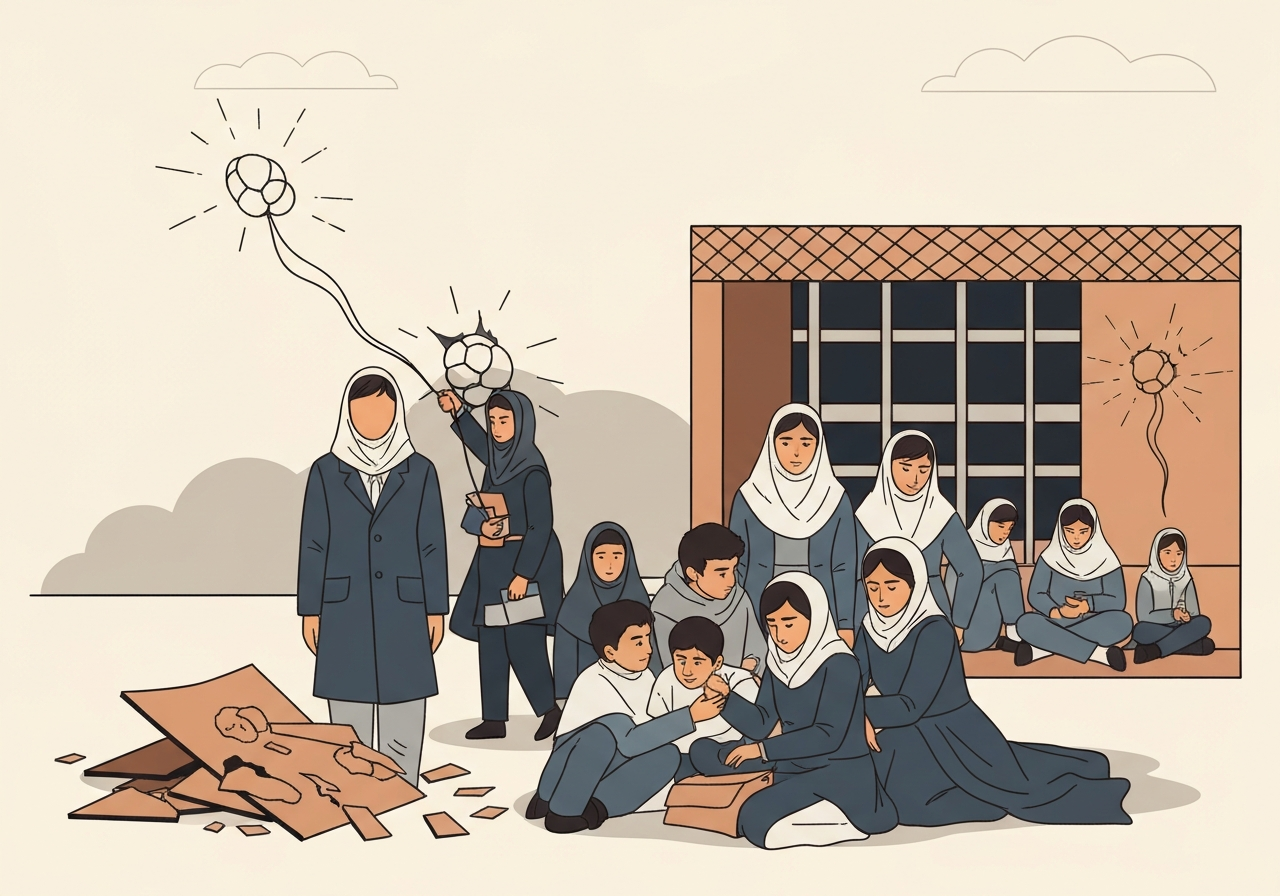
Lead: A missile struck Shajareh Tayyebeh girls’ primary school in Minab, southern Iran, during morning classes between about 10:00 and 10:45am on Saturday, as the first round of US‑ and Israeli‑led strikes unfolded. Iranian authorities say as many as 168 people were killed and 95 injured; independent verification is limited amid internet blackouts and restrictions on reporting. The blast demolished the school building, scattering classroom furniture and playground equipment, and rescue teams searched through concrete rubble for survivors. UNESCO condemned the attack as a potential grave violation of international humanitarian law.
Key takeaways
- Timing: The strike hit during the school’s morning session after a wave of US‑ and Israeli‑directed strikes that began around 9:40am local time; the impact on students occurred between roughly 10:00 and 10:45am.
- Casualties (reported): Iranian state media reported up to 168 dead and 95 injured; these figures are not independently verified and remain disputed.
- Location: Shajareh Tayyebeh school sits adjacent to an IRGC compound that includes medical and cultural buildings; the classroom block and playground are separated from the compound by a wall.
- Witness evidence: Verified photos and video from the scene show extensive classroom damage, bloodied backpacks and child-sized belongings; some material was not published because of graphic content.
- Claims and responses: US Central Command said it was “looking into” reports of civilian harm; Iranian officials and local teachers assert the school served ordinary local children, not exclusively military families.
- Misinformation: Multiple viral posts falsely repurposed footage and misattributed images from locations far from Minab; OSINT groups and factcheckers have debunked several such claims.
- Local impact: Minab, a small agricultural town near the Gulf of Oman, faces significant community loss given reports that many victims were young girls from multiple families.
Background
The strike occurred on the first day of a US‑ and Israeli‑led campaign of attacks on targets across Iran. Those operations were reported to have begun at about 9:40am local time; within that wave, a missile struck the girls’ school in Minab. Iranian state media and local outlets have framed the event as part of a broader escalation that has already produced heavy civilian tolls across the country.
Shajareh Tayyebeh is a small primary school whose murals and playground equipment are visible in open‑source satellite imagery and local footage. Satellite and on‑the‑ground verification by OSINT groups and independent Farsi factcheckers confirmed the school’s location adjacent to facilities identified as belonging to the Islamic Revolutionary Guard Corps (IRGC), including a clinic bearing IRGC markings and a cultural complex.
Because independent reporting inside Iran is heavily constrained and internet access was interrupted in many areas after the strikes began, international journalists have relied on geolocated video, satellite imagery and interviews with diaspora‑based union representatives and local sources to reconstruct events. That limited information flow increases the difficulty of independently verifying casualty totals and the precise weapon type involved.
Main event
According to multiple verified videos and satellite imagery, a missile impact demolished the school’s concrete classroom block and ripped out windows and curtains. Rescue workers and local people can be seen digging by hand through collapsed walls and floors while thick smoke rose from nearby buildings. Observers at the scene described piles of children’s books and colorful backpacks stained with dust and blood.
Witness footage shows playground remnants — a red plastic slide, small chairs and a pair of pink plastic sandals placed on an overturned shelf — strewn amid concrete debris. Some of the circulated videos include graphic images of injured or deceased children; major international outlets withheld publishing the most explicit material for ethical reasons.
Local sources and union representatives said the morning session normally hosts around 170 children aged roughly seven to 12. Reports indicate the headteacher may have been among those killed, though staffing casualty figures remain incomplete. Officials in Minab reported that morgue capacity was overwhelmed and refrigerated trucks were used to store bodies.
Iranian state media and local agencies framed the strike as part of attacks aimed at an IRGC complex next to the school. The complex includes facilities labelled as IRGC Navy medical command and a cultural complex; however, the classroom building appears structurally and functionally separated from those facilities.
Analysis & implications
The proximity of a civilian school to a facility identified as an IRGC compound creates a complex legal and operational question under international humanitarian law: whether the school was a legitimate military target, whether strikes were proportionate, and whether adequate precautions were taken to avoid civilian harm. UNESCO’s immediate condemnation underscores the potential for international legal scrutiny.
If confirmed, the heavy child casualties would mark a major escalation in civilian toll and would likely intensify domestic outrage in Iran and increase diplomatic pressure on the US and Israel. International human rights and humanitarian organizations will likely call for independent investigations into targeting decisions and munition types used.
Operationally, militaries conducting strikes near civilian infrastructure bear an obligation to take feasible precautions and to verify targets. The reported short interval between broadcast orders to close schools and the strike raises questions about whether local authorities and families had sufficient warning time to evacuate children.
Politically, the event may complicate efforts by external actors to limit the conflict’s expansion. Domestic grief and calls for accountability in Iran could harden public sentiment and affect the Iranian leadership’s calculus; internationally, states may press for transparent, independent inquiries to establish facts and responsibilities.
Comparison & data
| Source | Reported deaths | Reported injured |
|---|---|---|
| Iranian state media | Up to 168 | 95 |
| Iranian Red Crescent / human rights groups | Reports vary (hundreds nationwide) | Varies by source |
The table above summarizes the principal local casualty figures attributed to the Minab strike and notes broader national tallies reported by relief and rights organizations. Variance in totals reflects different verification thresholds, reporting windows and access limits; national aggregated figures published by humanitarian groups report hundreds of civilian deaths across Iran in the same wave of attacks, including a significant number of children.
Reactions & quotes
US Central Command acknowledged reports of civilian harm and said it was examining the incident, a response that stops short of assigning responsibility while signaling attention to allegations.
“We are aware of reports concerning civilian harm resulting from ongoing military operations. We take these reports seriously and are looking into them.”
Capt. Tim Hawkins, U.S. Central Command spokesperson (official statement)
UNESCO issued a categorical rebuke focused on the protection owed to schools and students under international law.
“The killing of pupils in a place dedicated to learning constitutes a grave violation of the protection afforded to schools under international humanitarian law.”
UNESCO (official statement)
A teachers’ union representative described the school as serving ordinary local families and emphasized the social impact of losing many children from multiple households.
“Because tuition was lower and many families could not afford private schools, ordinary children were enrolled here — some families lost more than one child.”
Shiva Amelirad, Coordinating Council of Iranian Teachers’ Trade Associations (union representative)
Unconfirmed
- The precise death and injury toll at the Minab school remains unverified by independent international monitors; the figures of up to 168 dead and 95 injured are reported by Iranian state media but have not been corroborated by third‑party observers.
- The weapon type and the strike’s ultimate author (whether a US, Israeli, Iranian domestic misfire, or other source) are under investigation; public claims attributing the attack to a misfired IRGC missile have been debunked in specific instances but broader attribution remains unresolved.
Bottom line
The attack on Shajareh Tayyebeh school, as reconstructed from satellite imagery, verified videos and local testimony, represents a catastrophic civilian outcome if the reported tolls are confirmed. The proximity of a military‑identified compound complicates legal assessment, but the scale of harm — particularly to children — has already prompted international condemnation and will increase pressure for an independent inquiry.
For Minab’s community, the human losses are immediate and profound, and the event will shape local needs for psychosocial support, mortuary capacity and long‑term education recovery. International actors and rights organizations should prioritize transparent forensic and humanitarian investigations to establish facts, ensure accountability where appropriate and reduce further civilian suffering.
Sources
- The Guardian — international news outlet (reported reconstruction and verified multimedia analysis)
- Associated Press — international news agency (on local casualty statements and official comments)
- U.S. Central Command — official military statements (response acknowledging reports of civilian harm)
- UNESCO — UN agency (official statement condemning attack on school)
- ISNA — Iranian student news agency (state‑affiliated local reporting)
- Hengaw — human rights organization (reporting on local casualties)
- Iranian Red Crescent / IFRC — humanitarian organization (national casualty and response reporting)