
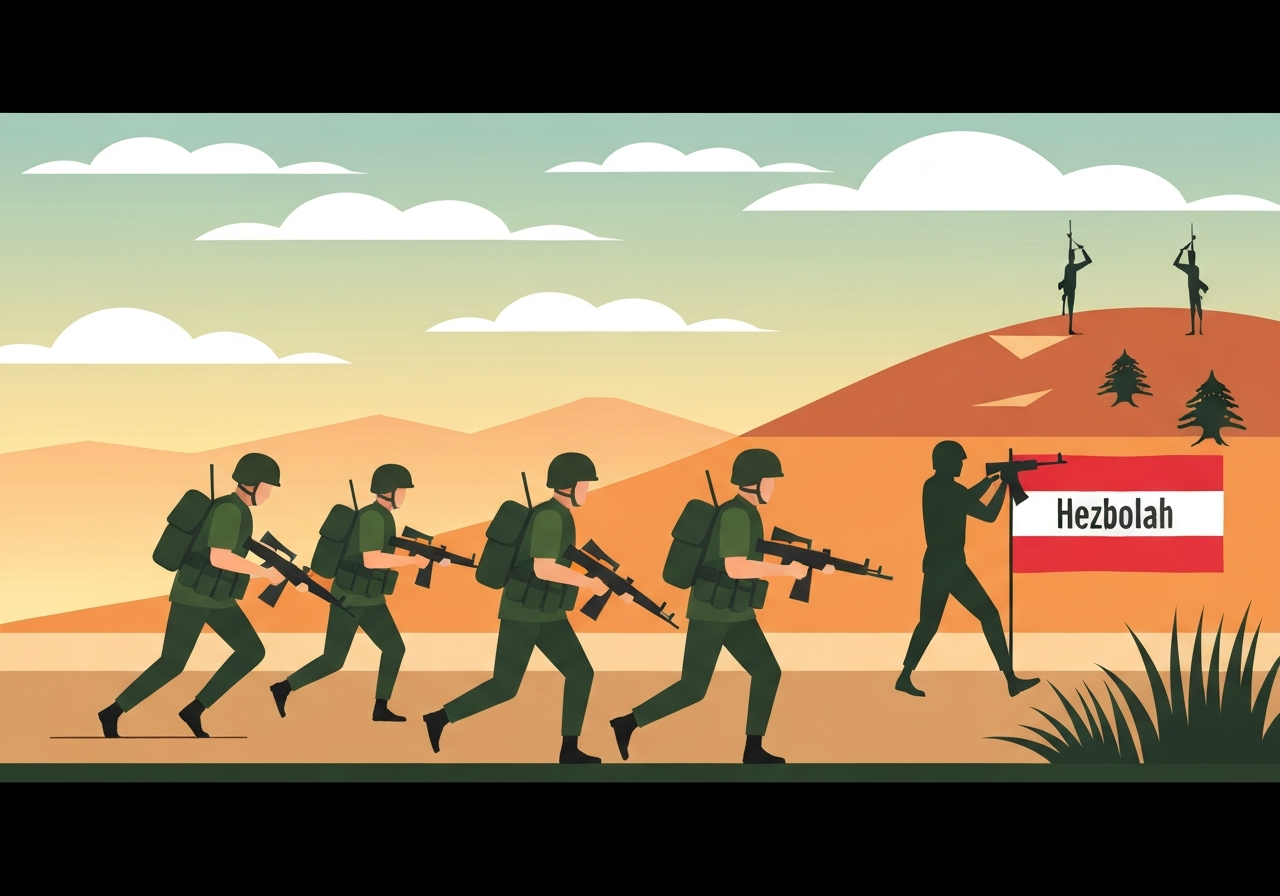
Israel moved troops into southern Lebanon on Tuesday and ordered residents of more than 80 villages to evacuate after Hezbollah launched rockets and drones toward northern Israel. Israel responded with heavy airstrikes that Lebanese officials say killed 50 people, including seven children, and wounded 335; the Health Ministry revised its count several times before listing 50 fatalities. Hezbollah declared it was prepared for an “open war” following the strikes, and the U.N. and aid agencies reported tens of thousands displaced amid cross-border movements into Syria and sheltering inside Lebanon.
Key Takeaways
- Israeli forces entered southern Lebanon on Tuesday and took positions near the border; the military said the moves strengthen forward defenses.
- Lebanese authorities reported 50 people killed in Israeli airstrikes, including seven children, and 335 wounded; the Health Ministry’s toll was adjusted several times.
- Hezbollah fired rockets and drones early Monday toward northern Israel and said it has no option but to respond openly after a year of intermittent strikes.
- UN agencies and Lebanese officials said tens of thousands were displaced; UNHCR reported 30,000 in collective shelters and 10,629 returned to Syria on Monday.
- UNIFIL observers reported Israeli patrols crossing into southern Lebanon and then returning to Israel; the exact number of Israeli soldiers inside Lebanon is unclear.
- Since the Oct. 7, 2023 Hamas attack, cross-border violence has escalated: a broader war flared in September 2024 and a U.S.-brokered ceasefire in November 2024 left lingering hotspots.
Background
Cross-border hostilities between Israel and Hezbollah have periodically intensified since the Hamas-led Oct. 7, 2023 attack on Israel. After months of clashes, a wider confrontation erupted in September 2024 and prompted ground operations in parts of Lebanon. A ceasefire mediated by the United States in November 2024 halted large-scale ground fighting, but both sides have traded near-daily strikes, particularly along the Lebanon–Israel frontier.
Under the ceasefire, Israeli forces withdrew from most of southern Lebanon but maintained a presence at five positions on the Lebanese side of the border, citing security concerns and the need to prevent Hezbollah from re-establishing fortified positions. Lebanon’s government, the U.N. peacekeeping mission (UNIFIL) and local militaries remain key stakeholders, while Iran-backed Hezbollah continues to assert influence across southern Lebanon.
Main Event
Early Monday, Hezbollah fired salvos of rockets and launched drones toward northern Israel, prompting Israeli airstrikes across Lebanon. Lebanese officials reported the most recent air campaign killed 50 people, including seven children, and struck targets in Beirut’s southern suburbs where a Palestinian militant and a Hezbollah intelligence official were among the dead. The Health Ministry’s toll was revised multiple times before the figure settled at 50.
On Tuesday the Israeli military said it had sent additional troops into southern Lebanon and occupied several strategic points close to the border to bolster its forward defense, while Lebanon’s state-run National News Agency reported that the Lebanese army was evacuating some border positions. A Lebanese military source told the Associated Press that Israel had moved into several areas and that the Lebanese army was repositioning; the source spoke on condition of anonymity because of security sensitivities.
UNIFIL later reported seeing Israeli troops cross the border on short forays and then return to Israel, and Israel’s Arabic-language spokesman said the movements add layers to the country’s defensive posture. The duration and scope of the current Israeli presence inside Lebanon remained uncertain, with the Israeli military acknowledging operations in Lebanon but not providing a detailed accounting of forces.
Analysis & Implications
The renewed exchanges mark one of the sharpest escalations since the November 2024 ceasefire, highlighting the fragility of the truce. Hezbollah’s public declaration that it is ready for an “open war” signals a possible shift from low-intensity, calibrated responses to broader operations that could draw in more direct confrontations across the border. That turn risks rapid escalation, complicating efforts by international actors to contain the fighting.
Humanitarian consequences are mounting: tens of thousands have been displaced within Lebanon and thousands more crossed into Syria, straining shelter, medical and logistics capacity. UN agencies warn that sustained cross-border exchanges will increase civilian casualties, disrupt essential services and hamper aid delivery to vulnerable populations, especially in southern Lebanon and border communities.
Politically, the incident pressures regional and Western governments to respond—raising the stakes for mediators such as the United States and neighboring Arab states. Lebanon’s central government faces domestic strain as it navigates between confronting Hezbollah’s military activities and avoiding a wider national confrontation that could devastate the country’s fragile economy and infrastructure.
Comparison & Data
| Metric | Recent figure | Notes |
|---|---|---|
| Deaths in latest strikes | 50 | Includes seven children; count revised multiple times |
| Wounded | 335 | Reported by Lebanese health authorities |
| Displaced in shelters (UN) | 30,000 | UN agencies report collective sheltering |
| Border crossings to Syria (single day) | 10,629 | UNHCR recorded Monday’s crossings |
| Fatalities in Lebanon since ceasefire (before latest attacks) | 397 | Lebanese Health Ministry figure for post-ceasefire strikes |
These figures show both immediate human costs and the accumulated toll since the November 2024 ceasefire. Discrepancies in casualty counts reflect rapid reporting and multiple agencies issuing updates; humanitarian agencies emphasize that numbers are subject to revision as access improves.
Reactions & Quotes
Lebanese political and military actors, regional capitals and international organizations offered swift responses that underscored the diplomatic sensitivity of the incident.
“The Zionist enemy wanted an open war, which it has not stopped since the ceasefire agreement.”
Mohamoud Komati, senior Hezbollah official
The quote came as Hezbollah framed its actions as a response to sustained Israeli pressure; the group said patience had ended after more than a year of intermittent strikes.
“We have moved troops to strengthen our forward defences and create an additional layer of security.”
Avichay Adraee, Israeli military Arabic spokesman (post on X)
Israel presented its troop movements as defensive and layered, but provided limited public detail on the number of personnel operating inside Lebanon. UNIFIL described seeing short-term border crossings by Israeli forces, underscoring the contested nature of frontline movements.
Unconfirmed
- Precise number of Israeli soldiers currently operating inside southern Lebanon—officials reported movements but did not provide an exact troop count.
- Full attribution of every strike site and responsible weapon system remains unsettled pending independent verification and open-source analysis.
- Longer-term intentions of Hezbollah leadership—whether rhetoric indicates a sustained strategy of expanded operations or short-term escalation—are not independently confirmed.
Bottom Line
The latest cross-border exchanges between Israel and Hezbollah risk unraveling a fragile ceasefire that has held since November 2024 but been punctuated by near-daily strikes. Immediate humanitarian impacts—50 dead, hundreds wounded and tens of thousands displaced—underscore the civilian cost of renewed hostilities and the urgency for de-escalation measures.
Diplomats and U.N. actors now face a narrow window to prevent a broader conflagration: international mediation, clearer rules of engagement on both sides and humanitarian access will be critical in the coming days. For residents of southern Lebanon and border communities in Israel, the priority remains safety, shelter and medical aid as the situation evolves.
Sources
- Associated Press — news report (media)
- UNHCR — humanitarian agency situational updates (international organization)
- UNIFIL — U.N. peacekeeping mission statements (official)
- Lebanese Ministry of Public Health — official health ministry reporting (official)