
Lead
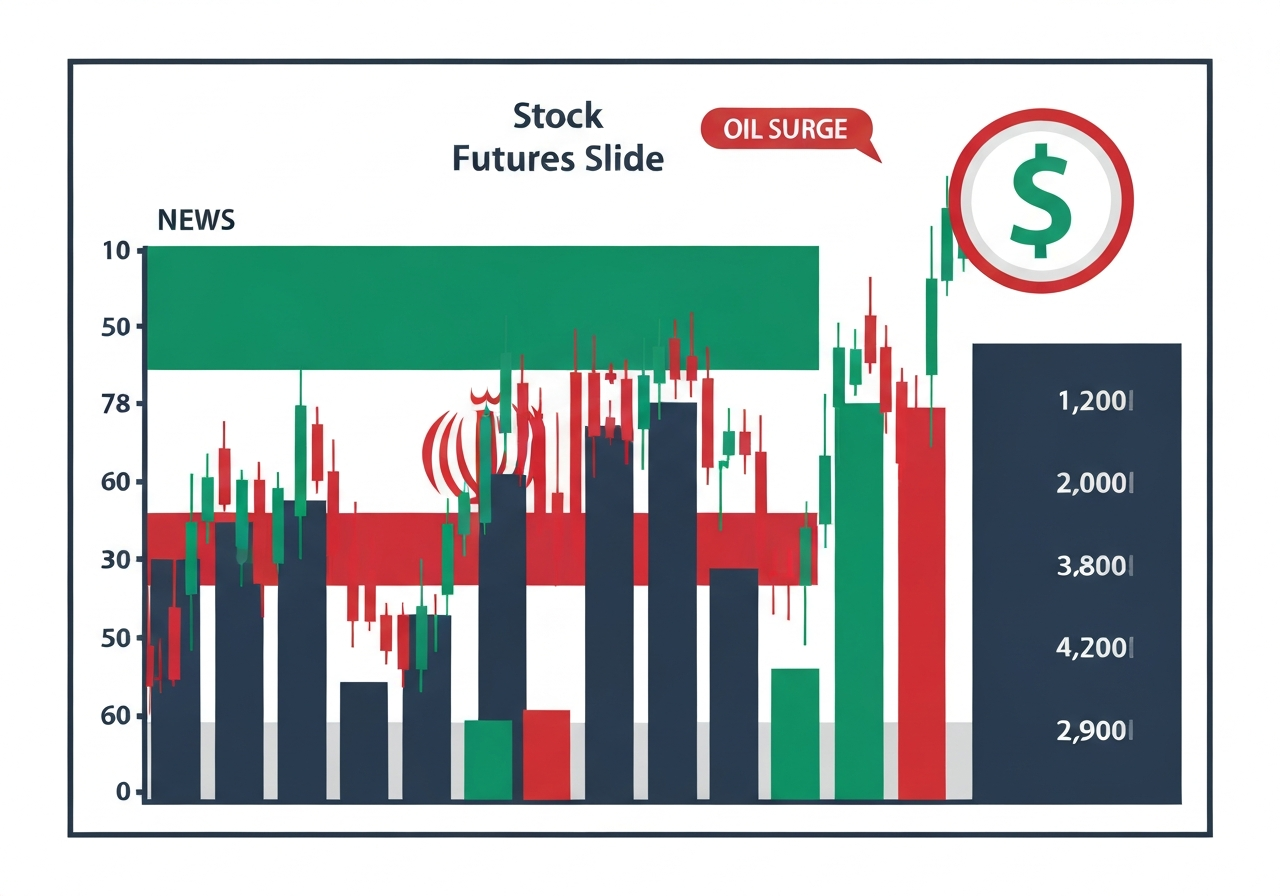
Stock futures opened lower on the evening of March 3, 2026, as investors digested fresh developments in the U.S.-Iran war and a sharp rise in oil prices. Futures tied to the Dow fell about 0.33%, the S&P 500 futures slipped 0.34% and Nasdaq 100 futures lost 0.45%. Major U.S. averages had ended the prior session notably lower — the Dow down roughly 403 points and the S&P 500 off about 0.34% — after intraday volatility driven by geopolitical risk and energy-market moves. Traders are watching incoming economic data and corporate earnings for clues on how policy and profits may respond.
Key Takeaways
- U.S. stock futures declined on Tuesday night: Dow futures -0.33%, S&P 500 futures -0.34%, Nasdaq 100 futures -0.45%.
- Major U.S. indexes closed the prior session in the red: Dow lost ~403 points (about 0.8%), S&P 500 down ~0.34%, Nasdaq Composite down 1%.
- Energy prices jumped: Brent crude settled up 4.71% and WTI rose 4.68% on March 3, 2026, amid shipping disruptions in the Strait of Hormuz.
- President Donald Trump announced U.S. risk insurance for maritime trade through the Persian Gulf to restore tanker movement through the Strait of Hormuz.
- Global spillovers: Dubai and Abu Dhabi benchmarks fell sharply on reopening (Dubai -4.9%, Abu Dhabi >3%), while South Korea’s Kospi plunged over 12% leading to temporary trading halts.
- Economic and market watchers expect ADP private payrolls for February at about 48,000 jobs, up from 22,000 in January.
- Major firms reporting after the bell included Abercrombie & Fitch, Broadcom and Okta; mixed earnings and guidance produced notable after-hours moves in names such as CrowdStrike, Box, GitLab and Ross Stores.
- Institutional forecasts vary: Goldman projects higher near-term inflation under a drawn-out conflict, while UBS maintains a constructive S&P 500 year-end target of 7,700.
Background
The latest market turbulence stems from an intensification of the U.S.-Iran conflict in late February and early March 2026 that disrupted shipping routes and lifted energy-risk premia. The Strait of Hormuz — a chokepoint for global crude flow — saw tanker traffic check as threats and strikes raised insurance and operational concerns. That disruption fed directly into oil futures and prompted policy and market responses across the globe.
U.S. monetary policy considerations are central to investors’ calculus. Higher oil prices can push headline inflation up in the near term and complicate the Federal Reserve’s path toward a 2% inflation objective. Analysts and banks have published scenario analyses quantifying potential CPI impacts if energy shocks persist, and traders now factor those scenarios into asset allocation and rates expectations.
Regional market linkages magnified the move. Gulf markets reopened after multi-day closures following missile and drone strikes; Asian equity markets, particularly South Korea’s, reacted strongly because of local index concentration in technology and export-oriented firms. That combination of geopolitics, energy and market structure has driven cross-border volatility since the conflict escalated.
Main Event
On March 3, 2026, U.S. equities endured a volatile session: the Dow at one point plunged more than 1,200 points before settling down roughly 403 points by the close, and the S&P 500 and Nasdaq Composite also finished in negative territory. Every one of the S&P 500’s 11 sectors closed lower, with materials (-2.7%) and industrials (nearly -2%) among the weakest performers as commodity and cyclical exposure weighed.
President Donald Trump announced that the United States would offer risk insurance for maritime trade transiting the Persian Gulf, aimed at getting tankers moving again through the Strait of Hormuz after threats from the Iranian Revolutionary Guard commander to target ships. The announcement was intended to reduce the immediate shipping stoppage and blunt further oil-supply disruptions.
Energy benchmarks reacted decisively: Brent crude rose 4.71% and West Texas Intermediate climbed 4.68% on March 3, finishing below their session highs but well above prior levels. Rising bunker and freight costs, plus insurance premia for transits, were cited by market participants as amplifiers of crude price moves during the session.
Overseas, UAE exchanges reopened after a two-day closure tied to regional strikes; Dubai’s index fell about 4.9% intraday and Abu Dhabi’s main gauge lost more than 3%. In Asia, South Korea’s Kospi plunged over 12% on March 4, 2026, prompting the Korea Exchange to suspend trading temporarily and triggering a circuit breaker on the Kosdaq, reflecting concentrated losses among large-cap exporters and chip makers.
Analysis & Implications
The immediate market implication is elevated risk premia across equities and commodities. When oil jumps nearly 5% intraday, it tightens corporate margins for energy-intensive sectors and raises inflation expectations, which in turn can pressure interest-rate-sensitive assets. Short-term volatility is likely to persist until shipping routes and risk-management measures stabilize.
Policy reactions will matter. If the conflict remains limited and insurance measures restore tanker flows, energy premia should ease and central banks may view the price shock as transitory. However, a protracted disruption would feed into headline inflation measures and could force the Federal Reserve to reassess its policy stance, complicating the path for rate accommodation or cuts later in the year.
Global contagion is also asymmetric. Markets with high concentrations in cyclical or export-sensitive sectors — such as South Korea’s chip-dominated Kospi — are particularly vulnerable to risk-off waves. Conversely, firms with pricing power or defensive cash flows may outperform in this environment, explaining some tactical buying opportunities that long-term investors and wealth managers are flagging.
Strategic forecasts diverge: Goldman Sachs’ note projects a rise in headline CPI to 2.7% in May under a baseline energy shock and to 3% under a more persistent scenario, while UBS retains a bullish S&P 500 year-end target of 7,700, signaling that major wealth managers still see upside in equities if supply disruptions prove brief. The variation underscores how market outcomes hinge critically on the duration and depth of the energy disruption.
Comparison & Data
| Instrument | Move (March 3 close / futures) |
|---|---|
| Dow Jones Industrial Average | Closed down ~403 pts (-0.8%); futures -0.33% |
| S&P 500 | Closed ~-0.34%; futures -0.34% |
| Nasdaq Composite | Closed -1.0%; Nasdaq 100 futures -0.45% |
| Brent crude | Settled +4.71% |
| WTI crude | Settled +4.68% |
| Dubai index | Reopened: down ~4.9% |
| Kospi | Plunged >12% (trading halted) |
The table highlights how equity futures slid in line with U.S. cash-market losses while oil futures surged nearly 5%, signaling a strong correlation between geopolitical supply risk and equity volatility on March 3–4, 2026. Regional markets reacted more sharply in places with concentrated sector risk or direct geopolitical exposure.
Reactions & Quotes
Market strategists and officials framed the moves differently depending on their focus: some emphasized the insurance measures and potential for a quick normalization of flows; others warned that inflation and supply-chain effects could linger.
“Amid all the noise we might be seeing some opportunities start to emerge for longer-term investors, especially if energy prices stabilize and moderate in days and weeks ahead.”
James McCann, Senior Economist, Edward Jones
Edward Jones’ economist highlighted the potential for selective buying if energy markets calm, reflecting a longer-term investment lens rather than short-term trading signals.
“A more persistent oil shock would take headline CPI to 3% in May and keep inflation elevated relative to our baseline for the rest of the year.”
Goldman Sachs economists (research note)
Goldman’s research note underscored the inflationary risk of a drawn-out conflict, a central consideration for policy makers and fixed-income markets.
Unconfirmed
- Whether the U.S. risk-insurance program will immediately restore normal tanker traffic through the Strait of Hormuz is not yet fully verifiable; maritime operators will weigh cost and security considerations in coming days.
- The length and intensity of the U.S.-Iran conflict, and therefore the duration of elevated oil prices, remain uncertain and depend on future military and diplomatic developments.
- Predicted macro outcomes—such as the exact peak in CPI or the timing of central-bank responses—are model-dependent and subject to revision as new data arrive.
Bottom Line
Geopolitical escalation in the Middle East has translated into clear market moves: energy prices surged and equities dropped on March 3–4, 2026, with futures reflecting continued caution into the evening. The near-term path for markets hinges on whether shipping through the Strait of Hormuz can be secured and whether energy-price pressure proves transitory or persistent.
Investors should watch incoming economic data, including the ADP private payrolls print and upcoming corporate earnings, as these will influence how participants and policymakers interpret the shock. Diversified positioning and scenario planning — rather than single-point forecasts — remain prudent while uncertainty about the conflict’s trajectory persists.