
Lead
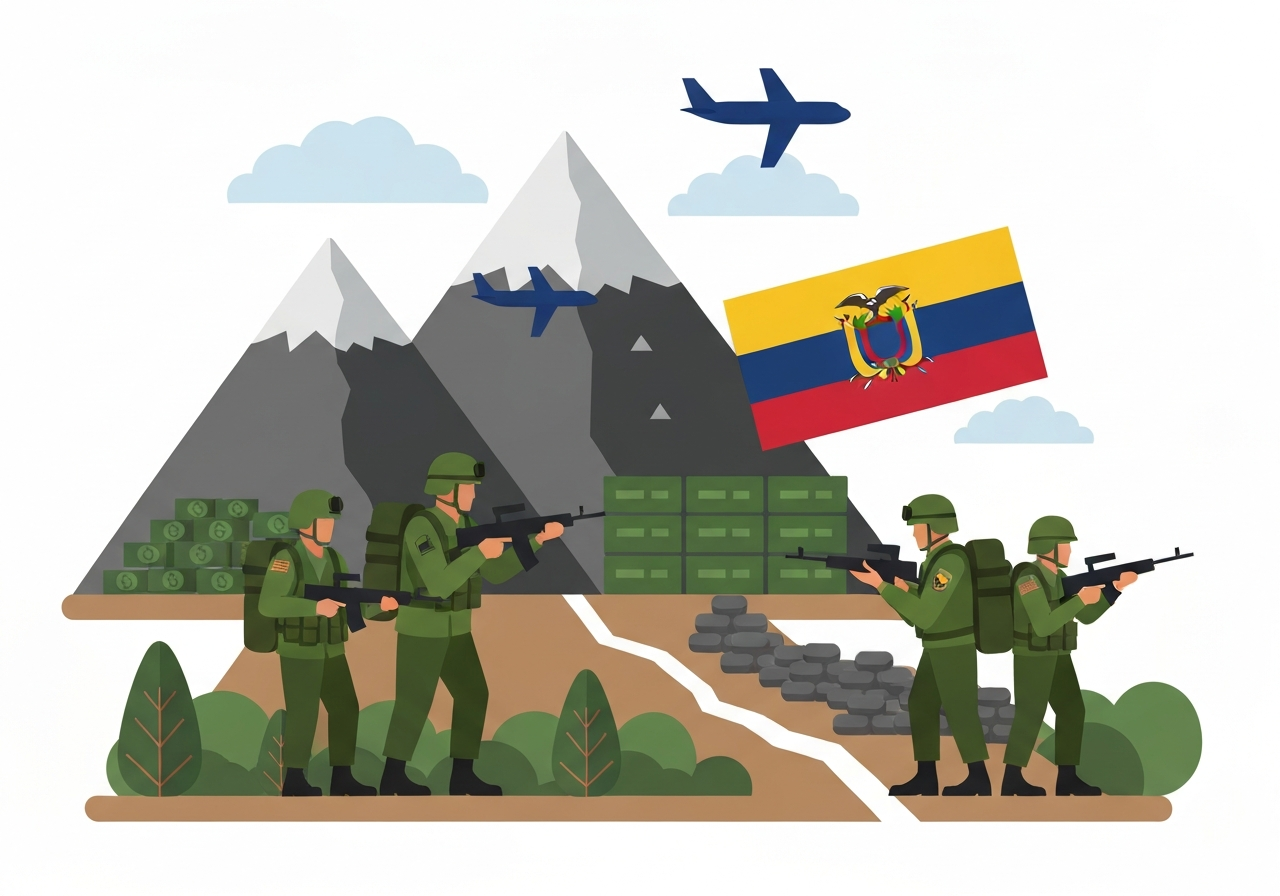
On Tuesday, US and Ecuadorian forces began coordinated operations aimed at disrupting drug-smuggling networks operating through Ecuador’s ports and airports, Southern Command said. The announcement, made by US Southern Command and acknowledged by Ecuador’s defense ministry, offered few operational details because offensive plans were classified. The move follows Ecuador’s statement that Washington has entered a “new phase” in its campaign against cartels. Ecuadorian President Daniel Noboa said regional partners, including the United States, were involved in efforts to counter trafficking routes used to move cocaine to international markets.
Key Takeaways
- US Southern Command said the joint action was “decisive” and directed at illicit drug trafficking across Ecuador’s transit points.
- Southern Command’s area of responsibility covers 31 countries in South and Central America and the Caribbean.
- Ecuador’s defense ministry confirmed the operation but classified operational details, citing security concerns.
- President Daniel Noboa met with US Southern Command chief Francis Donovan and US Special Operations head Mark Schafer before the operation was announced.
- About 70% of cocaine produced in Colombia and Peru is estimated to transit through Ecuador en route to international markets.
- The operation follows a period of intensified US-Ecuador security cooperation since Noboa took office in 2023.
- The United States temporarily deployed air force personnel to the former Manta base in December as part of prior cooperation steps.
Background
Over the past several years Ecuador has shifted from being one of Latin America’s safer countries to a nation grappling with violent clashes driven in large part by organized criminal groups. Cartels have exploited Ecuador’s extensive coastline and port infrastructure to move shipments, turning transit hubs into focal points for smuggling. Neighbouring Colombia and Peru remain the world’s largest and second-largest cocaine producers, and a large share of that output moves through Ecuador before reaching overseas markets.
Since President Daniel Noboa assumed office in 2023, Quito has pursued closer security ties with Washington, seeking support to counter increasingly organized and well-armed trafficking networks. Efforts at cooperation have included talks on intelligence-sharing, port and airport security, and limited US deployments to Ecuadoran facilities. Public opinion in Ecuador, however, remains divided over the presence and role of foreign military forces on national soil, a sentiment reflected in a November referendum that rejected lifting a ban on foreign bases.
Main Event
The US Southern Command announced on Tuesday that it had joined Ecuadorian forces in a coordinated operation targeting illicit drug trafficking. The statement called the action “decisive” but did not disclose the timing, locations, or units involved; Ecuador’s defense ministry similarly said operational specifics would remain classified. Officials in Quito described the operation as a continuation of recently expanded bilateral security cooperation, emphasizing coordination at airports, seaports and information sharing.
President Noboa met in Quito with Francis Donovan, the head of US Southern Command, and Mark Schafer, commander of US Special Operations in the region, days before the public announcement. According to Noboa’s office, discussions focused on sharing intelligence and streamlining operational coordination at key transit points; the meeting preceded the joint action. Ecuadorian officials have framed the initiative as part of a broader regional effort to disrupt trafficking networks that use Ecuador’s ports to forward shipments of cocaine to global markets.
Washington also confirmed prior steps in the partnership: a temporary US air force deployment to the former Manta base in the port city of Manta was announced in December, reflecting tighter operational ties. Quito had earlier sought to reopen a previously shuttered US base, but a national referendum in November rejected reversing the ban on foreign military bases. Ecuadorian authorities stress that current cooperation is structured to respect national sovereignty while enhancing interdiction capacity.
Analysis & Implications
The joint operation signals a tactical intensification in counter-narcotics work, but its strategic impact will depend on sustained intelligence sharing and the ability to translate interdictions into long-term disruption of cartel networks. Short-term raids or seizures can be disruptive, yet trafficking organizations have historically adapted by shifting routes, corrupting officials, or fragmenting operations into smaller, harder-to-detect shipments. For Ecuador, strengthening port and airport screening, paired with improved prosecutorial capacity, will be essential to convert operational gains into lasting reductions in trafficking.
Regionally, closer US-Ecuador cooperation could encourage neighboring states to deepen partnerships with Washington, creating broader pressure on supply chains running from production zones in Colombia and Peru to international destinations. However, political sensitivity around foreign military involvement remains acute. The November referendum rejecting foreign bases illustrates domestic limits; Quito must balance operational effectiveness with public concerns about sovereignty and foreign presence.
Economically, a sustained campaign that interrupts major trafficking flows could alter illicit revenue streams that currently fuel violence and corruption, but it may also prompt short-term escalation as groups contest control over lucrative corridors. Internationally, destination-country enforcement and demand reduction remain crucial complements to interdiction; without reduced demand in consuming markets, supply-side pressure alone is unlikely to end trafficking networks.
Comparison & Data
| Measure | Detail |
|---|---|
| Southern Command coverage | 31 countries in South & Central America and the Caribbean |
| Colombia & Peru cocaine transit | Approximately 70% of their production transits through Ecuador |
| Recent US presence | Temporary air force deployment to Manta announced in December |
The table highlights three concrete data points cited by officials and reporting: the geographical remit of US Southern Command, the high proportion of Andean cocaine shipments that pass through Ecuador, and prior US deployments demonstrating tighter operational ties. These figures help explain why Ecuador has become a focal point for interdiction efforts and why Washington views partnership with Quito as strategically important for regional counter-narcotics objectives.
Reactions & Quotes
Officials framed the operation as necessary to counter well-developed smuggling networks while withholding tactical details for security reasons.
“This decisive action is intended to disrupt illicit drug trafficking in the region,”
US Southern Command (official statement)
Southern Command’s wording emphasized purpose without offering operational specifics. Quito’s defense ministry reiterated the classification of offensive details, citing operational security and the need to protect ongoing efforts.
“Operational details are classified to preserve the effectiveness and safety of missions,”
Ecuador Defense Ministry (official statement)
President Noboa characterized the initiative as a regional collaboration. He stressed the role of partners in addressing cartels that exploit Ecuador’s ports to move cocaine abroad.
“Regional allies, including the United States, are taking part in operations against cartels using our ports,”
President Daniel Noboa (office statement)
Unconfirmed
- Precise locations, timelines, and unit identities for the joint operations have not been disclosed and remain unconfirmed.
- There is no publicly confirmed figure on seizures, arrests, or casualties tied to the operation as of the announcement.
- Details on the legal framework governing US personnel operations in Ecuador (rules of engagement, command relationships) have not been published.
- Whether the operation will include sustained deployments beyond temporary rotations has not been confirmed by either government.
Bottom Line
The public announcement of a coordinated US-Ecuador operation marks a clear escalation in bilateral counter-narcotics activity and reflects Quito’s pivot toward deeper security cooperation since 2023. While the partnership can enhance Ecuador’s capacity to interdict shipments that pass through its ports, classified operational details and the lack of publicly available results make it too early to assess the campaign’s effectiveness.
Longer-term success will depend on sustained intelligence exchange, stronger judicial follow-through, and measures to reduce corruption and alternative trafficking routes. Domestic sensitivities about foreign military involvement mean Quito must manage public scrutiny even as it seeks outside support to tackle powerful and adaptable criminal networks.
Sources
- The Guardian — media report summarizing official statements and regional context
- US Southern Command (Southcom) — official military website (official/agency)
- Ecuador Ministry of National Defense — official government site (official/agency)