
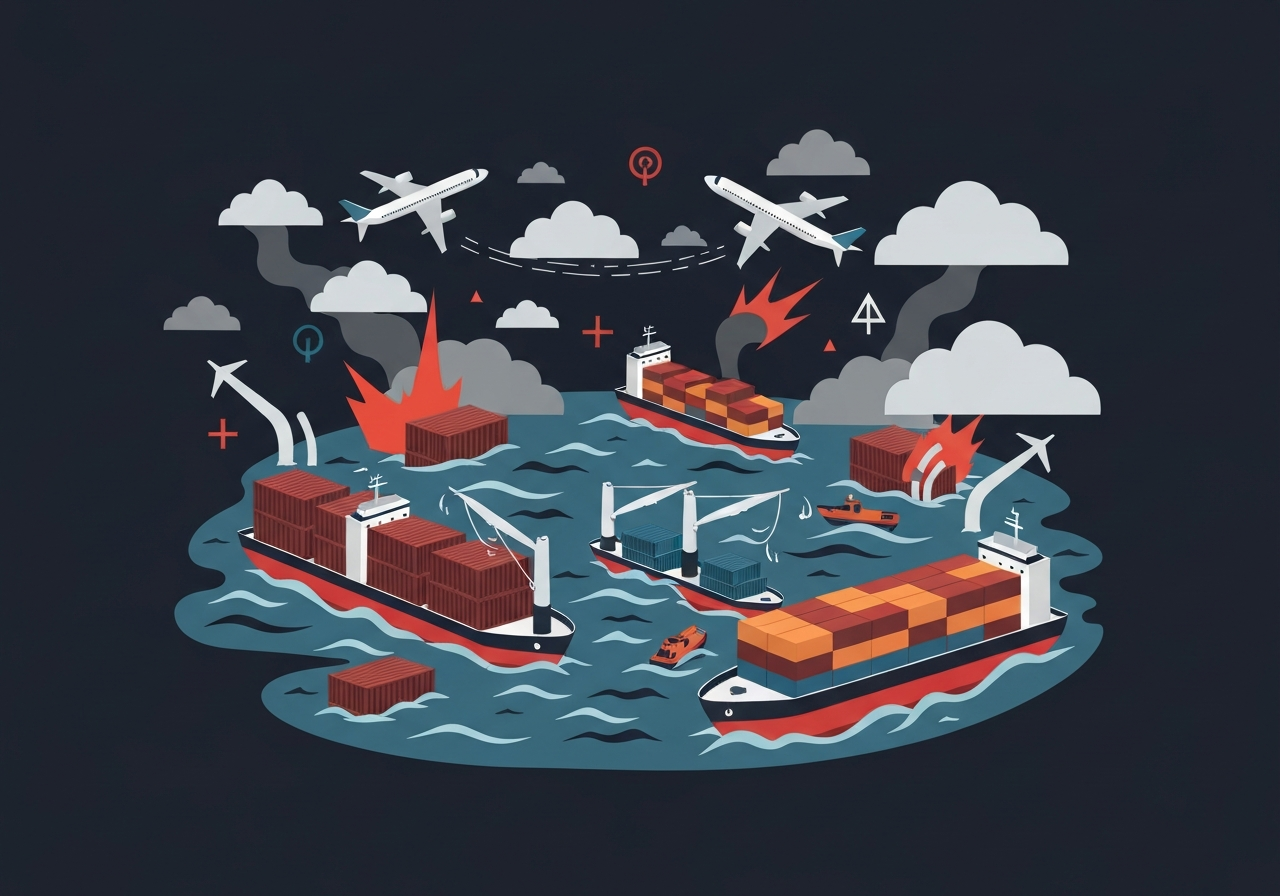
Lead: The conflict in and around Iran has effectively stopped oil tanker traffic through the Strait of Hormuz and is rippling across global freight networks beyond crude oil. Since the weekend outbreak of hostilities, hundreds of ships have been idled or rerouted, and major Middle Eastern air hubs have closed, stranding high-value and time-sensitive cargo. These disruptions are delaying pharmaceuticals from India, semiconductors and batteries from Asia, and oil-derived products such as nitrogen fertilizers from the Middle East. Analysts warn that continued instability will raise costs and create shortages across a broad range of goods.
Key Takeaways
- About 3,200 ships are idle inside the Persian Gulf, roughly 4% of global tonnage; roughly 1,231 of those vessels primarily operate within the Gulf region.
- Approximately 500 ships are waiting outside the Gulf near UAE and Oman ports, equal to about 1% of global tonnage, according to Clarkson Research data.
- Rerouting around the Cape of Good Hope adds an estimated 10–14 days and about $1 million in extra fuel per ship, increasing overall freight costs.
- Closed airspace and airports across UAE, Qatar, Bahrain, Kuwait, Iraq and Iran have grounded cargo flights, reducing airlift capacity for high-value and perishable goods.
- Air freight accounts for less than 1% of global freight by weight but roughly 35% of world trade value, concentrating risk on pharmaceuticals, electronics and fresh produce.
- Marine insurers have been canceling policies or raising premiums in the region; the U.S. has proposed political risk insurance and warned of naval escorts if needed.
- Shippers are adding fuel and war-risk surcharges, and airlines are reviewing potential war-risk fees, which will push up prices for consumers and businesses.
- Industry players say the logistics sector is accustomed to disruption, but the scale and simultaneity of current risks are unprecedented.
Background
The Strait of Hormuz is a chokepoint for roughly 20% of the world’s seaborne oil; when it becomes unsafe, vessels either wait in nearby waters or take alternate, much longer routes. The Middle East is also a major producer of natural gas–derived petrochemical feedstocks and nitrogen fertilizers, linking the region’s security directly to global commodity and agri-input supplies. Over recent years the Red Sea and the Suez Canal have also been intermittently threatened by Houthi attacks, prompting transits to resume and pause in waves and complicating routing decisions for container lines.
Major carriers and forwarders route a large share of Asia–Europe and Asia–Americas trade through Middle Eastern hubs and sea lanes for speed and fuel efficiency. Middle Eastern airlines — including Emirates, Qatar Airways and Etihad — operate dedicated freighters plus belly capacity on passenger flights, making regional airports critical nodes for time-sensitive cargo from India and Southeast Asia. When those hubs close, shippers must find overland or much longer air/sea alternatives, increasing transit times, handling, and cost.
Main Event
Shipping-tracking firm Clarkson Research estimates around 3,200 ships idle inside the Persian Gulf; about 500 additional vessels are waiting off the coasts of the UAE and Oman. Some of those idle ships are local coastal vessels, but the accumulation has already tightened berths and created knock-on congestion in ports beyond the Gulf. Carriers and terminals are recalibrating schedules as berthing windows shift and container stacks age at origin and destination terminals.
Several major container lines, including Maersk, announced rerouting of Red Sea and Suez transits via the Cape of Good Hope to avoid contested waters. That reroute increases voyage time by 10–14 days and raises fuel consumption substantially: Syracuse University supply chain expert Patrick Penfield estimates roughly $1 million extra fuel per ship for the longer passage, a cost many operators are pushing onto customers through surcharges.
Airspace closures across Gulf states have grounded freighters and curtailed belly capacity on passenger services, reducing available lift for pharmaceuticals, electronics and perishables. Industry forecasts and airline updates indicate upward pressure on air freight rates as capacity tightens and demand for reroutes grows. Airlines and forwarders are also evaluating ‘war risk’ surcharges to cover higher insurance and operational costs.
On the diplomatic and security front, the U.S. administration has said it will offer political risk insurance through the International Development Finance Corp. for tankers and other vessels transiting the Persian Gulf, and signaled that the U.S. Navy stands ready to escort ships if necessary. The Navy currently has at least eight destroyers and three littoral combat ships in the region, ships that have escorted merchant vessels in previous crises.
Analysis & Implications
The immediate effect is flow constraint: fewer ships and aircraft serving the same demand raise lead times and inventory stress across retailers, manufacturers and agriculture supply chains. For industries that rely on just-in-time deliveries — notably electronics assembly and some pharmaceutical supply lines — even small delays can cascade into production stoppages or costly last-minute sourcing changes. Companies with thin inventories and long supplier lead times are most vulnerable.
Price effects will be uneven but meaningful. Added voyage days and higher fuel consumption translate directly into higher freight rates; combined with war-risk surcharges and insurance spikes, importers face substantial cost increases. For fertilizers and petrochemical feedstocks, those cost rises can feed into agricultural input prices and, eventually, food prices in importing countries. For electronics, shortages of chips or batteries caused by delayed shipments could slow device production and push pricing higher for finished goods.
Geopolitical risk is also reshaping routing and sourcing decisions. Firms may accelerate diversification away from single-route dependence, increasing demand for alternative ports, rail corridors and nearshoring options. That shift can reduce exposure over time but requires capital and time to implement — leaving businesses exposed in the near term. The insurance industry’s reactions — policy cancellations or steep rate hikes — further complicate transport economics and decision-making for shippers.
Longer-term, persistent instability could prompt structural changes in global trade patterns: increased investment in multimodal corridors, a rise in inventory buffers for critical goods, and more regionalized manufacturing for sensitive sectors. However, those adaptations take months to years and will not prevent immediate price shocks or shortages if the conflict endures.
Comparison & Data
| Metric | Reported Figure |
|---|---|
| Ships idle inside Persian Gulf | ~3,200 (≈4% global tonnage) |
| Ships primarily operating within Gulf | ~1,231 |
| Vessels waiting outside Gulf ports | ~500 (≈1% global tonnage) |
| Added transit time via Cape of Good Hope | 10–14 days |
| Estimated extra fuel cost per ship | ~$1 million |
The table above summarizes reported shipping congestion and reroute metrics from tracking and industry sources. While percentage shares may appear small relative to total global tonnage, maritime logistics operate on tight schedules; a localized bottleneck can propagate delays across continents as containers miss planned sailings and airlift capacity is reduced. Freight rate indices and bunker fuel price movements will be early indicators of how costs are translating into market prices.
Reactions & Quotes
Industry and policy voices have emphasized both the immediate pain and the resilience of logistics networks:
Before the quote below, supply-chain scholar Patrick Penfield underscored expected supply and price pressure if disruptions persist.
“This is really causing some major impacts within the global supply chain. As this conflict keeps progressing, you’ll start to see some shortages, you’ll see some major price increases.”
Patrick Penfield, Syracuse University (supply chain practice)
Afterward, analysts noted that shortages and price rises will vary by product category and inventory buffers.
CARU Containers’ North America general manager Michael Goldman warned of cascading effects from localized port disruption.
“The supply chain is kind of like a long train … if one car gets derailed, it can very often have a domino effect.”
Michael Goldman, CARU Containers (logistics operator)
Following that quote, logistics managers explained they are prioritizing critical cargo while negotiating surcharges with clients. Separately, an airline analyst highlighted the stakes for pharmaceutical exports from India and passenger connectivity to the subcontinent, noting route and fuel-stop adjustments are likely.
Unconfirmed
- Extent of long-term naval escort operations: U.S. statements indicate readiness to escort, but the duration and scope of any sustained escort program remain unclear.
- Precise cargo composition of all idled vessels: publicly available tallies report counts and tonnage but do not enumerate specific high-risk commodity mixes for each ship.
- Full insurer reactions over the coming weeks: some carriers have already adjusted coverage, but the breadth of policy cancellations or permanent premium hikes is still developing.
Bottom Line
The Iran conflict has moved beyond a regional energy crisis into a broader logistics shock that touches ocean and air freight, with immediate impacts on transit times, insurance costs and freight rates. Even relatively small percentages of global tonnage taken offline can trigger cascading delays and congestion because modern supply chains operate with low slack and tight scheduling. Businesses importing time-sensitive or high-value goods should assume higher transit costs and prepare contingency plans.
Near-term relief depends on rapid de-escalation and the re-opening of key sea lanes and airspaces; absent that, expect phased responses including higher prices for fertilizers and petrochemicals, constrained airlift for pharmaceuticals and electronics, and gradual strategic shifts toward route diversification and inventory buffers. Policymakers and shippers will need to balance short-term crisis measures—such as naval escorts or temporary insurance schemes—with longer-term resilience investments in supply-chain architecture.
Sources
- Associated Press (news report)
- Clarksons Research (shipping analytics)
- Maersk operational updates (carrier advisory)
- Boeing World Air Cargo Forecast (industry forecast)
- Syracuse University (academic commentary from Patrick Penfield)