
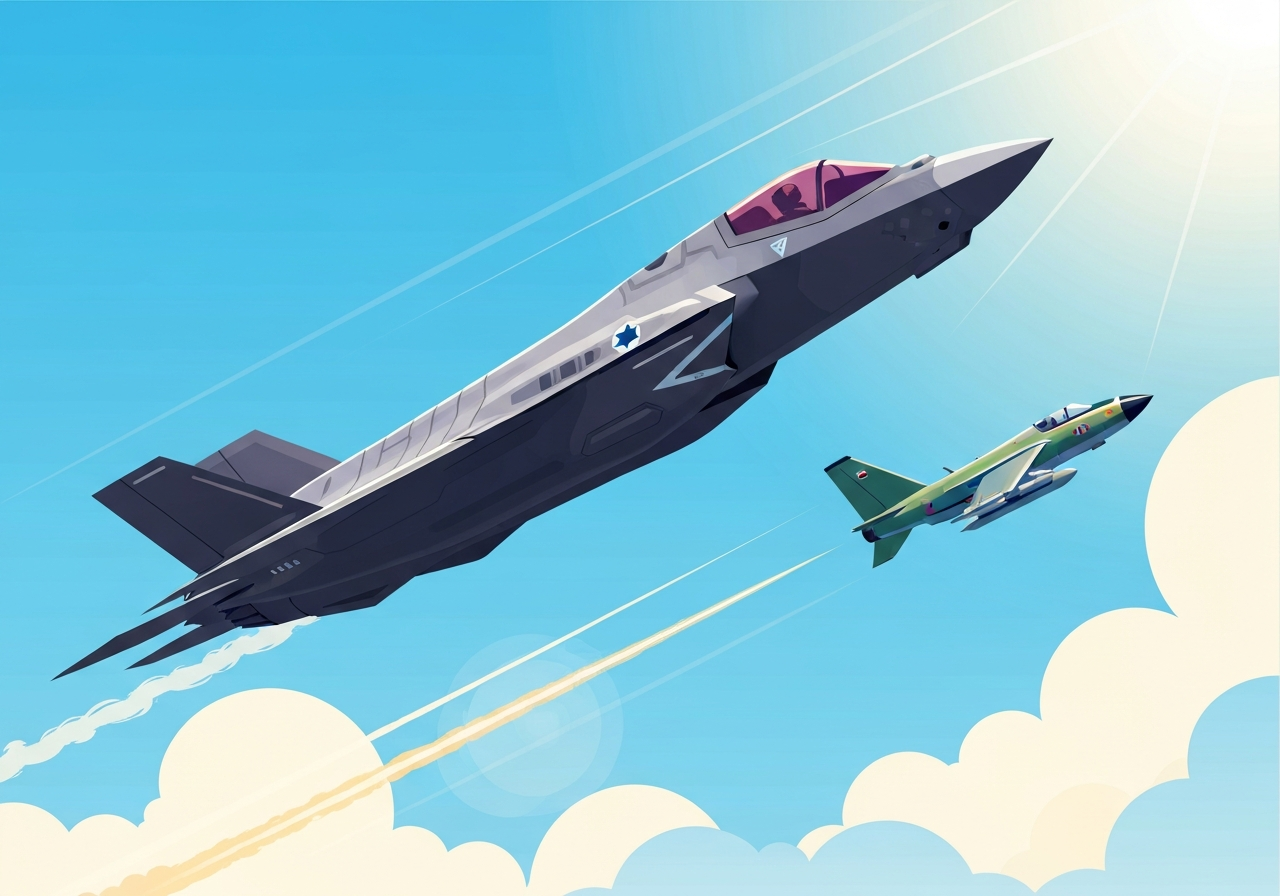
Lead: On March 4, 2026, at about 10:30 a.m., the Israel Defense Forces (IDF) announced that an Israeli F-35I Adir shot down an Iranian Yakovlev Yak-130 over Iranian airspace, marking the first confirmed manned air-to-air kill by an F-35 in this conflict. The engagement followed earlier IDF strikes that targeted Iranian fighters on the ground, and the military said the action reinforced Israeli and allied aerial superiority near Tehran. British RAF F-35B jets separately recorded the downing of an Iranian drone over Jordan the same period, in what the UK called its first combat kill by an F-35. Officials characterize the episode as a notable escalation in aerial combat during the campaign.
Key Takeaways
- The IDF reported the Israeli F-35I downed a Russian-made Yak-130 at 10:30 a.m. on March 4, 2026, the first confirmed F-35 air-to-air kill in the war.
- The Yak-130 is a 1990s-era advanced jet trainer that can be armed for light-attack roles; Iran fields these alongside older F-4 and F-5 fighters.
- The IDF says strikes on dozens of Iranian air-defence sites during Operation Roaring Lion strengthened Israeli aerial freedom near Tehran.
- Separately, RAF F-35B aircraft shot down an Iranian unmanned aerial vehicle over Jordan — the UK described it as the RAF F-35’s first operational kill.
- This is the first Israeli air-to-air shootdown since November 24, 1985, when an IAF F-15 downed two Syrian MiG-23s over Lebanon.
- The combined actions underscore Israel and coalition efforts to achieve local air superiority and to limit Iranian aircraft from complicating drone and close-range operations.
Background
The Yakovlev Yak-130 entered production in the 1990s as an advanced training platform for pilots destined for higher-end Russian fighters such as the Su-57, but it can carry weapons and perform light-attack missions. Iran has operated a mixed inventory that includes legacy U.S.-origin F-4 and F-5 jets, which are largely outclassed by modern Western fighters, and a limited number of more capable or domestically modified types. The presence of even moderately capable manned fighters can complicate drone-centric operations and require coalition forces to adjust tactics around contested airspace.
Since the opening days of the campaign, Israeli and partnered forces have prioritized neutralizing Iranian air-defence networks and suppressing airborne threats to enable persistent, near-target sensor and strike platforms. Israeli statements describe a campaign designed to maintain a persistent aerial envelope near Tehran, allowing stand-in attack aircraft and drones to operate with reduced risk. The shootdown marks a new chapter: a manned, aerial engagement between advanced stealth fighters and an adversary’s combat trainer configured for attack.
Main Event
According to the IDF announcement at 10:30 a.m. on March 4, 2026, an Israeli F-35I engaged and downed an Iranian Yak-130 in what the military called the conflict’s first fighter-jet dogfight. The IDF said the strike occurred amid broader operations targeting Iranian airfields and air-defence sites, part of a campaign the military named Operation Roaring Lion. Exact tactical details — ranges, altitude, weapons employed — were not fully disclosed in the initial statement.
Earlier in the week, the IDF reported strikes on Iranian fighters on the ground. On the preceding Sunday, two Iranian jets — identified in reporting as an F-4 and an F-5 — were struck on the runway while preparing for takeoff. The operations were described as preemptive moves to limit Iran’s ability to project manned air power in the theatre.
British forces also recorded an aerial intercept in the same timeframe: RAF F-35B jets shot down an Iranian drone over Jordan, which the United Kingdom characterized as the first operational kill by an RAF F-35. The RAF additionally used a Typhoon to intercept hostile drones in Iraqi airspace, signaling multi-national engagement patterns to suppress Iranian unmanned and manned threats.
Analysis & Implications
The confirmed shootdown carries several operational and symbolic implications. Operationally, achieving an air-to-air kill with an F-35 validates the platform’s sensors, datalinks and weapons integration in contested environments; it also signals that coalition pilots can achieve kinetic effects against agile targets despite stealth doctrines tailored primarily for strike and survivability. Symbolically, the episode marks the first reported manned dogfight of the campaign and the first recorded F-35 air-to-air kill in combat, which could influence perceptions of the jet’s role beyond strike missions.
Strategically, removing Iranian manned fighters from play reduces the risk they pose to drones and forward assets, easing close-range “stand-in” attack operations. It also constrains Tehran’s options for escalating via conventional air sorties, forcing reliance on long-range missiles, drones, or proxies. For Israel and partners, maintaining local air superiority helps protect logistics, reconnaissance and strike corridors, but it may also raise the stakes if Tehran pursues asymmetric counters.
Regionally, the incident may prompt adjustments in air-defence postures across neighboring states and accelerate allied efforts to deny Iranian aircraft sanctuary. Politically, the shootdown may be used domestically by involved states to demonstrate capability and resolve, while complicating diplomatic pathways for de-escalation. Over the medium term, lessons learned about F-35 employment in air-to-air scenarios could affect procurement priorities and rules of engagement among allied air forces.
Comparison & Data
| Aircraft | Origin | Primary Role | Notes |
|---|---|---|---|
| F-35I Adir | United States / Israel-modified | Stealth multirole fighter | Stealth sensors; first confirmed F-35 air-to-air kill in this war |
| Yak-130 | Russia | Advanced jet trainer / light attack | 1990s production; can be armed for combat missions |
| F-4 / F-5 | United States (legacy) | Cold-war era fighters | Reportedly antiquated relative to regional modern fighters |
The table contextualizes the platforms involved: the F-35 is a fifth-generation stealth multirole design optimized for integrated sensor use, while the Yak-130 is primarily a trainer with secondary attack capability. Older F-4 and F-5 fighters remain in Iran’s inventory but are generally considered less capable in contested airspace compared with modern Western aircraft.
Reactions & Quotes
The IDF framed the incident as part of its broader campaign to deny Iran freedom of action in the air.
“An Israeli F-35I engaged and downed an Iranian Yak-130,”
Israel Defense Forces (IDF) — official statement
The United Kingdom reported its own F-35B engagement against an Iranian drone and described the event as a milestone for RAF operations.
“This marks the first time an RAF F-35 has destroyed a target on operations,”
United Kingdom Ministry of Defence — official remark
External analysts note practical and reputational effects from a confirmed F-35 air-to-air kill, while urging caution about drawing broad technical conclusions from a single engagement.
“A single air-to-air engagement does not redefine a platform’s mission set, but it does demonstrate system integration and pilot proficiency under combat conditions,”
Independent defence analyst
Unconfirmed
- Precise weapons and engagement ranges used by the F-35 in the Yak-130 shootdown have not been publicly disclosed and remain unverified.
- The arming status and mission intent (trainer flight vs. combat sortie) of the Yak-130 at the time of engagement have not been independently confirmed.
- Detailed casualty information for the Yak-130 crew, if any, has not been released by official sources at the time of reporting.
Bottom Line
The March 4, 2026 shootdown marks both a tactical and symbolic moment: tactically, it reduces the presence of Iranian manned fighters that could threaten drones and forward assets; symbolically, it records the first confirmed F-35 air-to-air kill in the campaign. While the engagement underscores coalition capability to project and defend airspace, public details remain limited, leaving key tactical questions unanswered.
Going forward, expect continued operations to suppress Iranian air-defence and aviation assets to preserve air superiority near Tehran, alongside diplomatic friction. Analysts and militaries will scrutinize this engagement for lessons on employing stealth platforms in contested, multi-domain environments; the outcome could influence operational doctrine and political messaging in the weeks ahead.
Sources
- The Jerusalem Post — news outlet; original report including IDF statements and operational context.