
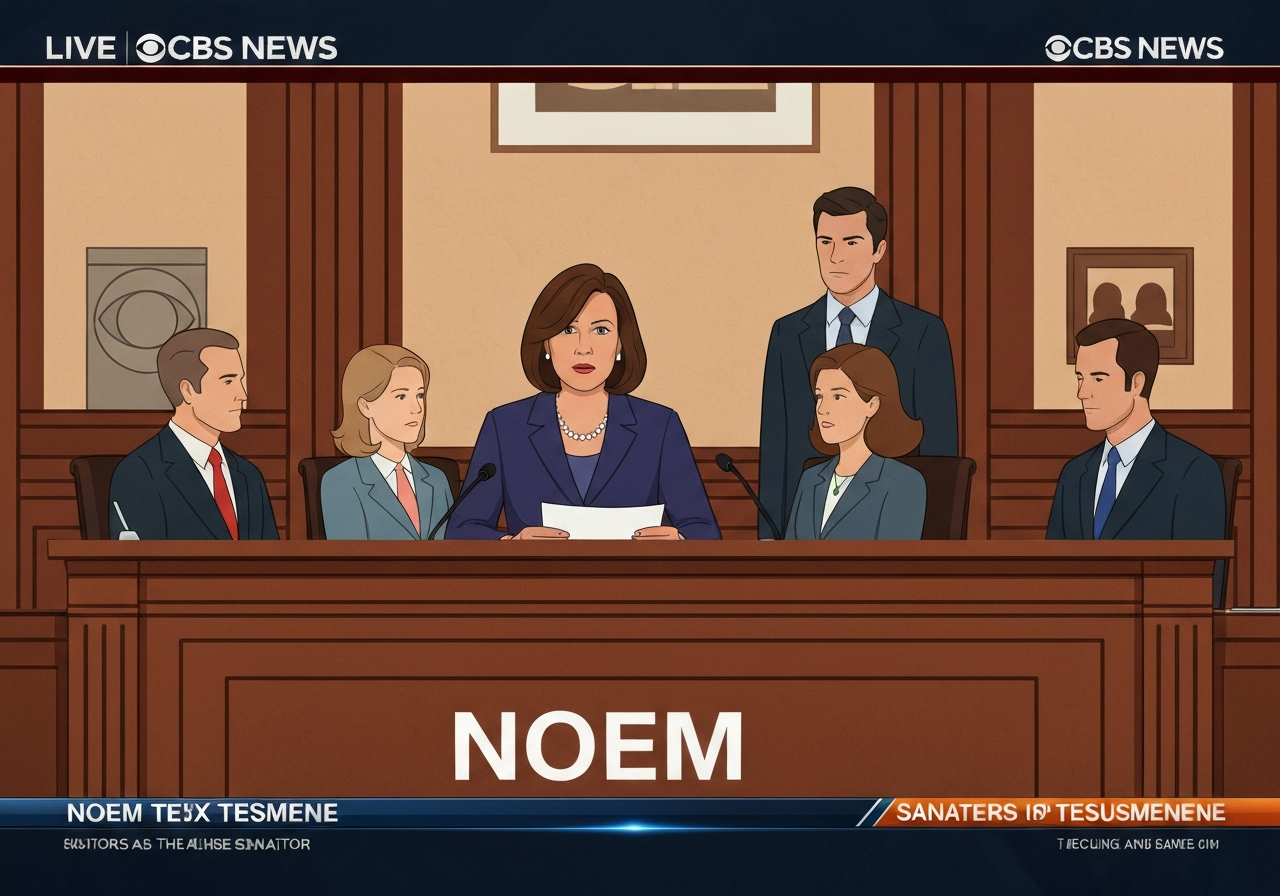
Homeland Security Secretary Kristi Noem testified before the House Judiciary Committee in Washington, D.C., on March 4, 2026, defending Department of Homeland Security actions amid intense questioning from Democrats and some Republicans. Lawmakers pressed her on allegations about a personal relationship with adviser Corey Lewandowski, a $220 million ad campaign, the department’s handling of two fatal Minnesota shootings, and the operational strain caused by a partial DHS funding lapse. Noem repeatedly denied the personal allegations and defended enforcement tactics and procurement decisions, while lawmakers warned of accountability measures and possible legal and political consequences. The hearing featured heated exchanges, new procurement scrutiny, and urgent warnings about Coast Guard pay and agency readiness.
Key takeaways
- Kristi Noem testified to the House Judiciary Committee on March 4, 2026, confronting questions about personnel, procurement and use of force in Minnesota.
- Lawmakers raised allegations about a romantic relationship between Noem and adviser Corey Lewandowski; Noem called the suggestion “tabloid garbage” and denied it.
- Rep. Joe Neguse highlighted a $220 million DHS ad campaign and a related award he said funneled roughly $143 million to a newly incorporated vendor; Noem said the procurement was legal and effective.
- Noem said DHS has roughly “one more paycheck” capacity to pay Coast Guard personnel during the partial shutdown; the funding lapse began on February 14, 2026.
- Noem reported about 14,000 body cameras deployed to enforcement agents but said tens of thousands more and long‑term maintenance remain unfunded.
- Democrats demanded accountability over the killings of Renee Good and Alex Pretti in Minnesota and criticized Noem’s earlier comments labeling the incidents as domestic terrorism; investigations remain ongoing.
- Senate scrutiny continued after a March 3 hearing; Senators John Kennedy and Thom Tillis voiced independent critiques while many Republicans defended the secretary.
Background
The hearing is the latest in a wave of congressional oversight following intensified immigration enforcement actions and a high‑profile security surge to Minnesota after two civilians were killed during federal enforcement operations. Noem, tapped by the administration to head DHS, has quickly become a polarizing figure: praised by many Republicans for aggressive border enforcement and criticized by Democrats and some oversight Republicans for procurement choices and operational decisions. The department oversees many components — ICE, CBP, FEMA, TSA and the Coast Guard — and several of them are operating amid a partial shutdown that began February 14, 2026, limiting payroll flexibility for some frontline workers.
Procurement and public messaging have also surfaced as flashpoints. Congress and watchdogs routinely scrutinize how large public information campaigns are awarded and managed, particularly when multimillion‑dollar contracts appear to favor newly formed vendors or politically connected firms. Simultaneously, the fatalities in Minnesota have kept scrutiny on use‑of‑force standards, evidence access for state investigators and the potential legal exposure for DHS officials as investigations continue.
Main event
Representative Sydney Kamlager‑Dove directly asked Secretary Noem whether she had engaged in sexual relations with adviser Corey Lewandowski, citing recent press reports. Noem rejected the line of questioning as “tabloid garbage,” emphasized Lewandowski’s status as a special government employee and said he lacked decision‑making authority within DHS. The exchange escalated as Kamlager‑Dove and Noem spoke over one another, with the congresswoman arguing that such questions bear on judgment and national security given DHS’s mission.
Representative Joe Neguse pressed Noem on the $220 million advertising campaign in which Noem is prominently featured. Neguse read from the federal notice asserting that DHS proceeded without full competitive bidding and said one awarded contractor had been incorporated only days before receiving work. Noem maintained the process was lawful and defended the campaign’s effectiveness, while Neguse warned that the documentation suggests a noncompetitive award and potential legal issues.
Several Democrats, including Jamie Raskin and Pramila Jayapal, challenged Noem over her earlier public comments that linked the deaths of Renee Good and Alex Pretti to “domestic terrorism.” Noem offered condolences to the families but repeatedly said the matter remains under investigation and declined to retract the characterization. Representative Becca Balint accused Noem of lawlessness and suggested the conduct could be impeachable, promising future accountability measures if political control changes.
On operational matters, Noem told Republicans she had rescinded certain prior memos and credited the administration with progress on fentanyl interdiction and deportations. She also reported that DHS has about 14,000 body cameras in use but lacks funding for the tens of thousands more she says are needed. Asked about personnel pay amid the shutdown, Noem said the Coast Guard had enough funds for one more paycheck and that DHS was employing “extraordinary measures” to support members and families.
Analysis & implications
The hearing underscores a convergence of political, legal and operational risks for DHS leadership. Politically, sustained allegations about personal impropriety and procurement practices can erode bipartisan support and invite further oversight, including subpoenas or conditioned confirmations for future nominees. Legally, procurement records and the justification for bypassing open competition will attract inspector general and GAO attention; if procedural gaps exist, contractors and watchdogs could mount challenges.
Operationally, the partial funding lapse materially affects frontline readiness. The Coast Guard’s reported single remaining payroll cycle illustrates the near‑term liquidity risk at certain components; prolonged impasse could degrade search‑and‑rescue capacity, maritime security and disaster response if FEMA resources remain constrained. That operational strain shifts oversight focus from high‑level politics to immediate public‑safety consequences.
On the reputational front, the department’s public messaging campaign and visible leadership role in it create a feedback loop: when advertising prominently features executives under investigation or political attack, critics argue the spending blurs governance and promotion. That dynamic complicates DHS efforts to maintain public trust across jurisdictions — federal, state and local — especially where state investigators have sought access to evidence in the Minnesota cases.
Comparison & data
| Item | Amount | Context |
|---|---|---|
| DHS total appropriation (One Big Beautiful Bill Act) | $165 billion | Aggregated funding passed last year; Congress prescriptively allocated some amounts |
| ICE allocation within that sum | $75 million | Congress directed funds to detention centers and contracts, limiting flexibility |
| DHS public information/ad campaign | $220 million | Campaign prominently features Noem; subject of competitive‑bidding scrutiny |
| Alleged large award to single vendor | $143 million (cited by Rep. Neguse) | Representative cited this as part of the noncompetitive award concerns |
These figures frame lawmakers’ arguments: advocates for the secretary say the infusion last year sheltered core enforcement activities from the shutdown’s worst effects, while critics say targeted allocations and rapid contract awards merit investigation. The contrast between large, legislated appropriations and line‑item contract decisions is central to current oversight.
Reactions & quotes
Lawmakers and stakeholders reacted sharply during the hearing, mixing calls for accountability with defenses of enforcement policy.
“Mr. Chairman, I am shocked that we’re going down and peddling tabloid garbage in this committee today.”
Secretary Kristi Noem
Context: Noem used this language when Representative Kamlager‑Dove raised press reports about a romantic relationship with a senior adviser, framing the line of inquiry as irrelevant and offensive while asserting the adviser’s limited formal authority.
“You should be able to answer the question clearly and without any hesitation if someone is asking if you or any federal official is sleeping with their subordinate.”
Rep. Sydney Kamlager‑Dove (D‑CA)
Context: Kamlager‑Dove argued the allegation goes to judgment and national security, pressing for a direct response and tying personnel decisions to DHS’s mission responsibilities.
“Your agency made a decision not to proceed with competitive bidding…one of the contractors that got the award was this Safe America media company.”
Rep. Joe Neguse (D‑CO)
Context: Neguse read from a procurement justification and questioned why a contractor with recent incorporation and political ties received a large award; Noem disputed the suggestion of impropriety.
Unconfirmed
- Allegations of a romantic relationship between Noem and Corey Lewandowski have been reported in press outlets and denied by the parties; congressional questioning does not constitute independent confirmation.
- Reports that ICE is building a comprehensive public database of protesters stem from a public comment by a former official and a video cited in committee; DHS officials on the record in this hearing denied creating such a database.
- Claims that a single vendor received $143 million without any prior government work are based on a committee reading of procurement notices; formal agency and inspector general reviews are pending and the legal implications have not been adjudicated.
Bottom line
The March 4 hearing sharpened oversight pressure on Secretary Noem and put several discrete issues — procurement practices, personal‑conduct allegations, and operational strain from the partial shutdown — into sharper relief. For lawmakers, the hearing provides a public record they can use to justify further subpoenas, inspector general probes, or legislative remedies; for the administration, it is an inflection point for defending policy and process.
Short‑term operational consequences are the most tangible risk: limited payroll capacity for units like the Coast Guard and underfunded body‑camera programs can directly affect public safety and interagency cooperation. Politically, the episode will likely animate both oversight strategies and messaging as the 2026 cycle proceeds, with potential ripple effects on confirmations, appropriations and local‑state investigative cooperation.
Sources
- CBS News live updates — Press (live reporting of the House Judiciary Committee hearing, March 4, 2026)