
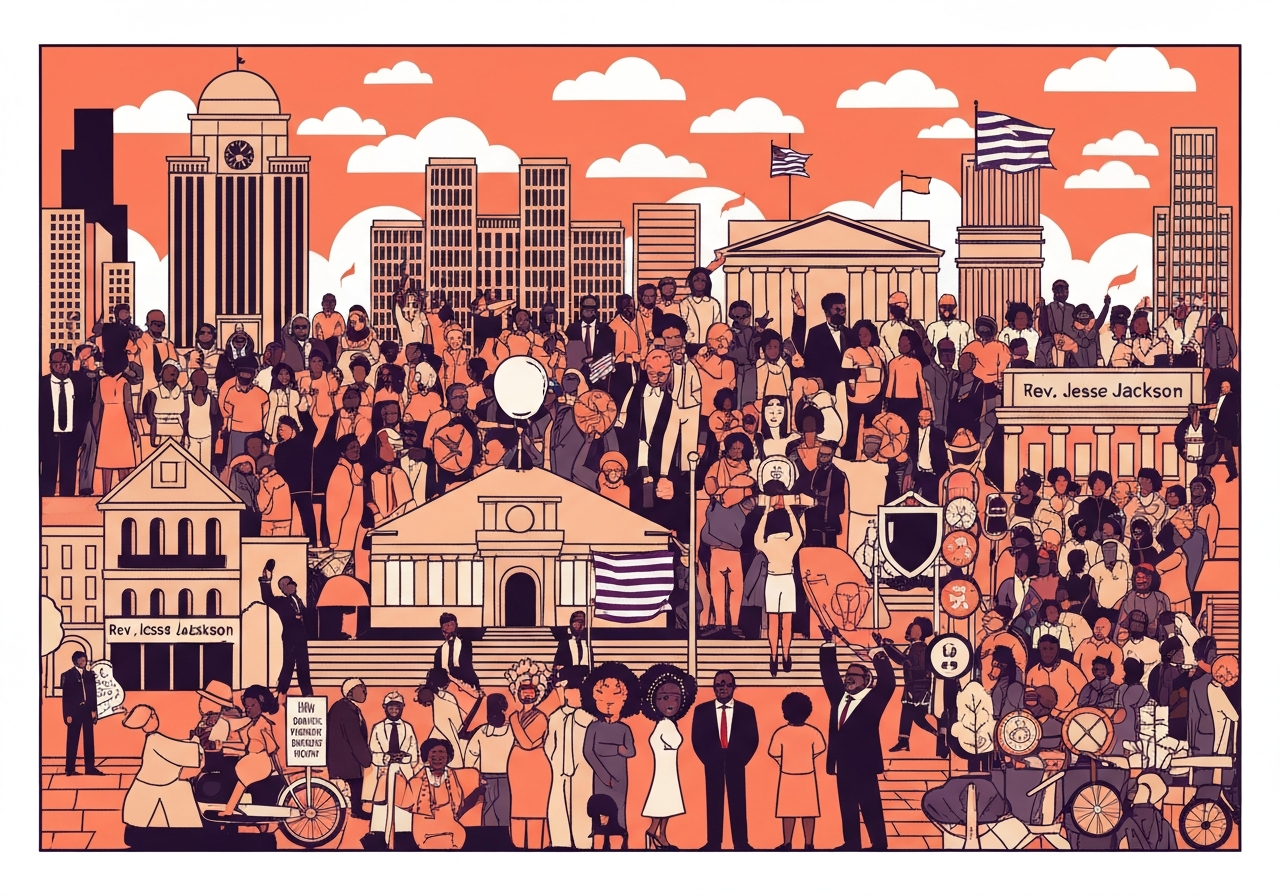
Thousands packed Chicago’s House of Hope on Friday as a celebration of life for Rev. Jesse Jackson began at 11 a.m., drawing a multi-generational crowd to the Pullman neighborhood. The event — part worship service, part political tribute — combined gospel music, eulogies and calls to civic action as guests from across the U.S. and abroad paid respects. Former presidents and senior officials shared memories while family members announced additional services and a procession to Oak Woods Cemetery. The tone was predominantly celebratory: mournful in moments, but driven by Jackson’s signature message to “keep hope alive.”
Key takeaways
- Service time and venue: The homegoing opened at 11:00 a.m. Friday at House of Hope in Pullman; doors had opened to the public at 9:00 a.m., and the venue seats roughly 10,000 people.
- Attendance and reach: Thousands attended in person; thousands more queued during the two-day repose at Rainbow PUSH headquarters in Kenwood ahead of the homegoing.
- Notable attendees and speakers: Former Presidents Barack Obama, Bill Clinton and Joe Biden spoke; former Vice President Kamala Harris, international leaders (including Colombia’s Gustavo Petro) and cultural figures such as Jennifer Hudson and Tyler Perry also participated.
- Program highlights: The program included musical tributes (“A Change Is Gonna Come,” “We Shall Overcome”), a roughly 30-minute eulogy from Obama, and extended remarks that pushed beyond personal reminiscence into policy critique.
- Family and follow-ups: The Jackson family announced additional services beginning at 10:00 a.m. Saturday at Rainbow PUSH, followed by a procession to Oak Woods Cemetery.
- Jackson’s life and age: Rev. Jesse Jackson died Feb. 17, 2026, at age 84; he had stepped down as president of the Rainbow PUSH Coalition in July 2023 because of health concerns.
- International and historical notes: Attendees recalled Jackson’s 1999 mission that helped secure the release of three U.S. soldiers in Kosovo and his two presidential campaigns in 1984 and 1988, which reshaped how Black voters saw political possibility.
Background
Jesse Jackson rose from the civil-rights ferment of the 1960s to become a national organizer, pastor and two-time Democratic presidential candidate. He founded and led the Rainbow PUSH Coalition for decades, positioning the organization at the intersection of faith, labor and electoral politics in Chicago and nationwide. Jackson’s campaigns in 1984 and 1988 broke rhetorical and representational ground, influencing how successive generations of Black leaders perceived political agency.
Internationally, Jackson cultivated a reputation as a negotiator and activist; his 1999 delegation to negotiate the release of three U.S. soldiers in the Balkans remains a noted episode in his public life. In later years his health declined: a 2017 Parkinson’s diagnosis was revised to progressive supranuclear palsy, and he retired from leadership roles as his condition progressed. Even so, his institutional imprint — on Rainbow PUSH, on local Chicago politics, and on national debates about race and economic justice — remained substantial.
Main event
Inside House of Hope the atmosphere alternated between high-energy gospel and pointed political rhetoric. Choirs and soloists energized the crowd while speakers threaded personal anecdotes with policy admonitions. Several family members, including Yusef Jackson, spoke about their father’s final months and his exhortations to sustain community programs such as food assistance during federal disruptions.
Public officials used the platform for both tribute and critique. Former President Joe Biden offered condolences and an account of grief’s progression, while sharply distinguishing his values from those of the current administration. Barack Obama framed Jackson as a prophetic figure who urged Americans to be “heralds of change,” delivering an extended eulogy that blended praise with warnings about threats to democratic norms.
Religious and civic leaders — among them Rev. Al Sharpton, Rev. Otis Moss III and Rabbi Sharon Brous — mixed sermonizing with calls to action. Sharpton’s remarks were forceful, warning against complacency and urging the audience to carry forward Jackson’s political energy. The crowd rose repeatedly for musical performances by Jennifer Hudson and others, underscoring the service’s dual character as both worship and public witness.
Analysis & implications
The gathering underscored Jesse Jackson’s role as a bridge figure: pastor, strategist and mobilizer who linked church networks, labor allies and electoral politics. Present-day politicians used the platform to reaffirm commitments to voting rights, social safety nets and racial equity; those appeals suggest Jackson’s funeral may momentarily recalibrate messaging within parts of the Democratic coalition.
Jackson’s emphasis on changing psychology — how Black Americans saw their own political worth — was repeatedly cited as his lasting achievement. Speakers argued that his work helped enlarge civic imagination, a legacy visible in the presence of younger activists and elected officials who trace formative influence to his campaigns and Rainbow PUSH programs.
Politically, the event highlighted tensions the Democratic coalition still navigates: generational divides, policy priorities such as health care and SNAP benefits, and strategic questions about electoral unity. Public rebukes of the Trump administration during the service framed Jackson’s legacy as both moral and policy-oriented, signaling that his memory will be invoked in contemporary partisan debates.
Comparison & data
| Item | Figure | Context |
|---|---|---|
| Age at death | 84 | Rev. Jesse Jackson, died Feb. 17, 2026 |
| Homegoing start | 11:00 a.m. | House of Hope service on Friday; doors opened at 9:00 a.m. |
| Venue capacity (approx.) | 10,000 seats | House of Hope arena seating; event drew thousands in-person |
The table places the funeral’s immediate facts alongside context: an 11:00 a.m. service in a large church facility, preceded by two days of public repose at Rainbow PUSH that attracted multigenerational crowds. Those data points reflect both the logistical scale of the event and its civic reach.
Reactions & quotes
Speakers came from different backgrounds but converged on two themes: Jackson’s personal generosity and his political boldness. Several short remarks captured the service’s tenor and were framed by context emphasizing action over sentiment.
“Keep hope alive.”
Yusef Jackson (son, family remarks)
Yusef’s brief refrain recalled a lifetime mantra and closed a family tribute that tied private memory to public mission.
“We won’t go back!”
Rev. Al Sharpton (civil-rights leader)
Sharpton’s chant punctuated a forceful address warning against political retrenchment and calling for renewed activism aligned with Jackson’s principles.
“His voice called on each of us to be heralds of change.”
Barack Obama (former president)
Obama used Jackson’s example to press civic responsibility and to frame the dead leader as an exemplar for public service beyond partisan lines.
Unconfirmed
- Claims that the U.S. Capitol was closed to the public or reserved for particular private groups during the period referenced by a speaker; the reported characterization was rhetorical and has not been independently confirmed.
- Any unreported private conversations or undisclosed arrangements among visiting world leaders and U.S. officials referenced informally during the event have not been corroborated.
Bottom line
The House of Hope service for Rev. Jesse Jackson was both a measure of personal grief and a public demonstration of political memory. High-profile tributes and a broad public turnout reinforced Jackson’s continuing influence on political messaging, civic mobilization and multifaith organizing.
In the weeks ahead, watch for the Jackson family’s planned processional events, continued programming by Rainbow PUSH and how elected officials incorporate Jackson’s themes—economic justice, voting rights and a broadened civic imagination—into policy and campaign priorities. The service served as a reminder that funerals of national figures often double as focal points for political alignment and generational handoffs.