
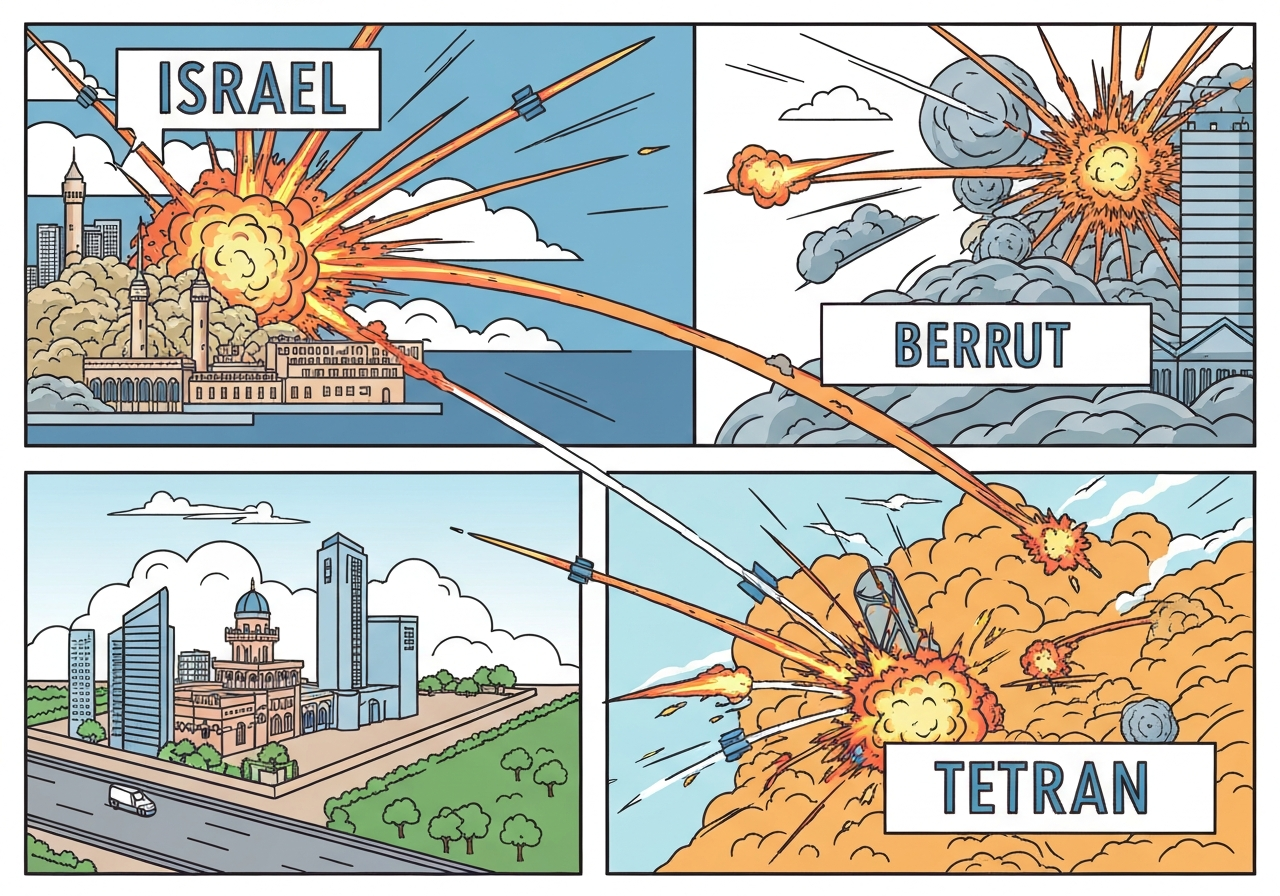
Who: Israeli forces and Iran, with U.S. involvement cited by officials. When: escalations occurred Friday into Saturday, with multiple waves of strikes and alerts. Where: strikes and impacts reported across Tehran, Beirut, eastern Lebanon, the Gulf and international airspace around Dubai. What: Israeli air raids hit targets in Lebanon and Iran while Iran launched further attacks on Israeli sites and regional states; U.S. forces reportedly struck an Iranian drone carrier at sea. Result: fighting has broadened, airspace and travel were disrupted, and reported casualties continue to mount.
Key takeaways
- At least 1,230 people have been killed in Iran, more than 200 in Lebanon and around a dozen in Israel, according to official tallies from those countries.
- Six U.S. service members have died amid the widening conflict, U.S. officials say.
- Israeli strikes struck parts of Beirut and Tehran in the latest round, with Lebanese authorities reporting at least 16 killed in eastern Lebanon’s Nabi Chit after overnight raids.
- Iran launched repeated missile and drone attacks that reached Israeli territory and Gulf states hosting U.S. forces; sirens were reported in Bahrain and the UAE.
- Dubai International Airport temporarily halted operations and Emirates suspended flights to and from Dubai after alert warnings and explosions near the airport.
- Pakistan raised petrol and diesel prices by about 20% citing a surge in global oil prices tied to the regional war.
- U.S. officials say they struck an Iranian drone carrier at sea and are investigating whether a Feb. 28 blast at an Iranian elementary school was caused by a U.S. strike.
- U.S. intelligence officials reported that Russia provided information that could help Iran target American assets, an allegation that, if confirmed, would mark a new phase of outside involvement.
Background
The conflict has escalated rapidly since the outbreak of open hostilities in late February. On Feb. 28 an Israeli strike killed Supreme Leader Ayatollah Ali Khamenei, 86, a development that Iranian officials and state media say significantly disrupted command-and-control within Iran’s armed forces. Iran’s Islamic Revolutionary Guard Corps (IRGC) has been a principal actor in the fighting and has launched missiles and drones at Israeli and regional targets.
The United States has moved naval and air assets into the region to protect its forces and allies, and U.S. commanders have acknowledged engagements at sea. The U.S. says it is targeting elements of Iran’s naval and drone capabilities; Iranian authorities accuse the U.S. and Israel of joint operations. The war’s regional ripple effects have already hit civilian infrastructure, aviation, and global energy markets.
Main event
Friday and early Saturday saw a fresh round of strikes. Israeli warplanes carried out raids on locations in southern Beirut and multiple sites in Tehran, including what Israel described as military training facilities and underground missile storage. Lebanese authorities reported large plumes of smoke in southern Beirut and fatalities in mountain towns after overnight strikes.
Iran responded with additional missile and drone attacks aimed at Israeli targets and at Gulf countries that host U.S. forces. Sirens sounded repeatedly in Bahrain; mobile alerts warned residents in Dubai of potential missile threats and Emirati air defenses were reported to have activated. Passengers sheltered in train tunnels at Dubai International Airport after a loud boom; airport operations were paused and major carriers suspended flights.
On the maritime front, U.S. forces reportedly struck an Iranian drone carrier at sea as part of an expanded campaign to degrade Tehran’s ability to project unmanned systems. U.S. military officials also said they are investigating the Feb. 28 elementary school blast in Iran that produced the conflict’s deadliest single civilian toll to date.
In eastern Lebanon, the Lebanese Health Ministry said at least 16 people were killed and 35 wounded in strikes on Nabi Chit. Hezbollah reported clashes with an Israeli force that it said landed in the area; Israel had not publicly confirmed a landing as of the latest reports. Across Israel, residents reported loud booms and headed to bomb shelters; emergency services reported no immediate large-scale casualty figures from those alerts.
Analysis & implications
The strikes on Tehran and Beirut represent a significant escalation in both reach and audacity—attacks on a capital city and on militant strongholds beyond immediate front lines broaden both political and military stakes. Striking Tehran risks provoking deeper Iranian reprisals, which in turn could draw in regional powers and external backers. The reported use of U.S. naval force to strike an Iranian vessel at sea signals Washington’s willingness to take direct kinetic action to protect fleet and regional stability.
Economic and civilian impacts are immediate. Dubai International’s temporary halt and Emirates’ suspension of flights disrupted one of the world’s busiest international hubs, with knock-on effects for global travel and logistics. Pakistan’s fuel price jump—about 20% overnight—illustrates how energy markets and domestic economies in import-dependent states are already reacting to the conflict.
Diplomatically, demands for Iran’s “unconditional surrender,” voiced on social media by U.S. President Donald Trump and reiterated by White House officials, close off negotiated pathways and raise the prospect of further attempts to shape Iran’s internal politics. Iran’s president, Masoud Pezeshkian, publicly apologized to neighboring states for some attacks and suggested miscommunication in the ranks, but his capacity to control hardline elements such as the IRGC appears limited.
If U.S. intelligence assessments that Russia provided targeting information to Iran are substantiated, that would widen the conflict’s international dimension and increase the risk to U.S. ships and aircraft. Even unproven, such allegations harden narratives on both sides and complicate diplomatic de-escalation efforts.
Comparison & data
| Location | Reported deaths | Notable recent incidents |
|---|---|---|
| Iran | At least 1,230 | Airstrikes on Tehran; deadly Feb. 28 school blast under investigation |
| Lebanon | More than 200 (nationwide); 16 in Nabi Chit | Nighttime raids in eastern Lebanon; clashes reported in mountain zones |
| Israel | About a dozen | Missile alerts and ground-level booms; shelters activated |
| U.S. forces | Six killed | Engagements at sea; reported strike on Iranian drone carrier |
The table aggregates official casualty figures and recent operational notes reported by national authorities and correspondent coverage. Numbers reflect the most recent publicly released tallies and will likely be revised as more information becomes available.
Reactions & quotes
Official statements and public reactions have ranged from calls for restraint to rhetoric that hardens positions on all sides.
“We call for Iran’s unconditional surrender,”
President Donald Trump (social media/posting)
The White House press office later clarified that the administration viewed “unconditional surrender” ambitiously and that changes in Iran’s leadership could be part of a post-conflict settlement, a stance that critics say further narrows diplomatic options.
“I should apologize to the neighboring countries that were attacked by Iran,”
President Masoud Pezeshkian (state broadcast)
Pezeshkian’s remarks, which included an apology and an attribution of some attacks to miscommunication, were aired after additional strikes on Gulf neighbors and did not halt subsequent operations by Iran’s paramilitary forces.
“We are investigating the Feb. 28 school blast and any responsibility,”
U.S. military official (statement to press)
U.S. officials say they are still examining forensic and intelligence evidence about the school explosion that produced the war’s highest reported civilian death toll.
Unconfirmed
- Allegations that Russia supplied targeting information to Iran come from U.S. intelligence sources and are not independently confirmed in open-source reporting.
- Responsibility for the Feb. 28 elementary school blast in Iran remains under investigation; while evidence points toward a U.S. airstrike, no party has formally accepted responsibility.
- Reports that Israeli forces conducted a large amphibious landing in eastern Lebanon and the full extent of any ground clashes there are based on militant group claims and lack independent confirmation from multiple on-the-ground sources.
Bottom line
The latest strikes mark a dangerous widening of the war: capitals and civilian hubs have been struck, regional transit and energy channels are disrupted, and external powers face pressure to respond. Casualty figures, disrupted air travel, and economic ripples show the conflict’s immediate human and material cost.
Short-term prospects point to sustained tit-for-tat strikes and heightened protections for military and civilian infrastructure across the Gulf and eastern Mediterranean. Diplomatic pathways appear constrained by public rhetoric demanding regime change or surrender; meaningful de-escalation will likely require discreet, multilateral engagement and verifiable steps to limit offensive capabilities.
Readers should expect casualty figures and operational claims to change as access improves and independent verifications are completed; follow-up reporting is essential to separate confirmed facts from competing narratives.
Sources
- AP News — live coverage — (news media)
- White House — (official government site)
- Lebanese Ministry of Public Health — (official government health ministry)
- Emirates Airline — (airline corporate announcements)