
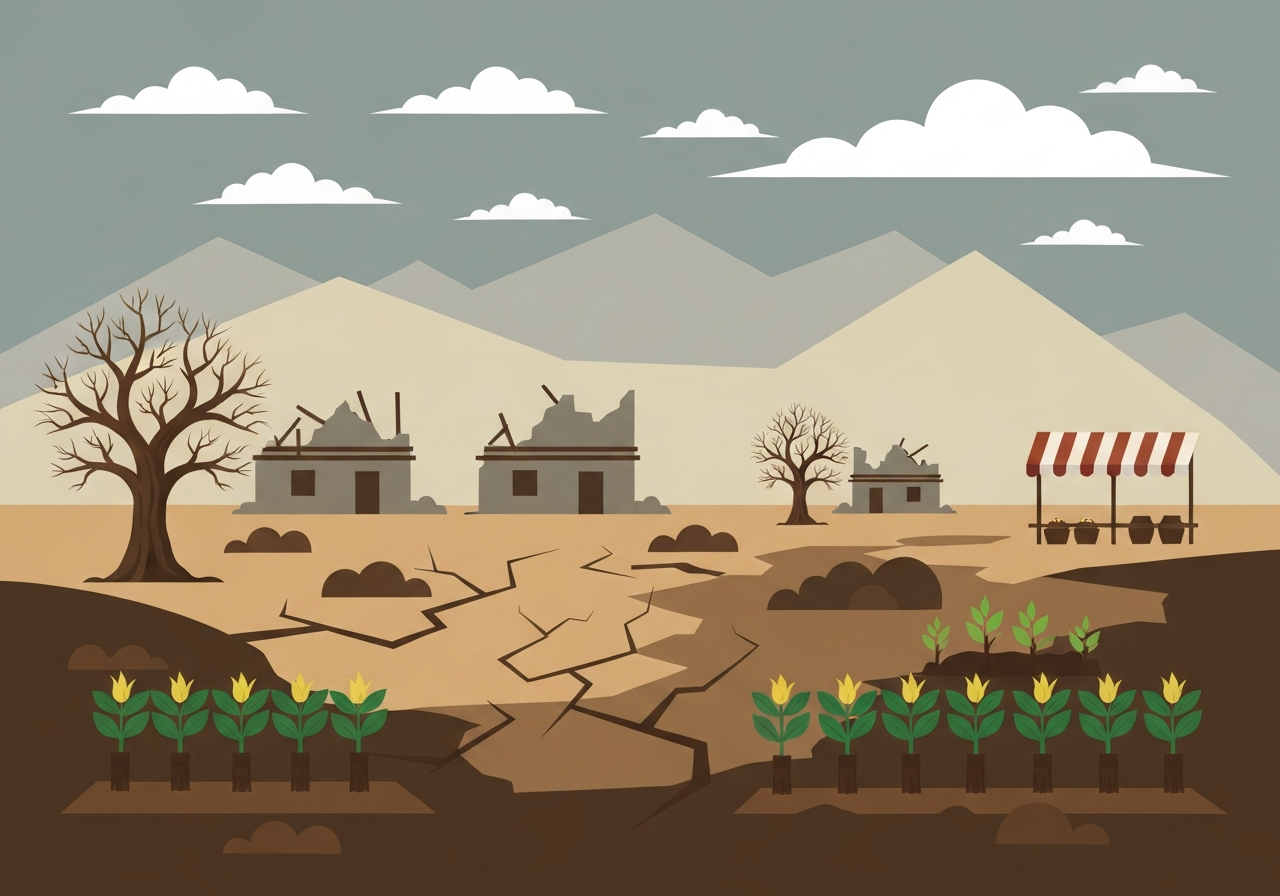
— A widening conflict in the Persian Gulf is raising the odds of higher food prices and localized shortages worldwide. Major fertilizer factories in the Gulf region remain operational, but shipments have been disrupted by an effective shutdown of the Strait of Hormuz, complicating deliveries to large buyers such as India. Nitrogen-based fertilizers, produced from natural gas and essential to crops that deliver roughly half of global calories, are especially at risk. The immediate result is rising input costs and a heightened risk that poorer countries will face reduced supplies and higher food insecurity.
Key Takeaways
- The Strait of Hormuz is effectively closed to commercial traffic as the March 2026 Gulf conflict escalates, disrupting exports of oil, gas and fertilizer-bound feedstocks.
- Nitrogen fertilizers—made from natural gas—support crops that provide about half the world’s food calories; interruptions threaten global yields and input costs.
- India sources roughly 40% of its urea and phosphate-based fertilizers from Middle East suppliers, making its agriculture highly exposed to Gulf export disruptions.
- Global oil and gas prices have surged since maritime traffic halted, pushing up the production cost of fertilizers and related chemicals.
- Most Gulf fertilizer plants are still producing, but logistics and shipping blockades have created immediate distribution bottlenecks.
- Analysts at CRU Group warn of sharply tighter markets for fertilizer commodities if the waterway remains closed for weeks rather than days.
- Smaller, import-dependent countries and low-income farmers are most likely to reduce fertilizer use, risking yield declines and higher local food prices.
Background
The Persian Gulf has long been a central hub for energy-intensive chemical manufacturing. Abundant natural gas supplies enabled the region to build large facilities that convert feedstock into nitrogen fertilizers, notably urea and ammonium nitrate, as well as intermediates used in phosphate and potash blends. Those products are distributed worldwide, with shipping through the Strait of Hormuz the main export route to Asia, Africa and Europe.
For decades, farmers around the world have relied on these affordable, industrial-scale supplies to maintain high-yield cereal and oilseed production. Policy shifts, such as post-2010 expansion in fertilizer demand and the diversification of supply chains after the 2022 Russia-Ukraine war, made buyers sensitive to further disruptions. Many countries, including India, still depend heavily on Middle East shipments for a large share of their fertilizer consumption.
Main Event
In early March 2026, military operations and maritime interdictions around the Gulf led to an effective halt of commercial traffic through the Strait of Hormuz. Vessels were diverted or suspended, port operations slowed, and insurers raised premiums for ships operating in the area. The immediate commercial impact was a spike in crude and natural gas prices, which in turn raised the cost basis for nitrogen fertilizer production.
Facilities inside the Gulf have largely continued manufacturing; operators have kept plants running where possible to avoid longer-term shutdown costs. But finished fertilizers and chemical feedstocks are accumulating at production terminals because carriers are unable or unwilling to transit the strait. That mismatch—ongoing output plus stalled shipments—has created a distribution choke point rather than an industrial stoppage.
Buyers in South and Southeast Asia, Africa and parts of Europe reported canceled or delayed shipments in the first week after the strait closure. India, which imports about 40% of certain fertilizer types from Middle Eastern suppliers, faces sharply elevated procurement costs and logistical uncertainty ahead of planting cycles. Traders are seeking alternative supplies, but sourcing elsewhere would likely be pricier and limited in volume on short notice.
Analysis & Implications
The immediate economic effect is higher fertilizer prices as buyers compete for diminished export capacity and as production costs rise with energy prices. For farmers, higher input prices often translate into reduced application rates or delayed purchases; both responses can lower yields at the farm level. In aggregate, reduced fertilizer use on staple crops can depress global output and push retail food prices higher.
Vulnerable countries that import a large share of their fertilizers and have limited fiscal capacity to subsidize inputs will feel the impact most sharply. When smallholder farmers cut back on nutrient application, cereal and vegetable yields fall disproportionately, widening nutrition gaps. Policymakers may face difficult choices: deploy scarce foreign-exchange reserves to secure shipments, raise subsidies for vulnerable consumers, or allow market prices to adjust—each option carries political and fiscal costs.
For global markets, the event underscores the fragility of supply chains that concentrate production in geopolitically sensitive regions. Even if Gulf plants remain operational, prolonged transport disruptions are sufficient to tighten physical availability. Over weeks to months, sustained higher fertilizer prices could prompt demand destruction in emerging markets and accelerate shifts toward alternative nutrient sources or agronomic practices that require less synthetic nitrogen.
Comparison & Data
| Indicator | Noted Value |
|---|---|
| Share of world food supported by nitrogen fertilizers | ~50% of calories |
| India’s imports from Middle East (urea & phosphate-based) | ~40% |
The table highlights two data points frequently cited in market analyses. Together they show why disruptions in Gulf exports can ripple into food markets: nitrogen fertilizers underpin roughly half of global caloric production, and large buyers like India rely heavily on Middle Eastern suppliers for timely deliveries.
Reactions & Quotes
Market analysts, international agencies and affected governments responded quickly after the strait became impassable, warning of near-term supply stress and price volatility.
“It’s bad — there’s no other way of putting it.”
Chris Lawson, CRU Group (market intelligence vice president)
CRU Group analysts highlighted that dependence on Gulf feedstocks leaves global fertilizer markets exposed to shortfalls when shipping routes are interrupted. That assessment has been echoed across commodity research teams tracking nitrogen, phosphate and potash flows.
“Any prolonged interruption in fertilizer shipments risks greater food insecurity among low-income importers and smallholder farmers.”
Food and Agriculture Organization (FAO) — paraphrased official caution
The FAO and similar international bodies typically caution that supply shocks to fertilizers and energy inputs can translate quickly into higher retail food costs and pressure on vulnerable populations. Governments in major importing countries are monitoring the situation and assessing emergency procurement and subsidy options.
Unconfirmed
- Duration of the Strait of Hormuz closure: exact timeline and the sequence of events leading to reopening remain unsettled and evolving.
- Quantitative estimates of near-term global production loss: precise tonnage reductions from possible fertilizer shortages have not been publicly released by major suppliers.
- Specific government procurement agreements or emergency shipments in response to the disruption have been reported in some channels but lack full confirmation from official agencies.
Bottom Line
The conflict-driven interruption of maritime traffic in the Persian Gulf has rapidly translated into a supply-chain crisis for fertilizers, with immediate price effects and a substantial risk that poorer countries will see higher food costs and lower yields. Even if production in the Gulf continues, logistics bottlenecks and elevated energy prices are enough to tighten global nutrient availability.
Policy responses over the coming weeks—emergency procurements, tariff or subsidy adjustments, and diplomatic efforts to reopen shipping lanes—will determine whether this episode becomes a short-term price spike or a longer, more damaging squeeze on food supplies. Readers and policymakers should watch shipment data, fertilizer-price indices and official procurement statements for signs of either easing or escalation.
Sources
- The New York Times (news reporting, March 7, 2026)
- CRU Group (industry research firm; market intelligence comment)
- Food and Agriculture Organization (FAO) (international organization; food security guidance)