
Lead
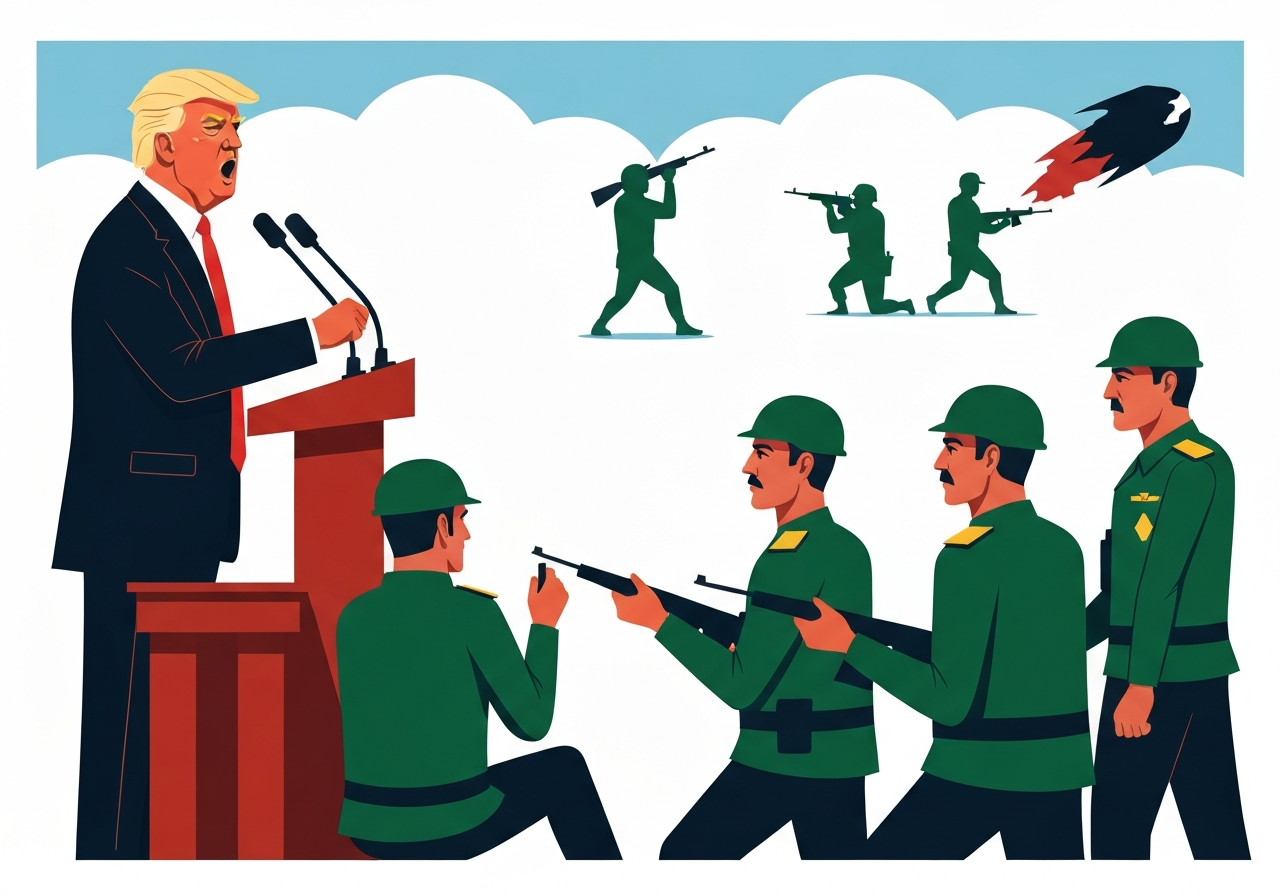
At a Miami-area summit on Saturday, President Donald Trump urged leaders from a dozen Latin American countries to use their militaries to confront transnational drug cartels and gangs, framing the groups as an “unacceptable threat” to hemispheric security. The meeting at Trump National Doral came as the administration sought to reassert U.S. influence in the Western Hemisphere while managing crises elsewhere, including a new conflict with Iran and the recent deaths of six U.S. service members. Trump linked the proposed anti-cartel effort to the U.S.-led coalition that fought the Islamic State, saying a military-centered approach is necessary to eliminate the organizations. The gathering — billed by the White House as the “Shield of the Americas” summit — drew a limited set of attendees and highlighted regional splits over Washington’s tactics.
Key takeaways
- Twelve nations attended the Doral meeting, including Argentina, Chile and Panama; notable absences included Brazil, Mexico and Colombia, key regional powers with large anti-narcotics roles.
- Trump explicitly urged the use of national militaries, saying “we have to use our military,” and compared the plan to the U.S.-led coalition against ISIS.
- The summit followed a high-profile U.S. operation two months earlier to seize Venezuela’s then-president Nicolás Maduro and his wife, an action cited by the administration as part of its tougher Western Hemisphere posture.
- The event overlapped with other crises: the U.S. and Israel opened a campaign against Iran one week earlier that officials say has resulted in hundreds of fatalities, and six U.S. troops were killed in a drone strike in Kuwait the day before the summit.
- Trump announced a looming focus on Cuba and suggested forthcoming negotiations with Havana, signaling a shift to a more confrontational approach toward the island’s government.
- Experts quoted by the administration warned that many governments in the region continue to value Chinese trade and investment, creating limits on how far they will align with a U.S. militarized strategy.
Background
The White House framed the Doral meeting as the “Shield of the Americas,” an initiative intended to reorient U.S. foreign policy toward a security-first posture in its hemisphere. The idea grew out of tensions surrounding the canceled 10th Summit of the Americas, which fractured during a U.S. military buildup off Venezuela and debates over which regimes to include. The summit’s limited roster reflected deeper regional divisions: host Dominican authorities, under U.S. pressure, barred Cuba, Nicaragua and Venezuela, prompting criticism and threats of withdrawal from left-leaning governments.
Since returning to the presidency, Trump has prioritized countering Chinese influence in Latin America, promoting a modernized Monroe-style corollary that targets Beijing’s infrastructure projects and investments. Administration actions have included pressuring Panama to withdraw from the Belt and Road Initiative and reviewing port agreements held by foreign companies. That diplomatic push has coincided with sharper security rhetoric — including publicized operations against Venezuelan leadership — intended to displace Chinese economic ties with security commitments and direct U.S. presence.
Main event
The Doral gathering convened leaders from 12 countries at Trump’s golf resort, where the president urged a military-led campaign against drug trafficking organizations and transnational gangs. He invoked the ISIS campaign as a model, arguing that a coalition of militaries across the hemisphere could “eradicate the cartels at home.” The summit agenda paired security talks with promises of renewed attention to Cuba and tougher measures against countries the administration views as destabilizing.
Attendance was selective: Argentina, Bolivia, Chile, Costa Rica, the Dominican Republic, Ecuador, El Salvador, Guyana, Honduras, Panama, Paraguay and Trinidad and Tobago participated. Major regional actors such as Brazil, Mexico and Colombia did not attend, and the exclusion of Cuba, Nicaragua and Venezuela underscored ideological lines that have complicated consensus-building in the region. Organizers described the meeting as a way to marshal like-minded governments, but the small roster limited the reach of any formal commitments announced at the summit.
The president’s remarks were timed amid overlapping foreign-policy crises. One day after the meeting he planned to attend a dignified transfer at Dover Air Force Base for six troops killed in Kuwait, and his administration had just engaged in military action relating to Iran that U.S. officials say has caused significant casualties. Those events framed the summit as part of a broader security-first narrative advanced by the administration across multiple theaters.
Analysis & implications
Shifting the anti-narcotics response toward overt military action raises legal, operational and political questions. Militaries in many Latin American states have limited training for sustained law-enforcement tasks such as evidence gathering, civilian arrests and judicial cooperation, and deploying them into prolonged domestic operations risks human-rights abuses and international criticism. The administration’s call for a coalition modeled on the fight against ISIS assumes a level of interoperability, intelligence-sharing and political alignment that does not yet exist across the hemisphere.
Regional leaders face trade-offs: aligning with a U.S.-led military approach could win security assistance but risks domestic backlash at home where militarization of policing is unpopular. Many governments have balanced relations with both Washington and Beijing because Chinese trade and infrastructure financing address development gaps that U.S. security promises do not fill. Experts note Washington has been trimming foreign assistance even as it pushes harder on immigration and security, reducing the set of tangible incentives offered to potential partners.
Operationally, a cross-border military campaign against cartels would require clear rules of engagement, shared intelligence protocols, and judicial cooperation to process seizures and prosecutions. Without robust civilian law-enforcement components and support for governance reforms, forcible disruption of trafficker activity can fragment criminal networks into more violent, dispersed cells. International law also constrains direct foreign military action on another state’s territory without consent, making bilateral or multilateral agreements a prerequisite for any cross-border strikes or intrusive operations.
Comparison & data
| Category | Count / Note |
|---|---|
| Attending countries (Doral) | 12 nations |
| Major regional absences | Brazil, Mexico, Colombia |
| Excluded by host pressure | Cuba, Nicaragua, Venezuela |
| U.S. troops killed (recent drone strike) | 6 service members |
| Casualties in Iran-related conflict | Reported as hundreds |
The small size of the Doral meeting contrasts with the 34-nation Summit of the Americas model established in 1994, underscoring its narrower political footprint. A focused, security-centric summit can accelerate bilateral defense cooperation among willing partners, but absence of regional heavyweights reduces the initiative’s capacity to shape hemispheric norms and coordinated law-enforcement architectures.
Reactions & quotes
Before presenting a quote from the president, it is important to note the specific claim he made linking military force to cartel eradication and the rhetorical analogy to the anti-ISIS coalition. His remarks were intended to frame the traffickers as an existential hemispheric threat, and to justify greater military involvement alongside U.S. support. The language signaled an escalation in tone and tools compared with recent U.S. drug-policy emphasis on interdiction and law enforcement.
The only way to defeat these enemies is by unleashing the power of our militaries. We have to use our military. You have to use your military.
President Donald J. Trump
Administration officials presented the quotation as a call for coordinated military action and intelligence sharing, but did not provide a detailed operational plan at the event. The comparison to coalition campaigns against terrorist groups raises questions about whether partner states will accept external military assistance on their soil and how such missions would be governed.
Scholars and former officials placed the Doral meeting in historical context, contrasting it with broader, more inclusive regional forums. Observers said the summit’s tone and composition reflected a more defensive posture and a preference for close alignment with administrations that share Washington’s hardline approach. One longtime policymaker expressed concern about the optics and strategic limits of a small, security-focused gathering.
“The hastily convened Shield of the Americas mini-summit conjures a crouched defensiveness, with only a dozen or so attendees huddled around a single dominant figure.”
Richard Feinberg, UC San Diego (academic)
Feinberg’s remark captured the contrast with the more inclusive 1994 Summit of the Americas, highlighting how diminished participation can translate into lower regional legitimacy for large security initiatives. Critics argue that without broad buy-in, announcements risk being declaratory rather than operationally transformative.
Economists and development experts warned that many Latin American governments will weigh U.S. security incentives against the concrete economic benefits of Chinese engagement. They argued that Washington’s mix of tariffs, deportations and military proposals may not be as persuasive as trade and investment packages offered by Beijing.
“The U.S. is offering the region tariffs, deportations and militarization whereas China is offering trade and investment.”
Kevin Gallagher, Boston University (academic)
Gallagher’s comment underscores the strategic dilemma for smaller capitals that must balance immediate security needs with long-term development priorities. The comment also suggests that U.S. pressure alone may be insufficient to dislodge entrenched economic ties between Latin American states and China.
Unconfirmed
- Specific operational plans or legal agreements to permit cross-border military strikes against cartels have not been published by the White House and remain unconfirmed.
- Details and timelines for the president’s suggested “big agreement” on cartel operations were not released at the summit and are therefore unverified.
- Public evidence for a completed U.S. operation that forcibly removed Nicolás Maduro to the United States has not been independently corroborated in government records accessible at the time of reporting.
- Claims about the exact casualty figures from the Iran-related conflict are described in broad terms as “hundreds,” but precise, independently verified totals have not been disclosed publicly.
Bottom line
The Doral summit marked a deliberate attempt by the U.S. administration to reframe hemispheric policy around a security-first agenda and to push allied governments toward a militarized approach to narcotics trafficking. While the rhetoric signals a tougher posture, the meeting’s limited attendance and the absence of regional heavyweights weaken prospects for a broadly legitimate, coordinated campaign across the hemisphere.
Practical barriers — legal constraints on cross-border military action, the need for judicial and law-enforcement capacity, and competing economic ties with China — mean that any shift toward military solutions will require detailed bilateral agreements, transparency, and safeguards to prevent abuses. For Washington and partner capitals alike, the test will be whether declarations at Doral translate into accountable, sustainable policies that reduce trafficking while preserving the rule of law and regional stability.