
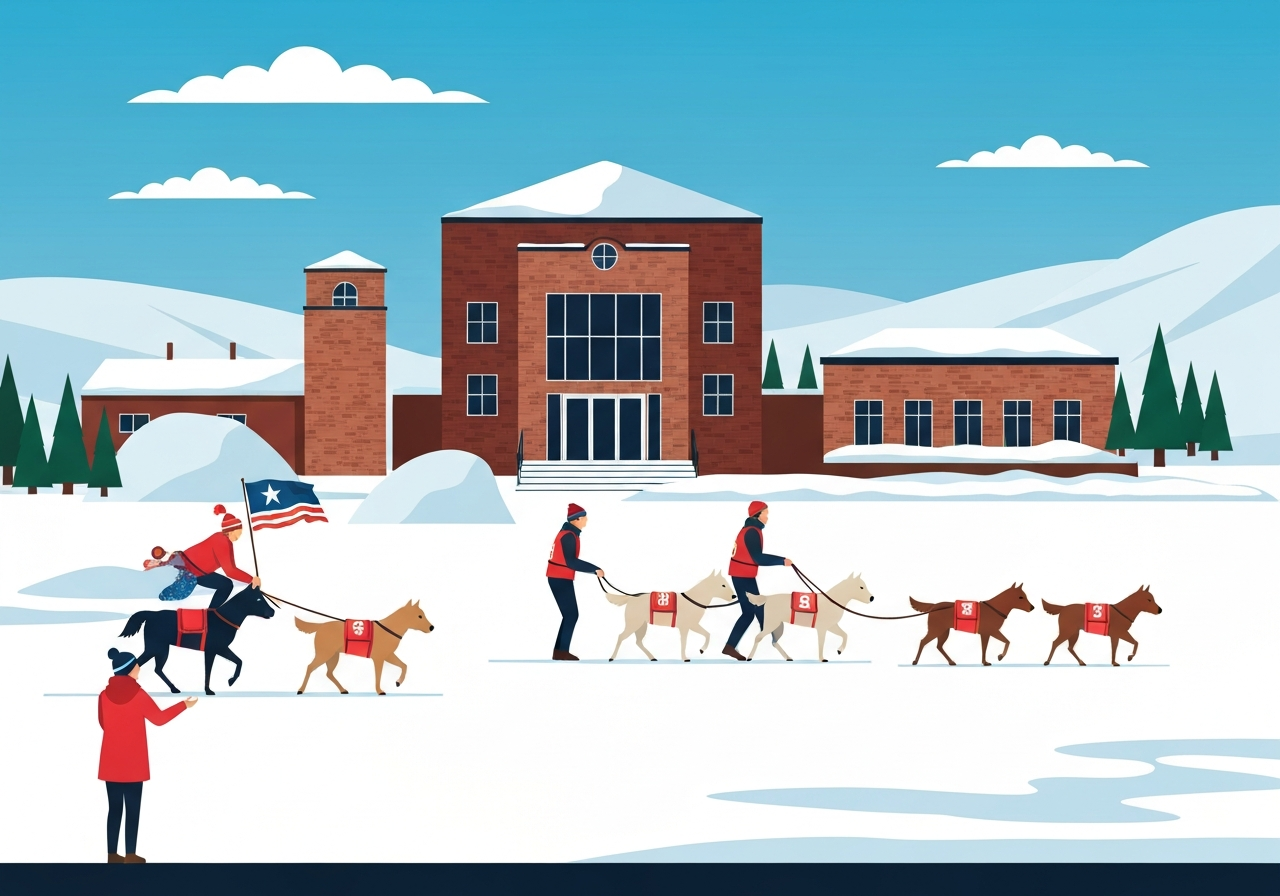
The ceremonial start of the Iditarod’s 54th running filled downtown Anchorage with barking teams and cheering crowds on Saturday, a day before the official 1,000-mile competitive race begins. Organizers staged 11 miles (18 kilometers) of trails through the city for fans to greet mushers and dogs before the timed start on Sunday on a frozen lake about 75 miles (120 kilometers) north of Anchorage. This year’s field features 34 competitive mushers — matching the number who began the inaugural 1973 race — while three additional entrants are competing in a new honorary category. Financial backing from Norwegian billionaire Kjell Rokke has increased the purse and provided direct support to Alaska Native checkpoint villages, reshaping both funding and debate around the event.
Key Takeaways
- Event: Ceremonial start took place in downtown Anchorage on Saturday; the competitive 1,000-mile (1,610-kilometer) race begins Sunday on a frozen lake ~75 miles (120 km) north of Anchorage.
- Field size: 34 mushers are entered for championship eligibility this year, matching the 1973 inaugural field; 37 people are on the trail with three in an honorary category.
- Prize money: Norwegian backer Kjell Rokke added $100,000 to raise the race purse to $650,000; the winner’s payout is now projected at about $80,000, up from nearly $57,000 last year.
- New category: The Iditarod Expedition Musher Program permits honorary entrants (allowed outside assistance) and includes high-profile participants such as Kjell Rokke and Canadian entrepreneur Steve Curtis.
- Support to communities: Rokke committed $170,000 in aid to 17 Alaska Native villages that serve as official checkpoints along the trail.
- Competitors of note: The field includes defending champion Jessie Holmes, 2023 champion Ryan Redington, 2019 winner Pete Kaiser, and three former champions overall seeking additional titles.
- Course conditions: Organizers expect deep snow across much of the route, which crosses two mountain ranges, the frozen Yukon River and hazardous Bering Sea ice, with the winner anticipated early the week of March 16.
Background
The Iditarod originated as a tribute to Alaska’s mushing heritage and the historic Iditarod Trail, a 938-mile (1,510-kilometer) freight and mail route linking Seward on the southern coast to Nome on the Bering Sea. Co-founders Dorothy Page and Joe Redington Sr. envisioned a long-distance sled race that would celebrate that history while energizing Anchorage, the state’s largest city, as a civic focal point. The race established a finish on Nome’s waterfront in part due to the efforts of Howard Farley; by design the course tests endurance across vast, remote terrain rather than a short sprint.
When the first modern Iditarod ran in 1973, 34 mushers started and 22 finished, with Dick Wilmarth winning in 20 days and famously never returning because, as he quipped, “Cause I won.” Over five decades the event has become faster and more professionalized: winners now commonly reach Nome in roughly 10 days. Participation has fluctuated, peaking at 96 starters in 2008; in the past decade fields have trended smaller as veteran mushers retired and operating costs — particularly dog food and kennel maintenance — rose.
Main Event
The ceremonial start in downtown Anchorage offers fans an up-close experience: mushers and teams travel roughly 11 miles (18 kilometers) through city trails, allowing spectators to meet dogs and watch teams leave under fanfare. That procession concludes before the competitive portion begins on Sunday at a lake checkpoint; timed racing covers approximately 1,000 miles (1,610 kilometers) to Nome. Organizers run the ceremonial start a day earlier specifically to concentrate spectator energy in Anchorage while preserving the competitive integrity of the timed course.
This year’s roster lists 37 entrants on the trail, but only 34 are eligible for championship standings and prize money because the Iditarod added an honorary Iditarod Expedition Musher Program. That program allows nontraditional entrants to race with permitted outside assistance and separate rules; among them are Kjell Rokke, who lives in Switzerland, and Canadian entrepreneur Steve Curtis. Rokke will be supported by Norwegian musher Thomas Waerner, the 2020 champion, and Curtis will receive assistance from four-time champion Jeff King via snowmachine.
Rokke’s financial contributions are prominent in this edition: he increased the purse by $100,000, lifting the total to $650,000, and pledged $170,000 to the 17 Alaska Native villages that function as official checkpoints. Race officials say the purse increase should raise top payouts to roughly $80,000 for the winner, a notable rise from last year’s nearly $57,000. Curtis’s recent commitment of $50,000 to youth sports programs in trail villages was announced days before the ceremonial start, according to race social posts.
Analysis & Implications
The infusion of private capital highlights how the Iditarod is adapting to rising operational costs and a shrinking pool of career mushers. Organizers and veteran racers frame Rokke’s support as an attempt to create more sustainable financing mechanisms for both races and competitive kennels, while maintaining dog-care and racing standards. If such patronage becomes common, it could offset barriers that deter prospective mushers but also shift governance questions about influence, sponsorship disclosures and competitive fairness.
The introduction of an honorary category raises policy questions about race identity and equity. Allowing outside assistance for certain entrants preserves the traditional competition while broadening participation and fundraising potential; however, critics argue it may blur public perceptions and fan expectations about what constitutes a competitive Iditarod entry. Clear labeling, separate prize structures and transparent rules for assistance are therefore central to preserving competitive integrity.
Economically and socially, Rokke’s village support addresses longstanding concerns about checkpoint communities’ resources during race season. Direct financial aid to 17 Alaska Native villages could improve local services tied to the event — logistics, hospitality and emergency support — but long-term benefit depends on sustained investment and partnership with tribal authorities. International entrants continue to underline the race’s global profile: this year includes competitors from Canada, Norway and Denmark among the championship-eligible mushers.
Comparison & Data
| Year | Starters | Purse (USD) | Winner’s Time (approx) |
|---|---|---|---|
| 1973 | 34 | — | 20 days |
| 2008 | 96 | — | — |
| 2023 | 33 | — | — |
| 2025 | 33 | — | — |
| 2026 (54th) | 34 (37 total with 3 honorary) | $650,000 | ~10 days (expected arrival week of March 16) |
The table underscores a return to the inaugural field size for championship-eligible mushers this year while showing long-term variation in participation. The purse increase to $650,000 is a measurable shift in the race’s commercial profile; organizers estimate the top payout will rise to about $80,000. Course distance remains near 1,000 miles (1,610 kilometers) with variable conditions that largely determine travel times from a week to nearly three weeks historically.
Reactions & Quotes
Race supporters and some mushers describe Rokke’s backing as pragmatic financial relief for a sport with rising costs, while other observers caution that donor influence should be transparent. Officials framed the initiative as a way to maintain high standards for dog care and competition while exploring sustainable funding models.
I believe it is healthy for the sport to evolve and look at new opportunities. The cost of running a competitive kennel has increased significantly over the years, and this initiative is an attempt to explore more sustainable ways to finance both a racing kennel and the race itself — while maintaining high standards for dog care, training, competition, and overall quality.
Thomas Waerner (AP interview)
Historical perspectives highlight how the race has changed since its first edition, when winners sometimes retired immediately after victory.
“Cause I won.”
Dick Wilmarth (1973 champion)
Unconfirmed
- Whether Rokke’s contribution will become a recurring funding model for the Iditarod beyond the current race remains unclear and has not been confirmed by a multi-year pledge.
- The long-term impact of the Iditarod Expedition Musher Program on championship competitiveness and field size is not yet measurable and depends on future participation and rule changes.
Bottom Line
The 54th Iditarod blends a deep-rooted Alaskan tradition with new funding realities: a ceremonial downtown start delivered spectacle for fans Saturday, while the competitive 1,000-mile trek to Nome begins Sunday. Financial backing from Kjell Rokke has immediately increased prize money and directed funds to checkpoint communities, easing some cost pressures for the sport but prompting debate about donor roles and program boundaries.
How organizers balance expanded participation pathways, transparency around outside assistance, and long-term support for villages and mushers will shape the Iditarod’s direction in the coming years. For fans and communities, the short-term result is a renewed purse and high-profile entrants; the longer-term questions concern governance, sustainability and the race’s identity as both a competitive event and cultural institution.
Sources
- Associated Press — News report on the Iditarod’s 54th run (news organization)
- Iditarod Official Site (official race organization)