
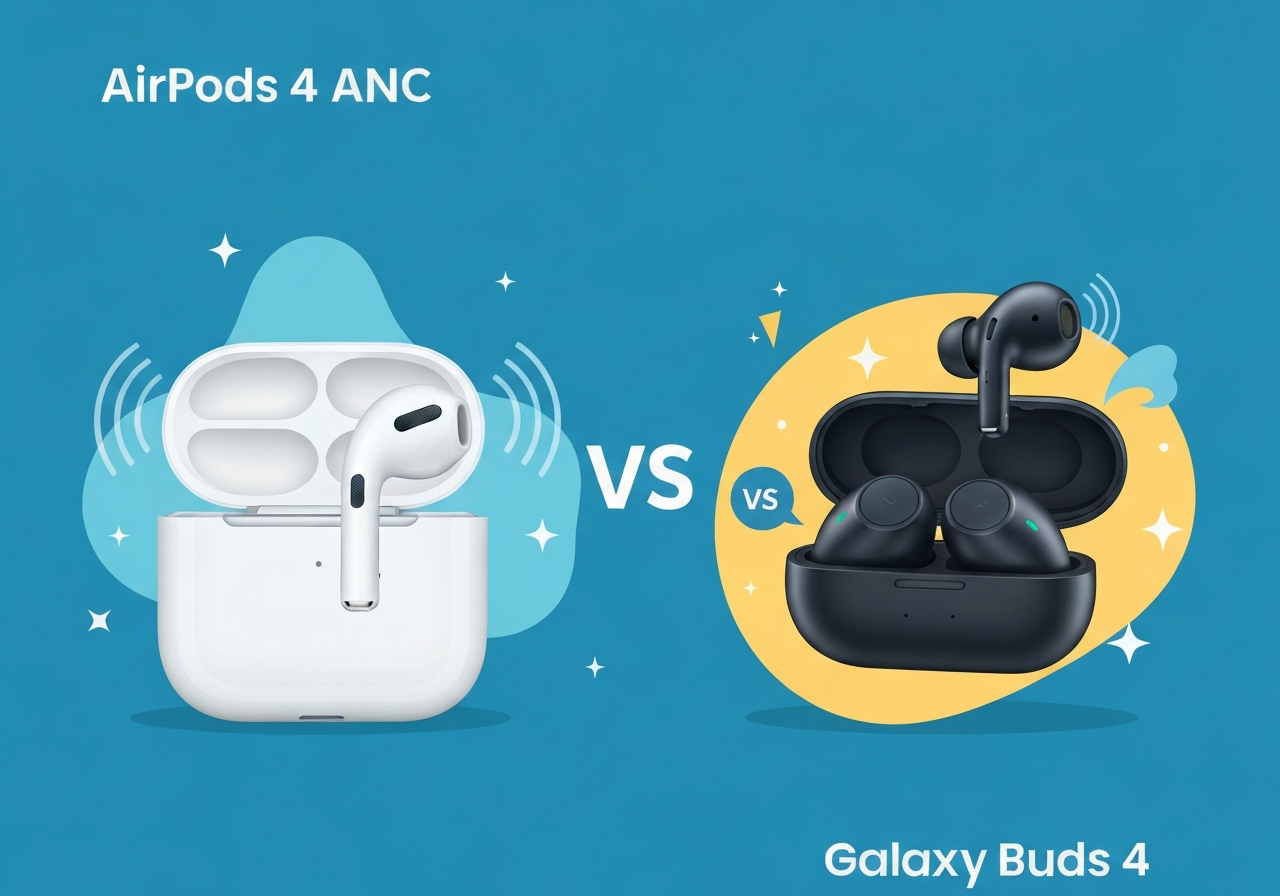
Lead: I compared Apple’s AirPods 4 with active noise cancellation (ANC) and Samsung’s new Galaxy Buds 4 in side‑by‑side listening, battery and feature tests to see which pair should be your everyday earbuds. The testing took place with both iPhone and Android devices, using identical playlists and real‑world scenarios such as office work, commuting and calls. Both models retail at $179 in the U.S., and each has strengths: the AirPods emphasize detail while the Galaxy Buds favour bass and extra features. After scoring design, connectivity, sound, ANC, calls and battery, one model edged the other by a single point.
- Price parity: In the U.S. both are $179; in the U.K. Galaxy Buds 4 list at £159 versus AirPods 4 ANC at £169.
- Connectivity: Galaxy Buds 4 use Bluetooth 6.1 and support Samsung’s UHQ codec up to 96 kHz, while AirPods 4 ANC use Bluetooth 5.3 and AAC.
- Battery: Galaxy Buds 4 deliver about 6 hours per charge (30 hours with case); AirPods 4 ANC offer about 5 hours per charge (30 hours with case).
- ANC & fit: Neither open‑fit design provides the full passive seal needed for strong ANC; both are adequate for quiet offices but weak on planes and loud transit.
- Sound signature: AirPods 4 lean toward detailed, high‑resolution presentation; Galaxy Buds 4 emphasize richer bass and wider low‑end warmth.
- Durability: Galaxy Buds 4 are rated IP57; AirPods 4 ANC are IP54.
- Overall score: On the review scorecard the Galaxy Buds 4 scored 70, the AirPods 4 ANC scored 69.
Background
Apple and Samsung now both offer multiple tiers of true wireless earbuds: flagship ‘Pro’ models and more affordable mainstream lines. AirPods 4 ANC and Galaxy Buds 4 sit in the non‑Pro, value‑oriented segment while attempting to bring higher‑end features like spatial audio and multipoint connectivity to a lower price point. The market has been shifting: manufacturers add software tricks (spatial audio, interpreter modes) and newer codecs to differentiate midrange models from basic earbuds.
Historically, Apple’s AirPods family has been tuned for clarity and integration with iOS, while Samsung’s Buds series have focused on bass, battery and features for Galaxy owners. This latest Buds 4 refresh brings Bluetooth 6.1 and Samsung’s UHQ audio option for compatible phones, a technical advantage on paper that Samsung hopes will close any perceptual gap with premium Apple models. Consumers now expect both hardware refinement and software services (voice assistants, find‑my features, device switching) even at the $179 price point.
Main Event
Design testing began by passing both earbuds around the office for immediate impressions. The AirPods 4 keep Apple’s familiar open‑fit silhouette with a shorter stem; some testers noted an abrupt nozzle end and an angle that didn’t suit every ear. Samsung’s Buds 4 adopt a refined ‘Blade’ stem with a tactile silver rear panel used for touch controls. Subjective preference split evenly among colleagues, so we mark design a draw overall.
On connectivity, Samsung’s use of Bluetooth 6.1 and UHQ delivers higher theoretical bitrates and sample rates (up to 96 kHz) for compatible phones, while Apple relies on AAC and the broader Apple ecosystem integration. In practice, UHQ sounded notably more expansive on a compatible Galaxy device, offering wider separation and perceived depth; with non‑Samsung phones the advantage diminishes.
For listening tests I used a mix of rock, pop and electronic tracks. On detailed tracks like Nirvana’s “Big Cheese,” AirPods 4 revealed more upper‑mid detail and instrument separation but could sound a touch pinched at the top of the mids. Galaxy Buds 4 delivered a powerful bass presence that sometimes pushed vocals back, but on bass‑forward pop and electronic tracks they were more enjoyable to many listeners.
Neither model produced strong ANC performance because both use an open or semi‑open fit without silicone ear tips, which limits passive isolation. They are OK for offices and light commuting but fall short on aircraft and very noisy public transport. Call quality was broadly similar and competent; both reduced background noise reasonably well and made voices clear for everyday calls.
Analysis & Implications
Sound preference remains the single largest determinant for buyers in this segment. Apple’s approach targets listeners who prioritise clarity and spatial accuracy; Samsung targets those who prefer a warm, bass‑forward presentation and seek higher fidelity when paired with a Galaxy phone. That means ecosystem and phone ownership still heavily influence the practical value of each option.
Samsung’s technical lead with Bluetooth 6.1 and UHQ is meaningful, but its benefit is conditional: you need compatible Samsung hardware and the right app support to unlock the full advantage. For cross‑platform users or those on non‑Samsung Android phones, the perceived uplift is smaller. Apple’s strengths are its consistent cross‑device experience inside iOS and deeper integration with services like Find My and Siri.
ANC limitations matter because many shoppers expect midrange ANC earbuds to handle travel and noisy environments. The open‑fit design used by both products trades passive isolation for wearer comfort and awareness; consumers who frequently fly or commute in loud settings will still prefer silicone‑tip models with stronger ANC. Manufacturers may respond by offering hybrid models or firmware updates to enhance adaptive algorithms, but physical seal limitations will remain.
Comparison & Data
| Specification | Galaxy Buds 4 | AirPods 4 ANC |
|---|---|---|
| Price (U.S.) | $179 | $179 |
| Price (U.K.) | £159 | £169 |
| Connectivity | Bluetooth 6.1, UHQ (Samsung) | Bluetooth 5.3, AAC |
| ANC | Yes (open fit) | Yes (open fit) |
| Battery (buds/case) | 6 hrs / 30 hrs | 5 hrs / 30 hrs |
| Durability | IP57 | IP54 |
| Review score (100) | 70 | 69 |
Context: the Galaxy Buds 4 gain an hour more single‑charge playtime, a higher dust/water rating (IP57) and a newer Bluetooth standard, which combined produced the one‑point lead on our scoring chart. The AirPods remain attractive for iPhone users thanks to tight iOS integration and consistent spatial audio handling.
Reactions & Quotes
“UHQ actually makes music sound incredible,”
Tom’s Guide review observation
This remark captures the subjective effect of Samsung’s higher‑resolution codec on compatible devices: increased width and instrument separation that some listeners find transformative.
“Neither bud has a silicone tip to get that all‑important ‘seal’,”
Tom’s Guide technical note
That observation underlines why ANC on both models is inherently limited: open or semi‑open earbuds cannot achieve the same passive isolation as in‑ear silicone‑tip designs.
Unconfirmed
- Price trajectories: exact timing and depth of future Galaxy Buds 4 discounts are not confirmed and depend on retailer promotions.
- Firmware updates: potential future firmware changes that might improve ANC or codec compatibility have been hinted at by manufacturers but are not yet confirmed.
Bottom Line
If you own a Samsung Galaxy phone and value warm, bass‑forward sound plus a slightly longer battery life and UHQ support, the Galaxy Buds 4 are the practical pick and earned a narrow overall lead in our testing. They offer superior durability (IP57), Bluetooth 6.1, and a listening character that many contemporary pop and electronic fans will prefer.
If you live primarily inside Apple’s ecosystem, the AirPods 4 ANC remain a compelling choice because of seamless iOS features, spatial audio consistency and a more detail‑oriented presentation. For travel or noisy environments, however, shoppers should consider silicone‑tip ANC alternatives; neither open‑fit model here replaces the isolation of in‑ear ANC pro designs.
Sources
- Tom’s Guide — Review and testing notes (technology review)
- Samsung product information (manufacturer / official)
- Apple product information (manufacturer / official)