
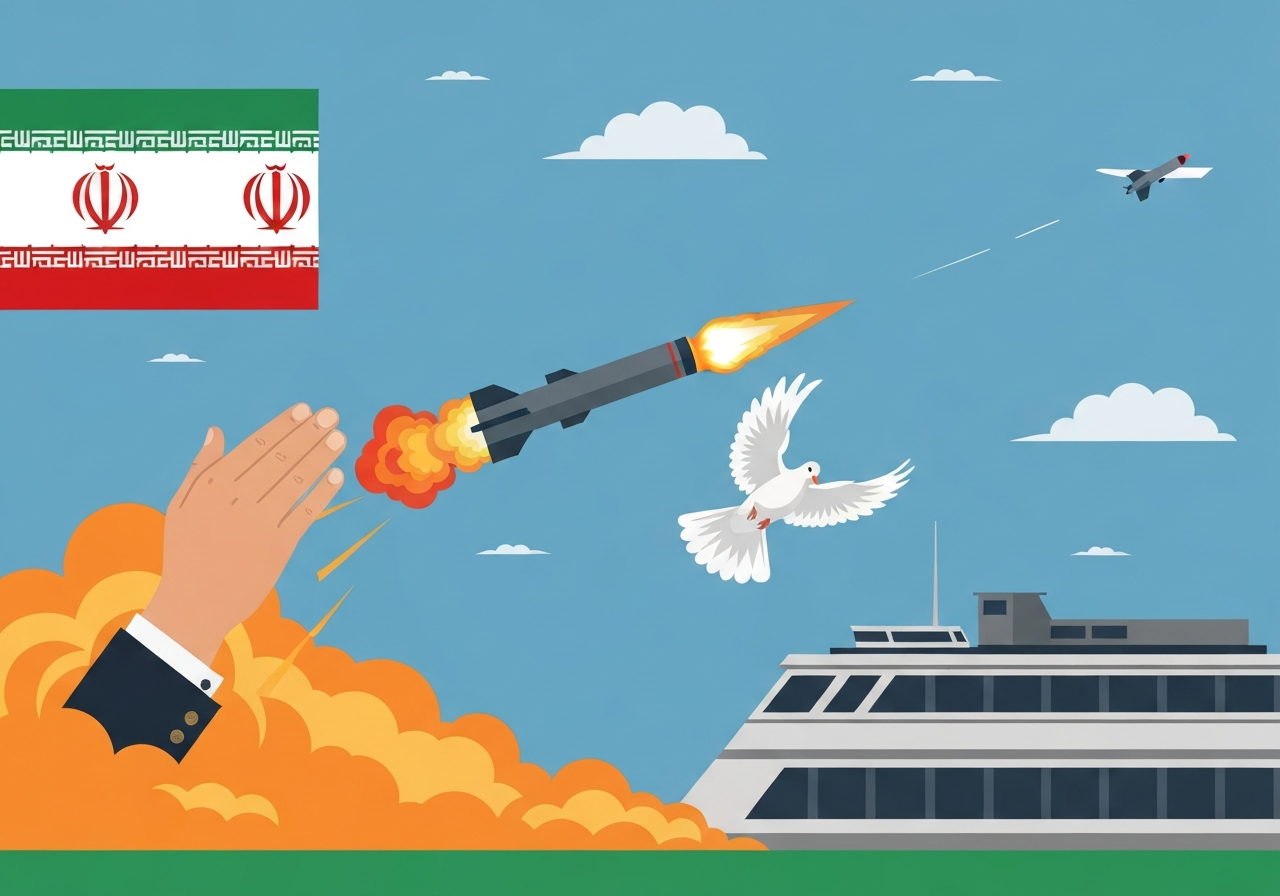
On the morning of , a missile or armed drone fired from Iran exploded near Dubai International Airport (DXB), briefly halting operations and prompting flight holds and diversions. Damage to aircraft and terminal infrastructure appears limited, but the blast occurred alarmingly close to passenger areas. Emirates suspended and then restored a reduced schedule within hours, while regional concern over a string of recent strikes has grown. Tehran’s interim leadership, led publicly by President Masoud Pezeshkian, issued an apology to neighbouring states and said it would suspend attacks on nearby countries unless those countries host attacks directed at Iran.
Key Takeaways
- On March 7, 2026, an Iranian-fired munition exploded near Dubai International Airport (DXB), prompting temporary suspension of airport operations and flight diversions.
- Reported physical damage appears limited to nearby infrastructure; no confirmed large-scale destruction of aircraft has been reported so far.
- Emirates resumed a constrained schedule within hours, prioritizing repatriation flights and canceling or delaying regular services.
- Tehran’s acting leadership, represented by President Masoud Pezeshkian, publicly apologised to neighbouring countries and pledged to halt strikes on nearby states unless attacks originate from their territory.
- The incidents follow a series of strikes across the region after recent U.S. and Israeli actions against Iran, increasing uncertainty for carriers and passengers using Gulf hubs.
- Airline operations, insurance costs, and passenger confidence are under immediate stress; long-term routing and hub strategies face potential revision if strikes continue.
Background
The flare-up follows recent strikes by the United States and Israel on Iranian targets, which Tehran has answered with a campaign of missile and drone launches across the wider Middle East. Over the past week, a number of detonations and explosions have been recorded in the United Arab Emirates and other nearby states, raising questions about intent, accuracy and command-and-control. Dubai International Airport, one of the world’s busiest transfer hubs, was struck roughly a week prior to March 7, sustaining terminal damage and triggering an industry-wide reassessment of flight safety across Gulf airspace. Major carriers that rely on the UAE for network connectivity, including Emirates, have repeatedly revised schedules, prioritized repatriation and sought alternative routings to maintain service.
Regional governments have generally downplayed individual incidents as “minor” while pursuing increased security coordination and investigations. For airlines, the combination of intermittent strikes and opaque claims of responsibility complicates risk assessment, crew dispatch, and insurance coverage. The political backdrop includes competing priorities: states in the region balance economic dependence on aviation and tourism with domestic and foreign-policy pressures to respond or defend. Private-sector stakeholders—from airports to insurers—face compressed timelines to adapt operationally and commercially to an evolving threat environment.
Main Event
Early on March 7, 2026, airport controllers and eyewitnesses reported a blast near a terminal area at DXB that led to immediate suspension of some stands and temporary ground stops. While emergency crews were deployed and perimeter checks conducted, initial reports indicated the explosive device detonated outside core passenger circulation zones and did not cause mass casualties. Nevertheless, flight operations were disrupted: some arriving aircraft entered holding patterns, others were diverted to alternate airports, and departure boards showed multiple delays and cancellations for several hours.
Emirates’ public-facing support channel issued, then removed, an earlier operational update to avoid confusion before confirming a scaled resumption of services. The airline described the restored schedule as limited and focused on repatriation and essential services, reflecting both safety caution and ongoing demand to return stranded passengers. Airport authorities have been working to verify structural integrity and operational readiness while coordinating with national security agencies to review surveillance and perimeter defenses.
Tehran’s temporary leadership council, speaking through President Masoud Pezeshkian, framed the action differently: it both acknowledged the incidents affecting neighbouring states and announced a policy shift to suspend strikes on nearby countries unless those states become a launch platform for attacks on Iran. The statement stopped short of altering Tehran’s stance toward the United States or Israel, which were explicitly excluded from the pledge. Local officials in the UAE continue to describe the incidents as containable while maintaining heightened alert levels.
Analysis & Implications
The immediate operational impact on Dubai is tangible but limited: DXB handled a temporary disruption and partial resumption, but repeated incidents erode its value as a reliable global hub. Airlines routing through the Gulf face a trade-off between operational continuity and passenger safety; repeated strikes raise crew-rest, diversion, and overflight-risk calculations that could drive longer routings or frequency cuts. Insurers may respond with higher premiums or specific war-risk clauses for flights to and from affected airports, increasing costs for carriers and, ultimately, passengers.
Strategically, Tehran’s apology and conditional pledge signal a possible de-escalatory opening designed to reduce regional blowback while preserving deterrence against direct U.S. and Israeli military pressure. The caveat—that strikes will resume if attacks originate from neighbouring territories—creates a conditional calm rather than an absolute ceasefire. Verification will become a central diplomatic and intelligence challenge: neighbouring states will likely demand mechanisms to ensure their airspace is not used for offensive actions, while Iran will seek assurances against external strikes conducted from third-party soil.
For regional diplomacy, the apology creates a narrow window for negotiation and confidence-building measures, but skepticism is widespread. Neighbouring states and international carriers will press for concrete steps: transparent incident investigations, agreed notification channels, and technical measures to protect airports and approach corridors. Absent such measures, even a formal pledge may not prevent future operational disruptions if misfires, miscalculations or asymmetric actors persist.
Comparison & Data
Compared with an incident roughly a week earlier that damaged DXB’s terminal infrastructure, the March 7 explosion was reported to have caused limited new structural damage but nonetheless produced similar operational effects—ground stops, holds and diversions. Both episodes demonstrate a pattern: strikes in the vicinity of airport property trigger outsized operational responses from carriers and air traffic control, even when physical harm is limited. That pattern points to aviation’s high sensitivity to security events and explains why airlines often ground or reroute flights as a precautionary measure.
Reactions & Quotes
UAE officials and airport operators described the incident as serious enough to merit temporary suspension of select operations while emphasizing passenger safety. Airlines communicated evolving operational notices to travelers, reflecting the fluid on-the-ground situation and the need to prioritize repatriation flights.
“I must apologise on my own behalf and on behalf of Iran to the neighbouring countries that were attacked by Iran.”
Masoud Pezeshkian, President (public statement)
This apology, issued by President Pezeshkian, was accompanied by a conditional policy declaration and framed as a unilateral step by Iran’s temporary leadership to limit escalation with neighbouring states.
“The enemies must take their wish for the surrender of the Iranian people to their graves.”
Masoud Pezeshkian, President (public statement)
That comment underscores Tehran’s continued adversarial posture toward the United States and Israel, even as it signals restraint toward bordering countries.
“Emirates has resumed operations. Passengers who have confirmed bookings for this afternoon’s flights may proceed to the airport.”
Emirates Support (airline communications)
Emirates’ communications—both public and then clarified—highlight the operational challenge of managing traveler information amid rapidly changing security assessments.
Unconfirmed
- Whether Iran intentionally calibrated strikes to avoid mass casualties and major infrastructure damage remains unverified and has not been independently confirmed.
- It is unclear how Tehran intends to verify that neighbouring territories are not being used for attacks against Iran, or what monitoring and communication mechanisms would enforce the pledge.
- Formal third-party assessments of the full extent of damage to airport systems and aircraft are pending and may revise initial impact estimates.
Bottom Line
The March 7, 2026 explosion near Dubai International Airport intensified operational disruption at a major global aviation hub and highlighted the fragility of air services amid regional hostilities. Tehran’s apology and conditional pledge to suspend attacks on neighbouring countries reduce the immediate risk profile but fall short of a comprehensive de-escalation, given the exception for attacks originating from those territories and continued hostility toward the United States and Israel.
Practical consequences are likely to include continued airline schedule volatility, higher insurance and operating costs for Gulf routes, and increased diplomatic pressure for transparent incident-verification mechanisms. Travelers and carriers should expect heightened sensitivity around aviation notices in the coming weeks as authorities and airlines seek clearer assurances that overflight and airport operations will remain secure.
Sources
- One Mile at a Time (travel media report summarising the incident and statements)