
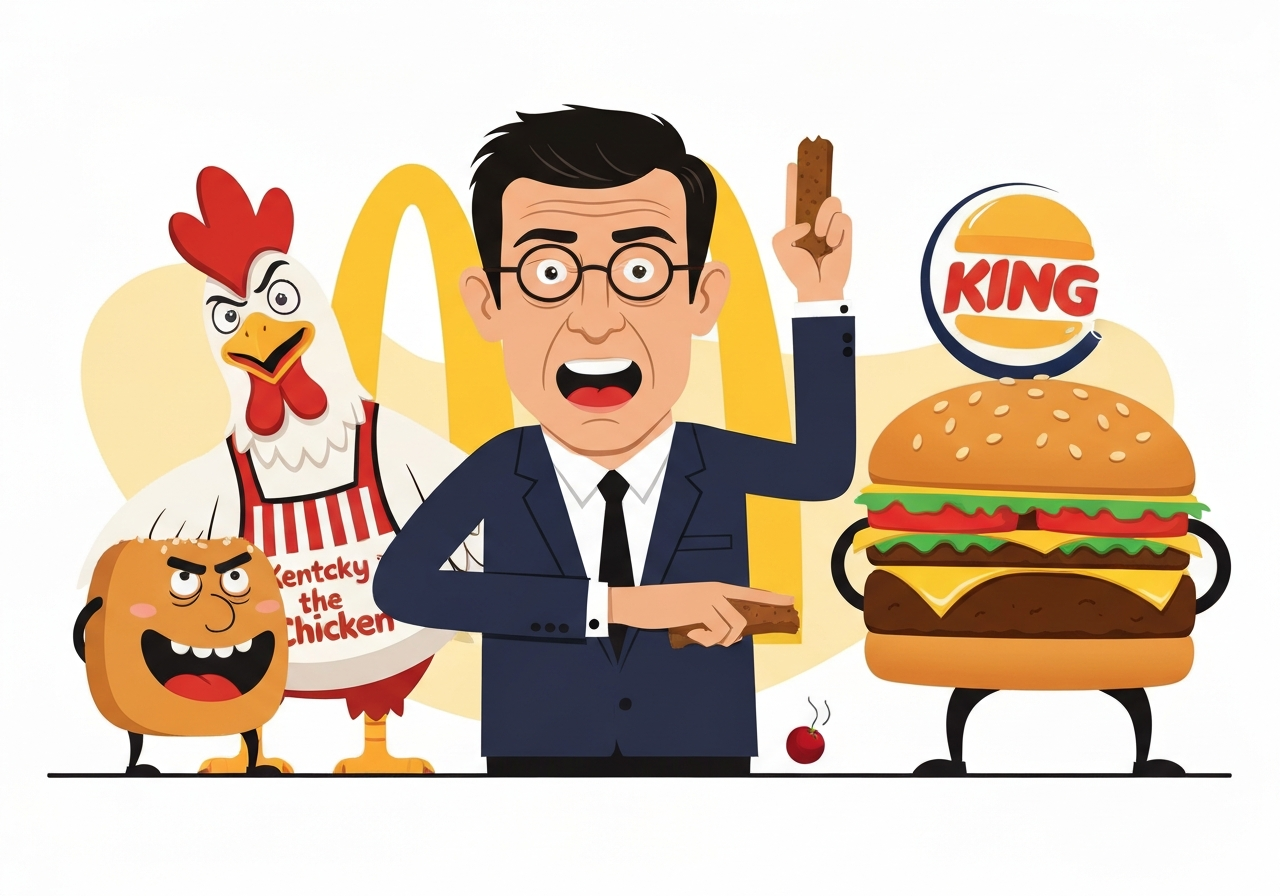
McDonald’s CEO Chris Kempczinski found himself at the center of a viral social-media skirmish after a February clip of him taking a small bite of the chain’s upcoming Big Arch burger resurfaced as the product’s March launch approached. The short, 81-second video — in which Kempczinski praised the sandwich ahead of a single, timed nibble — triggered a cascade of mocking responses from rival chains across platforms. Competitors from Burger King and Wendy’s to Jack in the Box, A&W Canada and KFC released cheeky videos or comments that amplified the moment into a wider fast‑food feud. By March 7, 2026 the exchange had broadened beyond burgers into public jabs about chicken, biscuits and even a hiring contest announced by Wendy’s.
Key Takeaways
- A February video of McDonald’s CEO Chris Kempczinski briefly tasting the Big Arch resurfaced as the burger neared its March 2026 release, drawing intense social attention.
- The resurfaced clip runs about 81 seconds and features a single, staged bite that viewers quickly highlighted as brief and highly timed.
- Rivals responded with branded videos and posts — Burger King and Wendy’s among them — turning the moment into a multi‑brand social campaign.
- Wendy’s announced a contest on March 5 to hire a Chief Tasting Officer with a $100,000 salary, prompting taunts from Popeyes and others.
- Jack in the Box, A&W Canada and Freddy’s posted videos or TikToks explicitly riffing on the “small bite” moment to invite further ridicule.
- KFC U.S. President Catherine Tan‑Gillespie posted a video on March 6 emphasizing chicken over beef and took a prominent bite of a KFC sandwich on camera.
- The biscuits thread between Church’s Chicken and Popeyes generated nearly 1,000 comments, underscoring how the spat expanded into product quality debate.
Background
Fast‑food brands increasingly treat social media as both battleground and megaphone; staged taste tests and executive appearances are common tactics to humanize launches and spark earned media. Product reveals — especially for limited or headline items — are planned months in advance and frequently rely on snackable video to drive awareness. In this environment, any deviation from the scripted narrative can become an asset for competitors looking to seize free publicity.
McDonald’s positioned the Big Arch as its largest burger ever and scheduled its arrival for March 2026, so promotional assets circulated in the weeks beforehand. Executives tasting new items on camera is a longstanding marketing device, but it also raises reputational risk: a short clip, an odd sound, or an offbeat line can be replayed and reframed by rivals and consumers alike. Franchisees, investors and marketing teams watch closely because launch momentum influences early sales and local marketing plans.
Main Event
The disputed material originated in a February clip of Kempczinski sampling the XXL Big Arch, where he praised the product before taking a single, staged bite. Viewers noted the brevity of that bite in the roughly 81‑second video, and critics quickly circulated screen grabs and short reaction clips. Business and social feeds amplified the moment, framing it as an awkward executive taste test rather than a straightforward product endorsement.
McDonald’s attempted to defuse the narrative with its own social post that echoed the CEO’s phrasing — inviting watchers to “take a bite of our new product” — signaling a self‑aware pivot from apology to lightheartedness. Rather than end the story, that move prompted rivals to lean in. Burger King and Wendy’s released playful content showing their executives or mascots enjoying larger, unambiguous bites.
Other chains pivoted from burgers to broader categories. Jack in the Box posted a video in which its Jack mascot mocked “small bites,” while A&W Canada shared a TikTok of a taste tester eating a Teen Burger and inviting Kempczinski to lunch. Freddy’s CEO Chris Dull posted an Instagram snippet demonstrating a more enthusiastic, all‑day eating routine.
The exchange widened on March 5 when Wendy’s unveiled a contest to hire a Chief Tasting Officer with a $100,000 salary; Popeyes replied on X (formerly Twitter) that hiring a taster might be wise, to which Wendy’s clapped back with “Flopeyes.” Church’s Chicken and Popeyes then traded barbs about biscuit quality, producing a thread of nearly 1,000 comments. On March 6, KFC U.S. President Catherine Tan‑Gillespie posted a video noting the number of CEOs talking about burgers and then taking a substantial bite of a KFC Chicken Sandwich, further steering the conversation to chicken.
Analysis & Implications
Social media gives brands a low‑cost pathway to hijack each other’s narratives; what began as a single promotional clip turned into a multi‑brand engagement engine that generated free impressions for every participant. For McDonald’s, the immediate cost is reputational noise ahead of a major launch; for rivals, the upside is increased visibility without the expense of traditional advertising. These exchanges often boost engagement metrics — likes, shares and comments — which platforms reward with broader distribution.
From a crisis communications standpoint, the episode illustrates two competing strategies: own the moment with self‑deprecating content or ignore it and let the narrative dissipate. McDonald’s chose self‑referential humor to regain control; rivals chose amplification and ridicule to position their own products as more authentic. Both strategies carry risk: self‑mockery can appear to admit fault, while taunting competitors can distract from a brand’s core product message.
Commercially, a social spat like this is unlikely to materially alter long‑term market shares, but it can influence short‑term trial rates and local sales during a product launch window. If the Big Arch performs well in day‑one sales despite the kerfuffle, the episode may be remembered as a promotional hiccup rather than a liability. Conversely, if initial sales underperform, critics may point to the social exchange as evidence of weak execution.
Comparison & Data
| Brand | Action | Date |
|---|---|---|
| McDonald’s | February CEO tasting clip surfaced; March Instagram post referencing bite | Feb / Mar 2026 |
| Wendy’s | Released playful videos; announced Chief Tasting Officer contest ($100,000) | Mar 5, 2026 |
| KFC | U.S. President posted bite of KFC Chicken Sandwich | Mar 6, 2026 |
| Jack in the Box / A&W Canada / Freddy’s | Posted mocking taste‑test videos inviting further banter | March 2026 |
The table summarizes the public, dated actions tied to the exchange; many posts were published across Instagram, TikTok and X in the opening days of March 2026, producing spikes in brand mentions. Social listening tools would show elevated share‑of‑voice for all brands involved, with sentiment split between amusement and criticism.
Reactions & Quotes
Company and executive comments were short and performative, designed to keep the tone light while drawing attention to each brand’s product.
“I love this product,”
Chris Kempczinski, McDonald’s CEO (clip)
The brief praise from Kempczinski — followed by a single, staged bite — was the clip’s focal point and the line most replayed in reactions and competitor posts.
“We’ll leave the beef to the boys,”
Catherine Tan‑Gillespie, KFC U.S. President (social video)
KFC’s senior executive used the clip to draw a clear category contrast and to spotlight chicken in a moment dominated by burger talk.
“Flopeyes,”
Wendy’s (social response to Popeyes)
Wendy’s and Popeyes traded concise jabs that prioritized shareable one‑liners and provoked a highly engaged back-and-forth among followers.
Unconfirmed
- Whether the February tasting clip was planned by McDonald’s corporate communications team or posted independently by an associate remains unspecified in public reporting.
- Any internal franchise or investor guidance that changed as a direct result of the social exchange has not been publicly disclosed.
Bottom Line
The episode underscores how modern product launches occur in public, and how quickly a controlled promotion can be repurposed into a cross‑brand spectacle. For McDonald’s, the incident is a reputational speed bump ahead of a high‑profile March release; for rivals, it was an invitation to harvest attention with little cost. Ultimately the question will be whether the Big Arch’s sales performance validates the publicity or whether critics will frame the episode as evidence of missteps.
Brands will likely treat this as a playbook moment: short, witty retorts can generate measurable engagement, but they do not replace consistent product quality and customer experience. Observers should watch early sales figures and consumer reviews in the weeks after the launch to judge which narrative — promotional noise or meaningful consumer preference shift — ultimately prevails.
Sources
- USA TODAY — news outlet (original report, updated Mar 7, 2026)
- McDonald’s Instagram — official corporate social account (post referenced)