
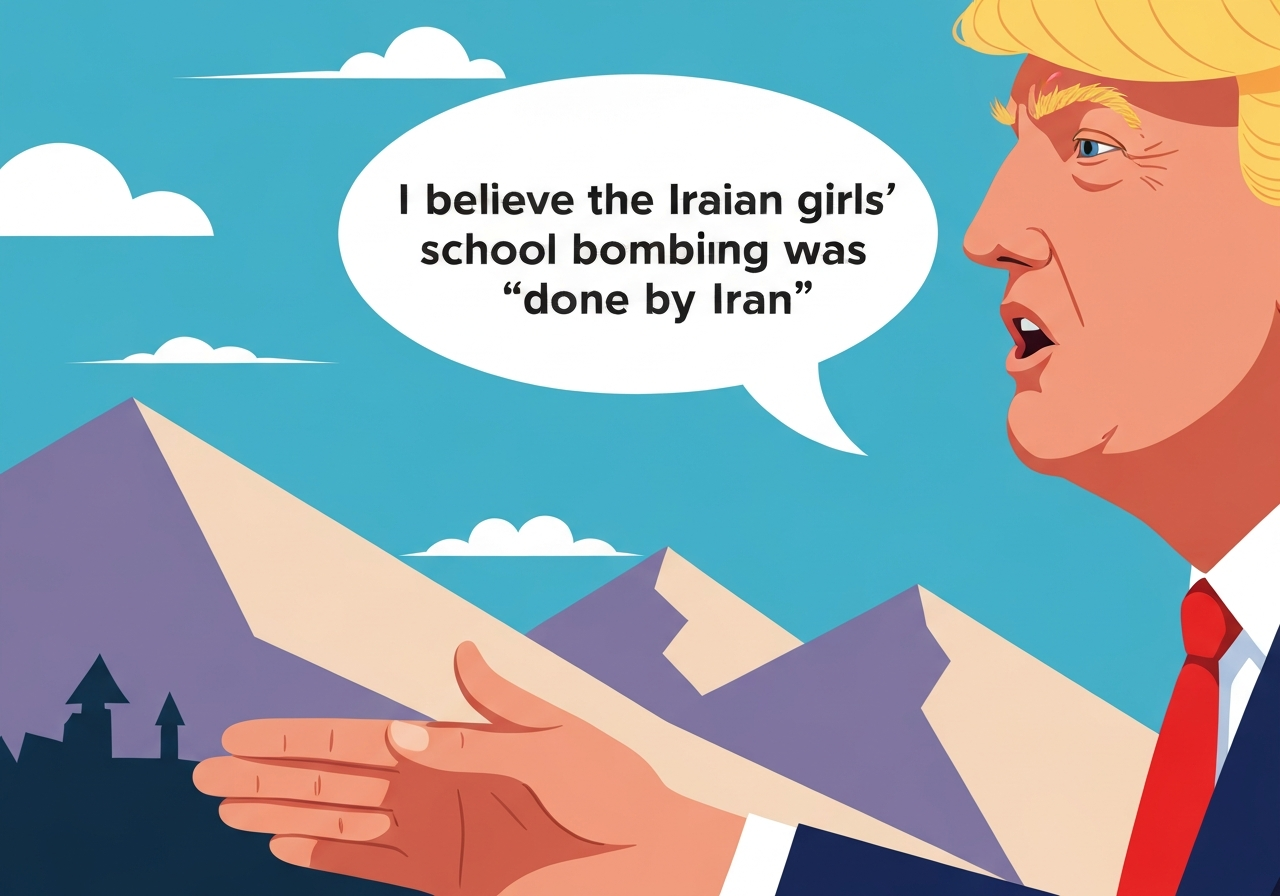
On March 7, 2026, President Donald Trump told reporters aboard Air Force One that, based on what he had seen, he believes the Feb. 28 strike on a girls’ primary school in Minab, southern Iran, was carried out by Iran. The allegation came after a dignified transfer for six U.S. service members killed in an Iranian strike in Kuwait on March 1 and amid competing claims about responsibility. Iranian state media and health officials reported dozens of deaths, including children aged 7 to 12, while Iranian authorities accused the U.S. and Israel. U.S. and Israeli officials have provided conflicting statements and an official U.S. inquiry remains ongoing.
Key takeaways
- President Trump publicly said on March 7, 2026, that he believes the Feb. 28 strike on a girls’ school in Minab was “done by Iran,” a statement offered without publicly cited forensic evidence.
- Iranian state media reported more than 170 fatalities from the Feb. 28 blast; Iranian health officials said the victims included schoolgirls aged 7 to 12.
- CBS News geolocated video of the explosion to the Shajareh Tayyebeh elementary school in Minab and confirmed the building’s proximity to two sites controlled by the Islamic Revolutionary Guard Corps (IRGC).
- Two sources told CBS News that Israel was not operating near the school at the time; one U.S.-familiar source cited to CBS said U.S. investigators are considering whether a U.S. weapon may have been involved.
- Defense Secretary Pete Hegseth said the Pentagon is “investigating,” and the White House spokeswoman warned against drawing conclusions before the inquiry is complete.
Background
The blast occurred on Feb. 28, described by Iranian officials as the first day of a broader war that has since escalated across the region. Iran’s government and state outlets rapidly blamed foreign actors — naming the United States and Israel — a familiar pattern in high-profile strikes that cause civilian casualties. Minab is a city in Hormozgan province on Iran’s southern coast; local footage circulated online showing smoke rising from a building painted with child-oriented murals, consistent with an elementary school site.
The Shajareh Tayyebeh elementary school, identified in Iranian reports and geolocated by CBS, sits near facilities the IRGC controls, a factor officials cite when discussing possible targeting motives or collateral effects. Historically, strikes in proximate military-civilian environments complicate attribution because munitions can miss intended targets or debris can cause secondary explosions. International law and wartime protocols require investigations into strikes that produce civilian deaths, especially involving children.
Main event
President Trump’s comments came after he attended the transfer of six U.S. soldiers killed in a March 1 strike in Kuwait. Speaking with reporters aboard Air Force One on March 7, he said he thought the Minab school strike was “done by Iran,” citing what he described as observations of munitions accuracy. He did not provide forensic evidence in that exchange.
Defense Secretary Pete Hegseth responded to a question about attribution by saying the Pentagon was conducting an investigation and repeating an assessment that Iran is the only party that targets civilians. The White House’s Anna Kelly urged restraint, saying there were no conclusions and calling premature assertions “irresponsible and false.”
Iranian state media and health officials reported the Feb. 28 blast killed dozens — with some state outlets putting the toll above 170 — and named children among the victims. Iranian authorities pointed to foreign involvement. Meanwhile, CBS reported two separate sources saying Israel was not operating in the area, and a U.S.-familiar source told CBS that U.S. investigators had not ruled out the possibility that a U.S. system was responsible.
Analysis & implications
Attribution in combat zones is technically complex: weapon fragments, flight paths, radar and communications intercepts, and satellite imagery are often required to establish who fired a lethal munition. A sitting president asserting responsibility publicly before forensic confirmation raises questions about how political narratives may shape public perceptions and diplomacy. Such statements can also complicate investigations by creating pressure for swift conclusions.
If investigations ultimately find Iran responsible, the claim would reinforce narratives used by regional rivals and could affect international support, sanctions, or retaliatory planning. Conversely, if a U.S. munition were implicated, the political repercussions in Washington and across U.S. alliances would be severe, with likely demands for operational reviews, accountability and potential policy changes to targeting and weapons employment.
The differing public statements from U.S. and Iranian officials also have short-term operational effects: denial or blame can harden domestic support for escalation and reduce diplomatic space for de-escalation. For humanitarian actors and reconstruction planners, confirmed civilian casualties on this scale will increase pressure for humanitarian access and independent monitoring.
Comparison & data
| Event | Date | Reported deaths (reported source) |
|---|---|---|
| School blast, Minab | Feb. 28, 2026 | >170 (Iranian state media) |
| U.S. soldiers killed, Kuwait | March 1, 2026 | 6 (U.S. military) |
These figures reflect publicly reported counts that are subject to verification. State-reported casualty totals in fast-moving conflicts can change as remains are recovered and hospitals update registers. Independent on-the-ground counts and forensic evidence are the standard means to reconcile divergent tallies reported by parties to a conflict.
Reactions & quotes
“In my opinion, based on what I’ve seen, that was done by Iran,”
President Donald Trump, March 7, 2026 (remarks aboard Air Force One)
Context: Mr. Trump offered the attribution during post-transfer remarks; he did not cite forensic evidence in the exchange.
“The Pentagon is investigating,”
Defense Secretary Pete Hegseth
Context: Hegseth said the Defense Department was examining the incident and additionally accused Iran of targeting civilians in its public remark.
“There are no conclusions at this time, and it is both irresponsible and false for anyone to claim otherwise,”
Anna Kelly, White House spokesperson
Context: Kelly reiterated the White House’s call for restraint while the inquiry proceeds and emphasized that the U.S. does not target civilians.
Unconfirmed
- President Trump’s public assertion that Iran carried out the Minab strike has not been substantiated with publicly released forensic evidence as of March 7, 2026.
- Iranian state media’s casualty figure of more than 170 remains unverified by an independent international body.
- Reports that U.S. investigators believe a U.S. weapon may have been responsible are preliminary and have not been confirmed by an official public U.S. forensic report.
Bottom line
The Minab school blast is a high-stakes incident with contradictory public claims and serious humanitarian consequences. Accurate attribution will require forensic evidence that has not yet been publicly released; premature conclusions by political leaders risk shaping policy and public opinion before investigators complete their work.
Readers should watch for a forensic report from the investigating authorities, independent verification by international monitors if allowed, and any changes in regional military posture that might follow formal attribution. The incident underscores the acute risks to civilians when fighting occurs near populated areas and the importance of transparent, evidence-based investigations.
Sources
- CBS News (U.S. media report; original reporting and statements cited)