
Lead
George Russell claimed victory at the 2026 Australian Grand Prix in Melbourne for Mercedes after a virtual-safety-car (VSC) sequence on Lap 11 tipped the strategic balance in the Silver Arrows’ favour. Kimi Antonelli completed a Mercedes one-two, finishing 2.9 seconds behind his teammate, with Charles Leclerc third, 12.5 seconds further back. The race, run over 58 laps, featured multiple early lead changes, two separate VSC periods and several reliability exits that highlighted the challenges of the new regulations. The outcome underlined Mercedes’ early-season strength while leaving Ferrari with a clear ’what if’ around its pit call.
Key takeaways
- George Russell (Mercedes) won the 2026 Australian Grand Prix, with Kimi Antonelli second; margin between the two was 2.9 seconds.
- Charles Leclerc finished third, 12.5 seconds behind Antonelli after dropping time following his later pit stop.
- The first VSC was triggered when Red Bull’s Isack Hadjar retired with a smoky engine on Lap 11 of 58; Mercedes pitted both cars under that neutralisation.
- Ferrari stayed out during the first VSC and later pitted Leclerc to hard tyres on Lap 25; Hamilton pitted on Lap 28.
- Mercedes recorded its first 1–2 since the 2024 Las Vegas Grand Prix, reinforcing its status as early favourite in 2026.
- Four cars failed to finish for reliability-related reasons, including Nico Hülkenberg (did not start) and Fernando Alonso (Honda-related problems with his Aston Martin).
- Rookie Arvid Lindblad scored four points with eighth place after qualifying ninth and holding contention through mid-race battles.
- Oscar Piastri crashed out on the reconnaissance lap roughly 35 minutes before the start, preventing him from taking the race start.
Background
The 2026 season opened under a new technical and power-unit formula that has shifted race management toward energy conservation and strategic deployment of battery power. Teams entered Melbourne having shown varied preseason form; Mercedes looked strong in qualifying while Ferrari demonstrated improved starts and early-race pace in practice and qualifying. The VSC and safety-car periods have increased the strategic value of pitting windows because time loss for a pit stop is reduced while the pack is slowed.
Milan-based Scuderia Ferrari arrived determined to erase a difficult 2025, and Charles Leclerc’s start in Australia — surging from fourth to the lead into Turn 1 — reinforced belief that the team’s initial race-pace work had paid off. Mercedes, by contrast, carried expectations from a dominant qualifying performance that suggested the Silver Arrows might be able to control race day if strategy and tyre management aligned. The presence of a lone rookie, Arvid Lindblad for Racing Bulls, added another storyline about adaptation to the new machines and energy-management demands.
Main event
Pole-sitter Russell lost the lead at the start, with Leclerc powering from fourth to first into Turn 1 and sparking a rapid scrap for position. Over the opening eight laps the lead changed hands five times as Russell and Leclerc traded places repeatedly, with Lewis Hamilton remaining close enough to influence the pace and tyre choices of the leaders. That early wheel-to-wheel action suggested a potentially prolonged Mercedes–Ferrari duel.
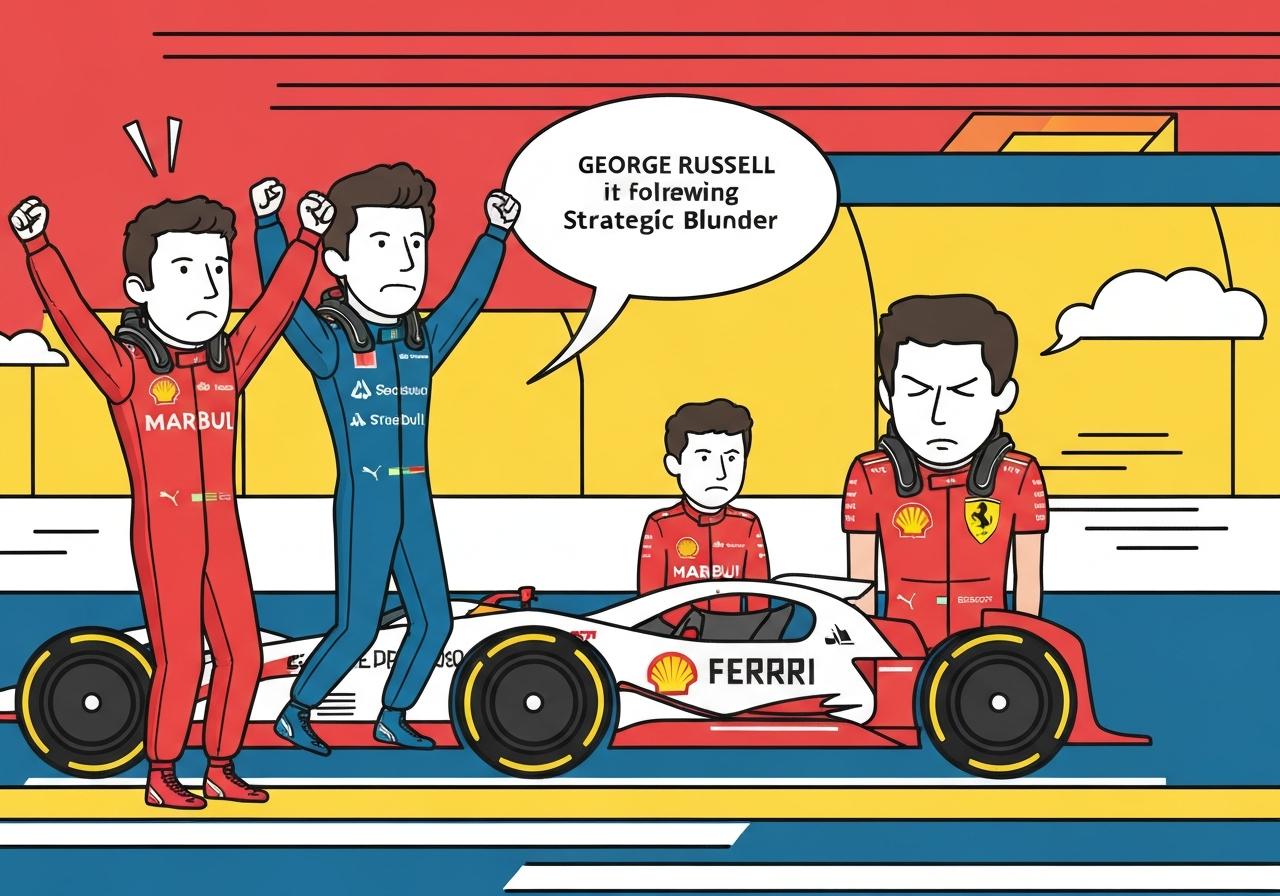
The complexion of the race shifted on Lap 11 when Isack Hadjar’s Red Bull developed smoke and was retired, prompting the first virtual safety car. Mercedes brought both its cars into the pits during that neutralisation and gained several seconds relative to rivals who stayed out. Ferrari declined to pit at that moment, a decision that would prove costly once Russell and Antonelli cycled ahead after taking service under the VSC.
A second VSC soon followed after Valtteri Bottas stopped at the pit entry; the pit lane was briefly closed to recover his Cadillac, denying teams another opportunistic stop and further complicating in-race strategy. Leclerc eventually stopped for hard tyres on Lap 25, with Hamilton following on Lap 28, but by then Russell and Antonelli had established track position. Both Mercedes drivers managed their long second stints well and eased to the finish without serious challenge from the red cars behind.
Off the main podium fight, reliability issues were prominent: Nico Hülkenberg never took the start, Fernando Alonso’s Aston Martin suffered Honda-related power problems, and other cars retired or were otherwise compromised. Oscar Piastri’s crash on the reconnaissance lap removed the Australian favourite from the race entirely, disappointing home fans and teammates alike.
Analysis & implications
Mercedes’ win and 1–2 result are a clear signal that the team has adapted fastest to the new regulations and power-unit characteristics. Securing both cars at the front required not only race pace but precise strategy calls under VSC conditions and disciplined tyre management across long stints. The margin of victory and the manner in which Mercedes converted the first VSC into track advantage suggest the team’s engineers and strategists have a current edge.
For Ferrari, the race exposes the thin margins of strategy under the new rules. The decision not to pit during the first VSC, combined with the subsequent pit-lane closure that eliminated a later opportunity, left Leclerc vulnerable once he stayed out and changed tyres later in the race. While Leclerc’s raw overtaking and early-pace capacity were obvious, the net effect of the pit-timing choices meant Ferrari could not sustain pressure on Mercedes through the second half.
McLaren’s performance illustrates the complexity of engine-integration versus outright chassis performance. Lando Norris finished fifth but was over 50 seconds behind Russell, a gap that teams in the paddock attributed partly to differences in how teams extract performance from the Mercedes-supplied power unit and its associated systems. Customer teams may lag the factory operation while they refine software and energy-management calibrations.
On a broader level, the race offered encouraging evidence that the new-generation cars can produce competitive wheel-to-wheel racing despite energy constraints. Early back-and-forth moves for the lead showed drivers could still craft successful passing manoeuvres, although the energy cost of repeated overtakes introduces a new tactical layer that will reward teams who master battery deployment and regeneration strategies.
Comparison & data
| Position | Driver | Team | Gap to winner |
|---|---|---|---|
| 1 | George Russell | Mercedes | — |
| 2 | Kimi Antonelli | Mercedes | +2.9s |
| 3 | Charles Leclerc | Ferrari | +15.4s |
| 4 | Lewis Hamilton | Mercedes | +17.9s |
| 5 | Lando Norris | McLaren | +50.0s+ |
| 6 | Max Verstappen | Red Bull | +51.2s+ |
The table above highlights the spread between the front-running Mercedes pair and the rest of the field. Russell and Antonelli benefited directly from an early VSC stop that, by reducing the time penalty of a pit sequence, allowed them to gain track position over teams that remained out. The gap to P5 underscores how concentrated performance currently is at the very front.
Reactions & quotes
Team and driver comments after the race reflected both satisfaction and frustration, with brief statements clarifying sequence and emotion.
“In the end, a race car is a race car, it’s got a throttle and a brake, but the energy is a bigger aspect… It’s not always about just being flat out, it’s about being more energy-aware.”
Arvid Lindblad, Racing Bulls (rookie)
Context: Lindblad, the lone rookie, explained how energy management shaped overtaking and stint decisions in his first F1 race, and he credited the team for getting the car into a competitive window in Melbourne.
“It’s obviously very disappointing… I’m just very sorry, obviously, for everyone that came out and wanted to support me.”
Oscar Piastri, McLaren
Context: Piastri addressed his reconnaissance-lap crash that prevented him starting the race, attributing the incident to a combination of a sudden electrical power surge from the engine and cold tyres while also accepting personal responsibility.
“We executed when it mattered and turned a timely VSC into track position — that was crucial today.”
Mercedes team representative (post-race)
Context: Mercedes highlighted the team-level coordination that delivered their one-two result, noting the strategic choice to pit under the VSC as decisive.
Unconfirmed
- Whether an alternative Ferrari call during the first VSC would have definitively beaten Mercedes remains unproven; the race suggests closer competition but not a guaranteed overturn.
- Piastri’s claim of an electrical power burst contributing to his reconnaissance-lap crash is the driver’s account; a formal technical report from McLaren or the FIA would be required to confirm the exact cause.
- The extent to which McLaren’s larger gap to Mercedes stems from chassis versus power-unit integration is debated in the paddock and will need deeper telemetry and team-level disclosures to quantify precisely.
Bottom line
Mercedes arrived at Albert Park with the strongest package on race day and converted opportunity into a textbook result: a strategic VSC stop, disciplined tyre management and consistent race pace produced a 1–2 finish. For Ferrari, the race was a reminder that racecraft and one-lap starts can win battles early but strategy execution across the full race remains decisive under the new rules.
The Melbourne race also offered encouraging signs for the spectacle of F1’s new era: close early racing, effective overtaking where drivers managed energy, and rookie Arvid Lindblad showing the kind of composure that could make him a regular points-scorer. Expect teams to refine VSC responses, pit-lane coordination and energy software as the championship moves on; small strategic gains look set to determine margins at the front for the immediate future.