
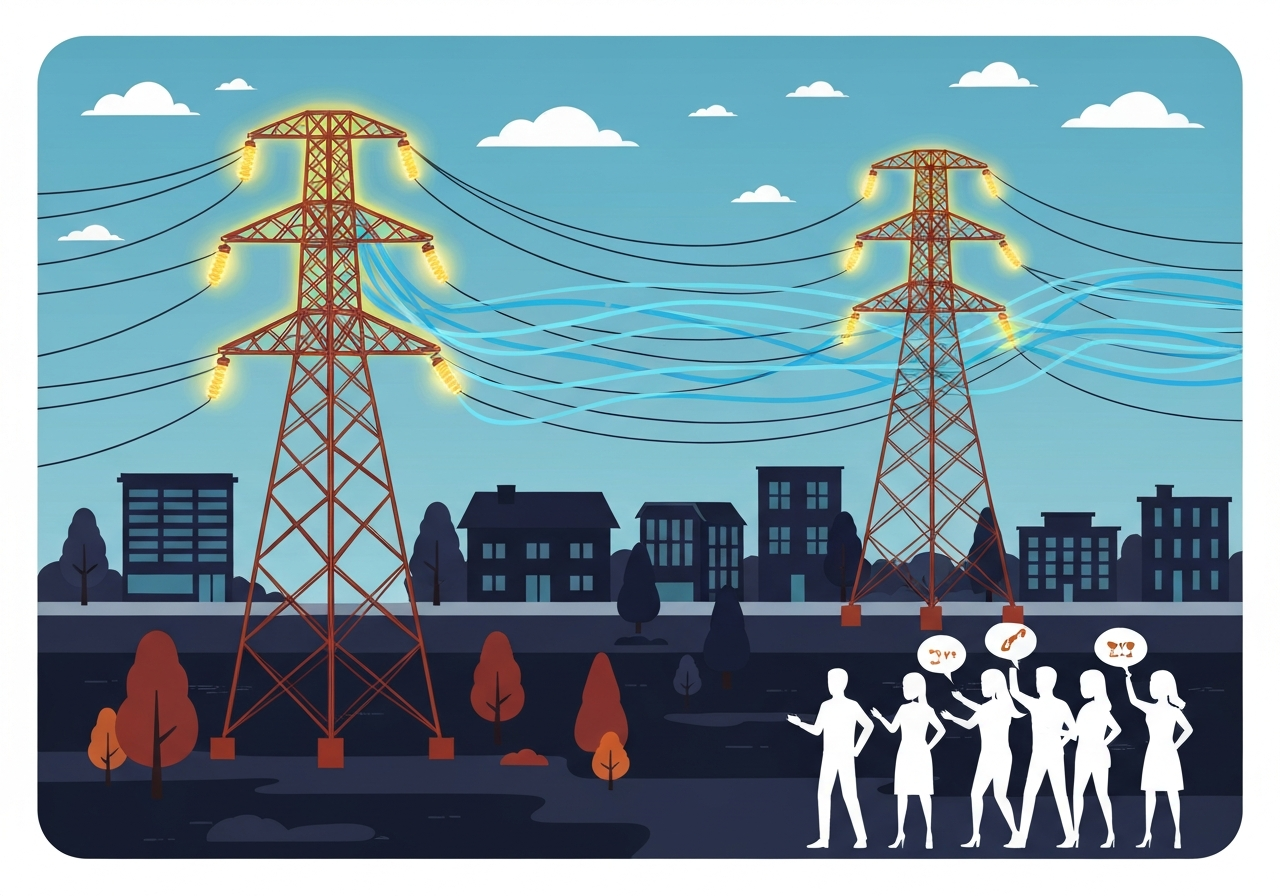
In late 2024 in Sugarloaf, Pennsylvania, landowner John Zola was told a contractor for utility PPL planned to run a 500-kilovolt transmission line across his 40-acre property, a move he says will put 240-foot steel towers and a roughly 200-foot corridor within yards of family homes and play areas. Utilities and grid operators say such large, long-distance lines are becoming necessary to meet rapidly growing electricity needs from massive data centers serving artificial intelligence workloads and to preserve reliability. Neighbors, conservationists and local officials argue the projects threaten private land, farms, waterways and property values while offering little direct benefit to nearby communities. The dispute around the Sugarloaf proposal exemplifies an expanding, nationwide battle over high-voltage transmission driven in part by AI-related power demand.
Key Takeaways
- The Sugarloaf case: PPL notified John Zola in late 2024 of plans for a 500-kilovolt line crossing his 40-acre property; towers would rise about 240 feet, and corridors can require roughly 200 feet of clearance.
- PPL says eastern Pennsylvania peak demand could more than triple by 2030 because of data center development; the utility serves more than 1.5 million customers.
- Transmission spending is projected to double to nearly $50 billion a year from 2019 to 2028, with utilities forecasting much of that growth will be transmission-related.
- Several large projects are in contention: a proposed $1.7 billion, 200+-mile Pennsylvania line from West Virginia; three 765-kilovolt lines in Texas; and a roughly $22 billion Midwest package challenged by multiple states.
- Landowner pushback can include conservation coalitions, state consumer advocates and legal resistance to eminent-domain use; cash offers in Sugarloaf reportedly rose from $17,000 to $85,000 for some holdouts.
- Utilities argue new long-distance lines add grid capacity and reliability even when major customers — such as hyperscale data centers — drive the need; opponents question whether benefits are equitably distributed.
Background
For much of the last two decades U.S. electricity demand was relatively flat, leaving transmission expansion low on the priority list. That changed as cloud providers and hyperscale data centers multiplied; recent AI workloads have accelerated electricity use at some sites, pushing planners to consider bulk transmission solutions that move large amounts of power across hundreds of miles. High-voltage transmission — at voltages like 500 kilovolts or the even larger 765 kilovolts used in some Texas corridors — is the engineering choice for moving bulk power efficiently over long distances, but it requires much taller steel towers and broader land corridors than local distribution lines.
Transmission siting and permitting are often multiyear, multi-jurisdictional processes that pit state and local land-use interests against regional grid planning and federal reliability concerns. Utilities and regional operators, including organized grid entities, argue that an aging, inefficient grid needs reinvestment to avoid blackouts on extreme-weather peak days. Opponents counter that many proposed routes cross sensitive public lands, farms and waterways, and that where large corporate customers are the proximate drivers, local communities may shoulder permanent impacts for benefits they never see.
Main Event
In the Sugarloaf area, PPL says its 12-mile project will reuse and expand an existing corridor rather than create a wholly new one, and the utility has offered payments to affected landowners. Zola and other neighbors say the towers will dominate family spaces and that offers do not compensate for long-term loss of privacy, views and potential declines in property value. Some holdouts have reported larger offers in recent days — Zola said his offer rose from $17,000 to $85,000 — but he rejects the tradeoff on principle.
Beyond Pennsylvania, fights are unfolding across the country. In Texas, a coalition formed to oppose the southernmost of three 765-kV lines argues regulators should reroute to follow existing highway corridors to avoid damage to iconic rivers and Hill Country landscapes. In the Midcontinent grid, regulators and utilities are locked in monthslong disputes over a roughly $22 billion transmission package that several state regulators have urged federal authorities to block. West Virginia communities are contesting lines that would carry power toward northern Virginia’s dense data-center clusters.
State and federal policy responses have varied. Some members of Congress have advocated limiting state environmental reviews or streamlining approvals for projects deemed critical, while some tech firms are exploring on-site generation or arranging nearby power plants to reduce dependence on contested long-distance lines. Utilities maintain that, even where large customers trigger projects, the added transmission capacity produces broader reliability benefits for multiple states and consumers.
Analysis & Implications
The immediate implication is political: transmission planning now collides with heightened local scrutiny and a more energized opposition movement. As utilities plan multi-billion-dollar projects, landowners and conservation groups have the resources and public sympathy to force harder scrutiny, alternative routing, or lengthy litigation. That dynamic raises project timelines and can increase costs, which regulators may ultimately allocate to ratepayers.
On system reliability, new high-voltage lines can relieve congestion and lower wholesale prices regionally by enabling low-cost generation to reach load centers. But the benefits are distributed unevenly across regions and customer classes, and critics note that investments driven by a handful of large customers (notably data centers) complicate cost-allocation debates. Whether downstream consumers see lower bills depends on regulatory decisions about who pays and how benefits are measured.
Environmentally and socially, the tradeoffs are complex. Long-distance transmission can enable lower-emissions generation to displace fossil plants in constrained regions, yet the physical footprint and localized impacts — habitat fragmentation, altered landscapes, and potential harm to waterways — are real and often irreversible. Policymakers face a choice between accelerating projects with limited local consent or enhancing siting processes, mitigation and compensation to reach durable outcomes.
Comparison & Data
| Project/Metric | Voltage | Length | Noted Cost | Corridor/Height |
|---|---|---|---|---|
| Sugarloaf (PPL) | 500 kV | 12 miles | N/A | ~200-foot corridor; ~240-foot towers |
| West Virginia → Pennsylvania proposal | Not specified | 200+ miles | $1.7 billion | Imports power into PA |
| Texas 765-kV corridors | 765 kV | East–west statewide corridors | N/A | Among highest U.S. voltages proposed |
| Midwest transmission package | Varied | Multi-state | $22 billion | Contested by several states |
| National transmission spending (2019→2028) | — | — | Nearly $50 billion/year (2028 projection) | Projected to double from 2019 levels |
The table above collects the concrete figures cited in planning documents and public reporting: several individual projects carry multi-hundred-million- to multi-billion-dollar price tags, and total transmission investment is projected to approach roughly $50 billion annually by 2028. Those figures explain why utilities and developers are moving aggressively while opponents press regulators and courts for closer review.
Reactions & Quotes
Locals like Zola emphasize the personal cost of routing a high-voltage corridor through family land and neighborhoods.
“They don’t look at whose lives they are destroying, whose property they are destroying.”
John Zola, Sugarloaf landowner
State and consumer advocates have questioned whether proposed lines truly serve local interests or primarily the needs of large corporate customers.
“We must question whether cheaper alternatives exist and whether the demand these projects aim to serve will materialize.”
Darryl Lawrence, Pennsylvania state consumer advocate
Industry groups emphasize the economic stakes and the visibility of consumer scrutiny.
“These are real dollars and consumers are paying a lot of attention.”
Todd Snitchler, Electric Power Supply Association
Unconfirmed
- Whether the full projected data-center-driven demand in eastern Pennsylvania will materialize exactly as forecast; long-term occupancy and load patterns remain uncertain.
- Whether the $1.7 billion line and other contested projects will yield net financial benefits to local retail consumers after cost-allocation decisions — regulators have not finalized those determinations.
- Exact final routes, mitigation measures and eminent-domain outcomes for many projects remain unresolved and subject to future filings and court rulings.
Bottom Line
The expansion of very high-voltage transmission is accelerating because of rising, concentrated electricity demand tied to data centers and other large customers, and because grid planners see a need to shore up reliability. But the pace and shape of that expansion are now meeting organized local resistance, legal challenges and political scrutiny that can reshape or delay projects.
Policymakers will face tough choices: speed approvals to meet reliability and economic goals, or strengthen siting, compensation and environmental review to protect local communities. How regulators allocate costs and how tech firms and utilities adapt (including through on-site generation) will determine whether the coming years bring broad system benefits or prolonged conflict at project sites like Sugarloaf.
Sources
- Associated Press — Investigative news report on transmission expansion and local opposition (news)
- PPL Corporation — Utility statements and project materials (utility/official)
- Midcontinent Independent System Operator (MISO) — Regional grid operator filings and planning documents (regulatory/operator)
- Electric Power Supply Association — Industry trade group commentary (industry)