
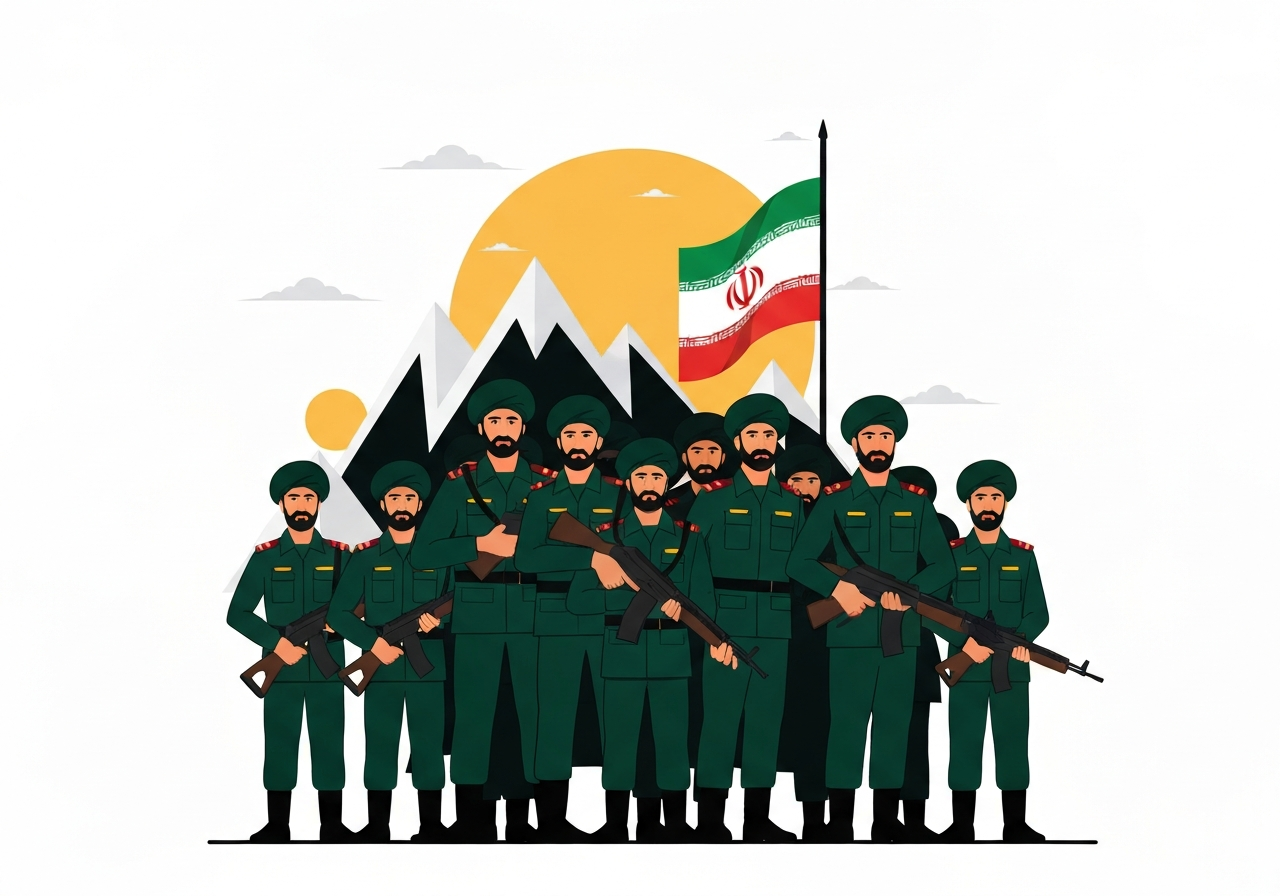
Lead — On March 8, 2026, hours after Israeli and American airstrikes struck targets in Iran, members of the Islamic Revolutionary Guard Corps (I.R.G.C.) moved into neighborhoods across Tehran and other cities. Eyewitness reports and short videos showed plainclothes militiamen armed with Kalashnikovs manning checkpoints, searching cars and mobile phones, and deploying anti‑riot vehicles in sheltered locations. Analysts say the swift, visible deployment was aimed at projecting control and deterring public gatherings. The Guards’ wide military, political and economic reach makes them a central obstacle to any drive for regime change.
Key Takeaways
- The I.R.G.C. mobilized in Tehran and multiple urban centers within hours of airstrikes on March 8, 2026, establishing checkpoints and search operations.
- Witness accounts reported plainclothes fighters with assault rifles searching vehicles and cellphones; black anti‑riot vehicles were staged in enclosed schoolyards and other sheltered sites.
- Scholars say the deployment combined messaging to external audiences and a tactic of intimidation to discourage street protests.
- The Guards hold entrenched military, political and economic positions that analysts identify as the primary barrier to rapid political change in Iran.
- President Trump publicly suggested the Guards disarm to bolster prospects for regime change; experts consider such an outcome unlikely.
- Historical roots: founded after the 1979 revolution amid distrust of the regular army, the I.R.G.C. has grown into a hybrid security and governance actor.
Background
The Islamic Revolutionary Guard Corps emerged in the wake of the 1979 Iranian Revolution as a force loyal to the new theocratic leadership. Ayatollah Ruhollah Khomeini and his allies distrusted the pre‑revolution regular army (Artesh), which they associated with the Shah, and created the I.R.G.C. as a parallel instrument to safeguard the revolution. Over decades the Guards expanded beyond battlefield roles into domestic security, political influence and commercial enterprises.
That institutional expansion included the growth of auxiliary forces such as the Basij militia, close ties to state institutions, and deepening economic footprints in sectors from construction to energy. These overlapping roles gave the I.R.G.C. both the means to project force and the financial resources to reward allies and co‑opt rivals, creating a resilient power base inside Iran’s political order. External pressures—sanctions, regional conflicts and periodic military strikes—have often reinforced the Corps’ internal standing as guarantor of regime survival.
Main Event
In the hours after airstrikes by Israeli and U.S. forces, local residents and online videos documented I.R.G.C. personnel in plainclothes and in vehicles deploying into urban neighborhoods. These units set up ad hoc checkpoints where drivers and passengers were stopped, and some reports said mobile phones were inspected for signs of anti‑state organizing. Black anti‑riot trucks were observed arrayed in closed schoolyards and courtyards, locations chosen for protection from potential follow‑on strikes.
Observers interpreted the visible deployments as a twofold signal: to external adversaries that the regime retained a ready internal security apparatus, and to domestic audiences that public dissent carried immediate risk. A University of Tennessee political scientist described the posture as intended to create an appearance of control for outsiders while instilling fear among residents so people would refrain from appearing in the streets. Officials in Tehran framed the movements as necessary measures to preserve order amid heightened threats.
The Guards’ rapid response built on existing domestic networks—informal neighborhood cells, intelligence branches and auxiliary militias—allowing swift mobilization without overt, large‑scale armored columns. This low‑visibility, distributed approach complicates external efforts to measure the Corps’ true force posture and limits opportunities for visible public resistance. Analysts noted that the I.R.G.C. can combine kinetic deterrence with policing measures to shape daily life during crises.
Analysis & Implications
The I.R.G.C.’s blend of security, economic and political functions makes it a uniquely resilient institution within Iran. Militarily, it commands elite units and proxy networks in the region; politically, its leadership has direct channels into state decision‑making; economically, affiliated conglomerates generate revenue and patronage. Together these capacities allow the Corps to absorb shocks and maintain influence even when conventional governance faces stress.
Domestically, the Corps’ visibility during and after external strikes is likely to suppress spontaneous mass protests in the short term by raising the perceived costs of dissent. That suppression can, however, deepen grievances over time, particularly if checkpoints, searches and detentions become routine. Economically, continued militarization of state functions and sanctions targeting I.R.G.C. entities will constrain private sector growth and complicate recovery efforts.
Regionally, the Guards’ network of proxies and operational reach mean that external strikes can produce asymmetric responses via allied groups in Lebanon, Iraq, Syria and Yemen rather than direct conventional exchanges. This diffusion raises the risk of escalation in proximate theaters and creates a strategic dilemma for external actors seeking to degrade specific capabilities without triggering broader retaliation.
Comparison & Data
| Role | Primary Functions | Examples |
|---|---|---|
| Military | Conventional and asymmetric operations, elite ground and missile forces | Quds Force, ballistic missile launches, regional proxy support |
| Internal Security | Neighborhood policing, checkpoints, Basij mobilization | Plainclothes patrols, cellphone searches, anti‑riot deployments |
| Political Influence | Access to levers of state power, vetting and patronage | Appointments, parliamentary allies, security ministries |
| Economic | Business holdings, construction and energy interests | Conglomerates and contracting firms linked to I.R.G.C. affiliates |
The table summarizes the Corps’ multi‑dimensional role. While precise budgets and revenue figures tied to I.R.G.C. entities are contested and have been subject to sanctions, the qualitative breadth—military to commercial—explains its durability in crises. External actors have used targeted measures, but dismantling such integrated influence would require sustained political as well as economic pressure.
Reactions & Quotes
Observers and local sources offered immediate and divergent readings of the March 8 deployments, highlighting both security rationales and domestic intimidation effects.
“They tried to create the illusion for outsiders that they are in control, and inside to create fear for people so they do not dare come out to the street.”
Saeid Golkar, political scientist (University of Tennessee)
Golkar framed the deployment as a deliberate information and control operation rather than a purely defensive maneuver, underlining the political purpose of a security posture.
“Plainclothes men were stopping cars and checking phones in several neighborhoods within hours of the strikes.”
Local eyewitness accounts compiled by reporters
Those on‑the‑ground reports emphasized the immediacy of the I.R.G.C. response and how it translated into visible street‑level policing in urban areas.
Unconfirmed
- Whether calls by external political figures for the Guards to disarm would generate meaningful defections or internal splits remains speculative and lacks independent verification.
- Exact casualty figures, detention numbers and the full scale of I.R.G.C. deployments following the strikes have not been independently confirmed at the time of reporting.
- Attribution of any future proxy attacks to specific I.R.G.C. elements should be treated cautiously until validated by multiple reliable sources.
Bottom Line
The March 8, 2026 deployments underscored the I.R.G.C.’s role as Iran’s primary instrument of hardened state power—capable of rapid, low‑profile internal control and of sustaining regional projection through proxies. Its combined military, political and economic capacities make it the most significant institutional obstacle to sudden regime change.
For policymakers and analysts, the key implication is that actions aimed at Iran’s political balance must account for the Corps’ resilience and its ability to absorb shocks while preserving internal control. Short‑term deterrence or punitive strikes can alter tactical calculations, but they are unlikely on their own to dislodge an institution so deeply embedded in Iran’s state and society.
Sources
- The New York Times — international news media (reporting on March 8, 2026 deployment and expert commentary)