
Lead
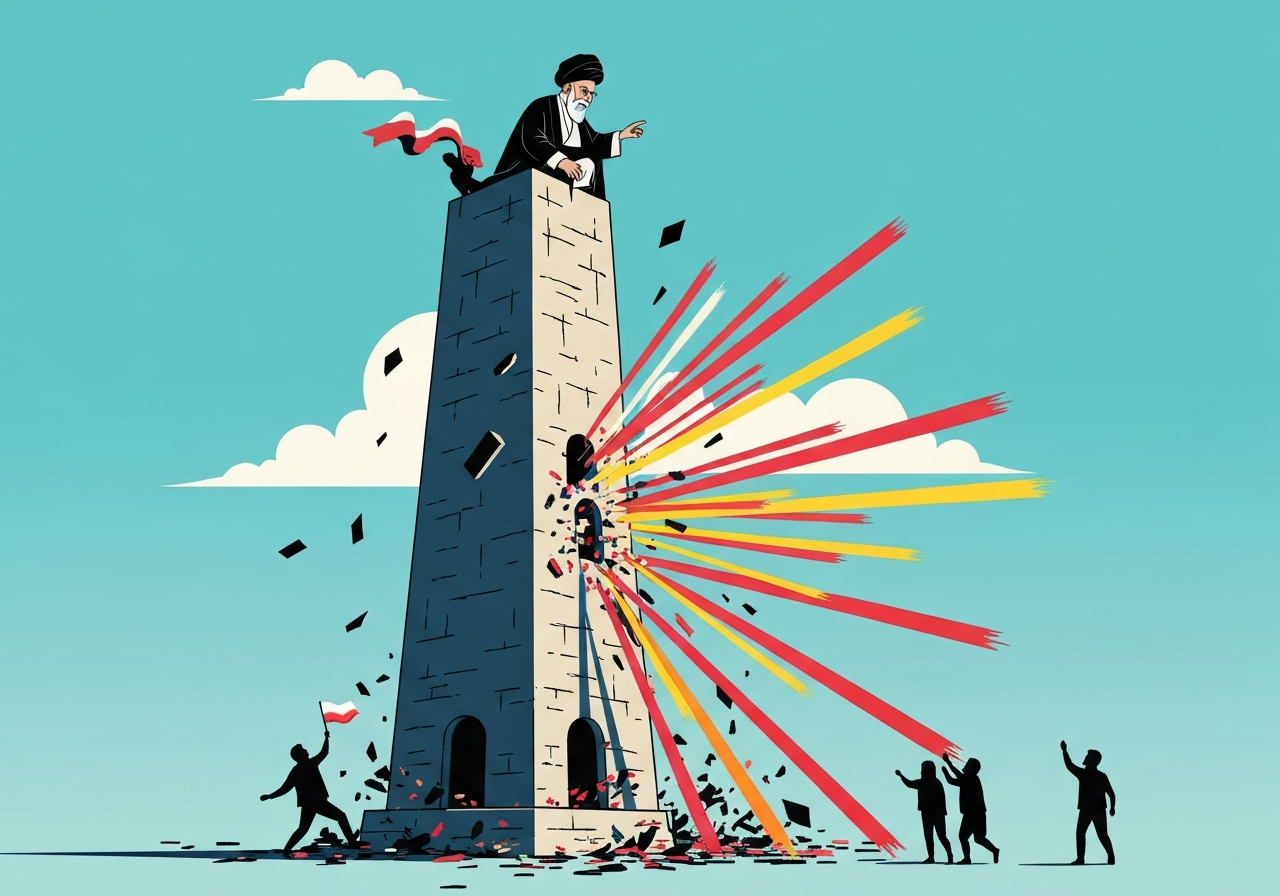
Iran’s political landscape entered a sudden transition after the supreme leader, Ayatollah Ali Khamenei, 86, and his wife were killed in an Israeli missile strike on his Tehran compound last Saturday. The killing follows nationwide demonstrations in January, which were violently suppressed with estimated deaths in the tens of thousands. Observers and some Iran specialists say the shock of Khamenei’s death could mark a pivotal, symbolic rupture—likened by several analysts to the fall of the Berlin Wall—creating a political vacuum and testing the resilience of the Islamic republic’s institutions. Officials have already altered normal procedures, citing security concerns as the state contends with strikes, reprisals and leadership maneuvers.
Key Takeaways
- Khamenei, 86, led Iran’s velayat-e faqih system for 37 years (1989–2026), roughly a decade longer than the Berlin Wall stood (1961–1989).
- The supreme leader and his wife were killed in an Israeli missile strike on his Tehran compound last Saturday; authorities postponed the funeral citing security risks.
- January’s nationwide protests were met with repression that human-rights groups estimate cost tens of thousands of lives.
- The 88-member Assembly of Experts met remotely this week; Qom’s shrine complex was struck in recent bombardments.
- Mojtaba Khamenei has emerged publicly as a leading candidate to succeed his father amid a formal succession process already under way.
- Security services have reportedly dispersed high-risk political prisoners and tightened control in detention facilities including measures related to ward 209 at Evin prison.
- Analysts are divided: some argue the regime can adapt through the IRGC or a managed succession; others say Khamenei’s removal removes the glue holding the system together.
Background
The Islamic Republic is governed by velayat-e faqih, a system placing a supreme religious authority above elected institutions; Khamenei occupied that role since 1989. Over his 37-year tenure he exercised final authority on foreign policy, the nuclear file, domestic social policy and the allocation of power to security organs, notably the Islamic Revolutionary Guard Corps (IRGC). His leadership style was widely described as consolidating decision-making and resisting reforms that might dilute clerical control.
In January 2026, Iran experienced mass demonstrations calling for political and social change. Those protests were harshly repressed; independent and human-rights groups estimate fatalities in the tens of thousands, a figure that has fed domestic anger and international condemnation. The unrest strained the regime’s legitimacy and exposed fissures between hardliners and more pragmatic officials who had at times pushed for limited accommodation with the West.
Before the strike that killed Khamenei, analysts had increasingly suggested Iran was approaching a historic inflection point. Comparisons to the 1989 fall of the Berlin Wall circulated among scholars and commentators as shorthand for a rapid, systemic break if unified civic opposition met a weakened, delegitimized leadership.
Main Event
On Saturday an Israeli missile strike hit Khamenei’s compound in Tehran, killing him and his wife, according to Iranian and international reports. State media and officials confirmed the leader’s death and immediately took extraordinary security measures, postponing the public funeral and moving key meetings to remote formats. Authorities said they altered plans to reduce exposure of senior figures to further attacks.
The Assembly of Experts, the 88-member clerical body charged by the constitution with selecting a new supreme leader, convened remotely this week rather than assembling at its Qom headquarters; Qom and other religious sites have been targeted in recent bombardments. Officials cited the risk of strikes on prominent gatherings as the reason for the change.
Security forces reportedly intensified pressure on political prisoners while also releasing some inmates on bail, moves that observers interpret as attempts to manage unrest and mitigate the risk of jail-targeted strikes. Reports indicate ward 209 at Evin prison—used for high-security political detainees—has been emptied or dispersed as a precautionary step after jails were struck during last June’s 12-day conflict with Israel.
On the streets, patterns of control and propaganda shifted: Basij militia patrols have been seen driving through neighborhoods broadcasting pro-regime slogans, while security personnel have responded forcefully to localized celebrations or anti-regime chants, including reported live fire directed at residential windows. Authorities also said they were wary that naming a successor publicly could invite targeted attacks on transition figures.
Analysis & Implications
Khamenei’s sudden, violent removal poses both institutional and symbolic challenges. Institutionally, the regime had formal succession mechanisms—including the Assembly of Experts and a transition council—but analysts warn that these structures were designed for orderly transfer under normal conditions, not amid active external strikes and heightened domestic unrest. The risk is a contested transition that further weakens centralized control.
Symbolically, multiple Iran specialists argue Khamenei functioned as the pivotal personality holding competing centers of power together: the presidency, clergy, IRGC and security services. His absence could therefore accelerate realignment within the elite, either toward a managed continuity led by security institutions such as the IRGC or toward concessions to quell public anger, depending on which faction consolidates influence.
Economically and geopolitically, the fallout may be severe. The IRGC controls sizeable economic assets; if it seeks to stabilize the state by loosening some domestic repression, that could open limited social breathing space but also risk fragmenting the coalition that supports theocratic rule. Conversely, a turn to intensified nationalism and invocation of martyrdom narratives could deepen militarization and international isolation, with consequences for regional security and oil markets.
Externally, the incident raises questions about deterrence, escalation and the legality of cross-border strikes on top political leaders. If other states perceive such attacks as lowering thresholds for targeting leadership figures, the risk of reciprocal or wider conflict increases. International actors will weigh responses cautiously, balancing concern for civilian protection with avoidance of a broader war.
Comparison & Data
| Entity | Start | End | Duration |
|---|---|---|---|
| Berlin Wall | 1961 | 1989 | 28 years |
| Ali Khamenei as Supreme Leader | 1989 | 2026 | 37 years |
The table highlights why commentators compare Khamenei’s passing to a ‘‘Berlin Wall’’ moment: his 37-year rule exceeded the Wall’s existence by roughly a decade, underscoring the symbolic heft of his sudden removal. The comparison is metaphorical—Berlin’s fall followed rapid civic mobilization and structural collapse of East Germany’s ruling party; whether Iran follows a similar path will depend on elite cohesion, security force loyalties and popular momentum.
Reactions & Quotes
“I think the death of Khamenei is close to a Berlin Wall moment; it marks the end of an era,”
Abbas Milani, Stanford University (Iran studies director)
Milani stressed the psychological and political rupture created by the leader’s removal and argued that the system’s personalized nature makes survival harder without him. His view represents analysts who believe Khamenei’s centrality made the regime brittle.
“Everyone has a plan until they get punched in the face,”
Naysan Rafati, International Crisis Group (senior Iran analyst)
Rafati used the remark to emphasize that succession rules may not hold under active attack and described the transition as occurring amid the most violent conditions imaginable for the state.
“For some inside the system, this may be an opportunity to escape accountability by recasting themselves as defenders of the homeland,”
Alex Vatanka, Middle East Institute (Iran program director)
Vatanka warned that hardline institutions could shift narrative frames—turning from internal repression to nationalist defense—to restore legitimacy among parts of the population.
Unconfirmed
- Precise death toll from January’s protests: estimates of ‘‘tens of thousands’’ come from human-rights organizations and have not been verified by an independent census.
- Full details about the circumstances of Khamenei’s killing, including intelligence chain-of-custody and specific strike authorization, remain unverified in open-source reporting.
- Reports of live rounds fired at residential windows and the complete dispersal plan for ward 209 at Evin prison are based on multiple but not independently corroborated accounts.
Bottom Line
Khamenei’s sudden death is both a concrete shock and a potent symbol. It removes a centralizing figure who had shaped Iran’s domestic politics and foreign posture for nearly four decades. That vacuum increases the possibility of rapid change, but outcomes are uncertain: the regime could either reconstitute itself through security institutions and nationalist narratives or face accelerated delegitimation if it cannot reassert control.
Key indicators to watch in the coming days and weeks include the Assembly of Experts’ public moves, factional alignment within the IRGC, patterns of repression or liberalizing concessions, and civilian response in major cities. International actors will also test their responses carefully, because decisions now could determine whether this moment leads to managed continuity, internal fracturing, or a broader regional escalation.
Sources
- The Guardian — international media report and analysis
- Stanford Iranian Studies (Abbas Milani profile) — academic/subject expert
- International Crisis Group — policy think-tank analysis
- Middle East Institute — policy research institute (Alex Vatanka)
- Reuters — international wire reporting on security developments