
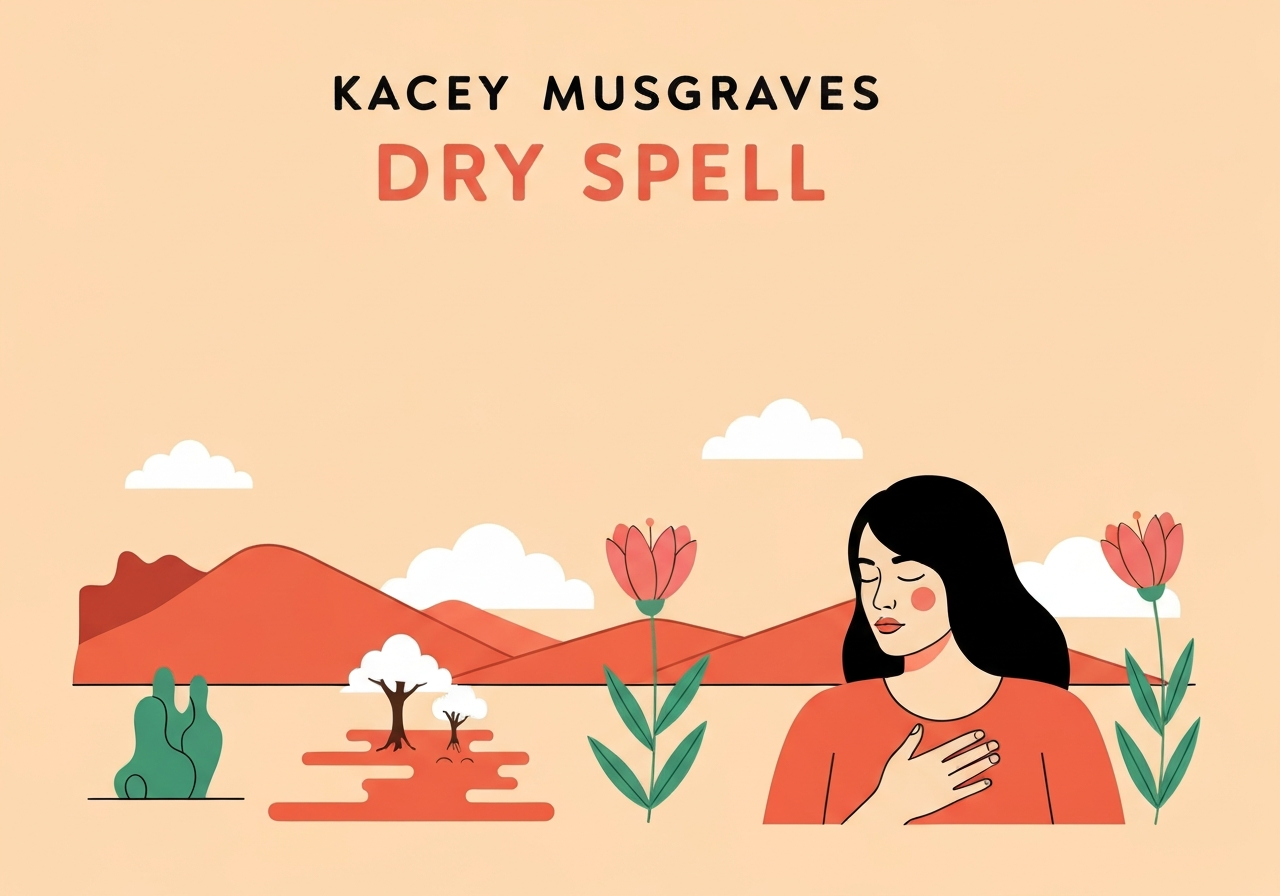
Lead
Kacey Musgraves has released a new single, a playfully frank country tune that frames sexual frustration as plainspoken humor. The song leans on minor-key Spanish guitar and spitfire wordplay to chart a 335-day “dry spell,” while teasingly spelling out the singer’s lust in everyday, Western-flavored images. The single arrives ahead of an upcoming album and channels a mix of queer-ready line-dance energy and noir-tinged tension. The overall result is a short, wry confession rather than a seduction.
Key Takeaways
- The track repeatedly references “335 days” as the length of the singer’s dry spell, making the number a running gag and structural anchor for the lyricism.
- Lyrics name-check mundane objects—“a truck up in her drive” and “a tool up in her shed”—to deploy double entendres that shift between cheeky and explicit.
- Instrumentation includes a minor-key Spanish guitar tone, which lends a Western-noir atmosphere rather than a straight country twang.
- Musgraves frames the song as social confession—“Y’all, I’m going through a dry spell”—positioning it as conversational, not aggressively erotic.
- The single is timed ahead of a new album release, suggesting it functions as a tone-setting preview for a larger project.
- The song is described as tailor-made for queer-friendly line-dancing, indicating an intentional nod to inclusive country spaces.
Background
Kacey Musgraves built her profile by blending traditional country forms with contemporary lyrical frankness and pop-savvy production. Over the last decade she has repeatedly blurred genre lines, and her catalog has often foregrounded candid takes on desire and domestic life. Country music has long contained a palette of rural imagery—trucks, sheds, porches—that songwriters rework as metaphors for intimacy; Musgraves repurposes this vocabulary with overt sexual humor. At the same time, mainstream country remains uneven in its reception of overtly queer or sex-positive narratives, making an explicitly playful and inclusive line-dance-ready single a notable cultural gesture.
The single’s timing also invites reading as part of an album rollout: shorter, cheeky tracks can act as palate-cleansers or mood-setters before a fuller record arrives. Public-facing moments—social posts, teasing questions, and gossipy captions—have become part of how artists prime listeners for new releases. Musgraves’ 331-day-old X post asking, “Is it possible to die of horniness? Asking for a friend,” resurfaced alongside the single’s release as a near-mischievous Easter egg for attentive fans. Those overlaps shape how critics and listeners parse intent: joke, confession, or marketing move.
Main Event
The single opens with a spare arrangement and an intimate vocal that quickly yields to a twang-tinged Spanish guitar line in a minor key, creating an uneasy yet playful sonic bed. Musgraves’ delivery alternates between deadpan and flirtatious; she tells a story that is more list than narrative, dropping images rather than building a chronology. Repeated refrains—most notably the hook, “Y’all, I’m going through a dry spell”—anchor the song in communal speech and demotic humor.
Lyrically the track trades in double entendres that are explicit without being lurid: lines mention a “truck up in her drive” and a “tool up in her shed,” phrases that function simultaneously as everyday detail and sexual metaphor. The result is an aesthetic choice to make desire banal and mundane rather than theatrical. Production choices—muted percussion, sparse keys, reverb on the guitar—sustain a late-night, almost noir feeling that keeps the song from tipping into novelty.
Musgraves’ tone undercuts any attempt at seduction; the song reads as an admission one might make after a round of brunch mimosas with friends. The voice on the track is conversational and self-aware: the speaker acknowledges her status and invites empathy or laughter rather than pursuit. That stance shapes how the single will be received on radio, streaming playlists, and in live sets: as a wink to existing fans and as a safe point of entry for broader audiences.
Analysis & Implications
On its surface, the song is a short, clever exercise in country-inflected innuendo. But its implications stretch into questions about how women—particularly those in their thirties—are allowed to express sexual desire in popular music. The track sidesteps melodrama, choosing instead to normalise unromanticized appetite. That rhetorical move may broaden Musgraves’ appeal among listeners who want frankness without confessional heaviness.
Commercially, the single’s cheeky tone and concise runtime make it playlist-friendly: streaming algorithms and country crossover playlists often favor bite-sized, memorable hooks. The minor-key Spanish guitar gives programmers a sonic signpost that differentiates the track from both standard pop-country and acoustic singer-songwriter fare. If the forthcoming album continues in this conversational register, it could consolidate Musgraves’ position as an artist who balances mainstream accessibility with subcultural signaling.
Culturally, the line-dance and queer-leaning framing matters: country’s relationship to LGBTQ+ audiences has been fraught, and music that explicitly invites queer-friendly spaces contributes to ongoing shifts. The single doesn’t overtly politicize desire, but it normalizes it within a genre where coded language has often been the norm. That small normalization can have ripple effects in concert bookings, festival programming, and mainstream visibility.
Comparison & Data
| Reference | Number / Element | Context |
|---|---|---|
| “Dry Spell” lyric | 335 days | Repeated as the song’s running joke about sexual drought |
| Musgraves X post | 331 days prior (approx.) | Public social post that echoed the single’s theme and raised fan speculation |
The table highlights how two nearby numeric references—335 days in the lyric and a 331-day-old social post—operate as connective tissue between Musgraves’ public persona and the single itself. Both numbers are used more for narrative texture than for documentary precision; they function as inside jokes aimed at engaged listeners and followers.
Reactions & Quotes
“Y’all, I’m going through a dry spell.”
Kacey Musgraves (song lyric)
This hook is the song’s social connective tissue—an address to friends or listeners rather than a direct seduction, which frames the track’s confessional register.
“Is it possible to die of horniness? Asking for a friend.”
Kacey Musgraves (X / social post)
That social post, shared roughly 331 days before the single’s release, circulated among fans as a cheeky precursor that retrospectively reads like an Easter egg for the new song.
“A sly, conversational take on desire that folds classic country imagery into modern frankness.”
Pitchfork (music journalism)
Critical responses have emphasized the track’s balance of humor and craft, noting production and lyric choices that keep the song from becoming mere novelty.
Unconfirmed
- That the single was explicitly written as a “queer line-dancing” anthem: the track’s danceability and inclusive references are clear, but direct intent has not been confirmed by the artist or label.
- That the 331-day-old social post was planned as a pre-release Easter egg: the proximity of the dates invites speculation, but no official confirmation ties the two.
- That the single’s tone guarantees a fully sex-positive, club-ready album: the single sets a tone, but the album’s broader themes and production choices remain unannounced.
Bottom Line
“Dry Spell” is a compact, wry entry in Kacey Musgraves’ catalogue that leans on everyday rural imagery and frank humor to talk about desire. Its production—minor-key Spanish guitar and restrained arrangement—keeps the track moody rather than campy, while the repeated 335-day motif gives the song a memorable throughline. The piece functions more as a convivial admission than as an erotic provocation, which broadens its potential audience.
As a prelude to a forthcoming album, the single signals that Musgraves will continue to navigate the space between mainstream country-pop and candid, boundary-pushing lyricism. Listeners and programmers will likely treat the track as both a crowd-pleaser and a conversation starter about how desire is presented in modern country music.