
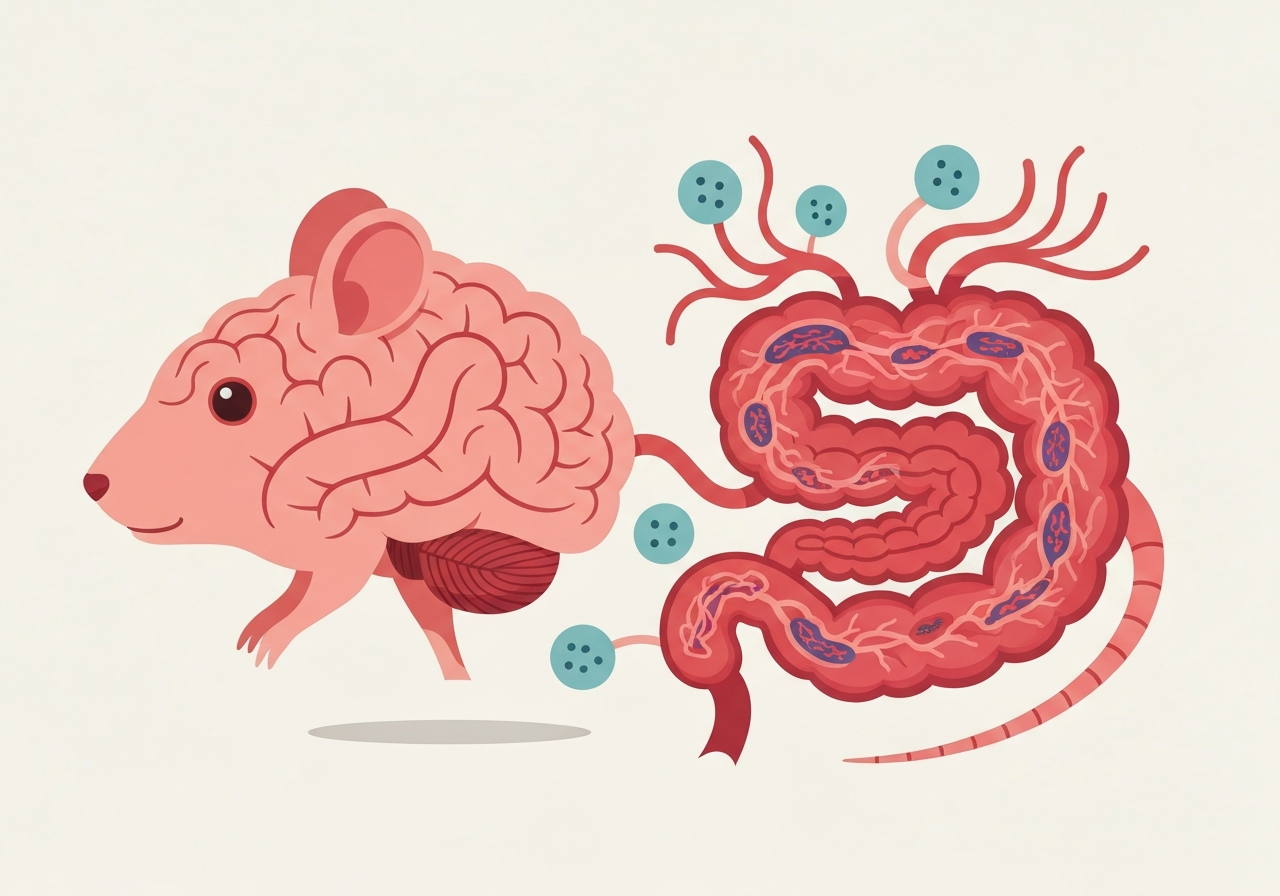
Researchers report that a specific gut bacterium, Parabacteroides goldsteinii, increases in older mice and contributes to age-related memory decline. In experiments described in Nature, young (2-month-old) mice co-housed for one month with old (18-month-old) mice acquired older animals’ microbiomes and showed marked short-term memory loss. Introducing P. goldsteinii alone into young mice reproduced the deficit, while removing it with antibiotics or a targeted phage restored performance to near-young levels. The team links the effect to dampened signalling along sensory nerves that connect the gut to the brain.
Key takeaways
- Co-housing: Young (2-month) mice housed for one month with old (18-month) mice adopted an older microbiome and lost short-term memory on standard object-recognition tests.
- Pathogen identified: Parabacteroides goldsteinii was singled out as sufficient to reproduce memory impairment when given to young mice.
- Rescue interventions: Broad-spectrum antibiotics or a phage therapy that eliminated P. goldsteinii improved memory in old mice to levels comparable with young controls.
- Mechanism: The bacterium appears to interfere with sensory nerve signalling from the gut to the brain, reducing internal signal perception analogous to age-related sensory decline.
- Translatability: Investigators note the gut–brain circuit implicated is likely conserved in humans, though direct evidence in people is not yet established.
- Magnitude: Behavioral deficits in co-housed young mice were described as profound—performance became effectively indistinguishable from that of 18-month-old mice on the tasks used.
Background
The gut–brain axis has emerged as a major field linking intestinal microbes to neural function through immune, metabolic and neural routes. Aging alters the composition of the gut microbiome in mice and humans, and prior studies have associated those shifts with inflammation, metabolic change and altered behaviour. Microbial transfer among co-housed mice is a well-established route to change gut communities: animals eat each other’s feces and readily acquire donors’ bacterial species. That transfer model has been used widely to test causality by moving microbes between young and old hosts.
Age-related cognitive decline in mammals is multifactorial, involving synaptic changes, inflammation, vascular factors and sensory loss. Sensory pathways that convey information from peripheral organs to the brain also degrade with age, and reduced internal signal fidelity could plausibly affect learning and memory. The new study builds on these themes by testing whether specific age-enriched microbes can alter gut-to-brain sensory signalling and thereby behavioral performance.
Main event
The research team set up co-housing experiments in which groups of two-month-old mice were placed with 18-month-old mice for one month. After that period, young animals displayed impaired performance on object-recognition mazes and related assays: where young controls preferentially explored novel objects, co-housed young mice treated familiar and new objects similarly, indicating loss of short-term recognition memory. Investigators reported that the behavioural change correlated with a shift in the young mice’s gut microbiome toward the older animals’ composition.
To pinpoint causal taxa, researchers transplanted candidate bacterial species into germ-free or antibiotic-depleted young mice. Parabacteroides goldsteinii alone reproduced the memory deficit when introduced to young hosts. Conversely, administering a broad antibiotic course that depleted gut bacteria, or a bacteriophage therapy directed against P. goldsteinii, improved memory performance in old mice, suggesting the species plays an active role rather than merely marking age-associated community change.
Physiological assays indicated that P. goldsteinii dampened signalling along sensory neurons that connect the intestine to central brain circuits. The team measured reduced responsiveness in vagal-sensory pathways and alterations in downstream neural activity tied to memory processing. Those changes provide a candidate mechanistic route linking a single bacterial species to behavioural outcomes, though the molecular mediators remain to be fully mapped.
Authors emphasize rigorous controls: behavioural testing used blinded scorers, microbiome changes were confirmed by sequencing, and rescue experiments employed two independent interventions (antibiotics and phage) that converged on improved cognition. Together these steps strengthen a causal interpretation within the mouse model, while highlighting points where translation to humans will require additional validation.
Analysis & implications
If similar microbe-driven dampening of gut–brain sensory signalling occurs in humans, this work could reshape how we think about normal cognitive ageing. Rather than being solely a product of intrinsic brain ageing, some component of decline might reflect altered peripheral signalling driven by specific microbes. That reframes possible interventions away from the brain alone toward gut-targeted therapies that modulate particular taxa or their molecular products.
Therapeutic prospects implied by the mouse work range from targeted bacteriophages and narrow-spectrum antimicrobials to probiotics or dietary strategies that suppress harmful taxa and support beneficial communities. Phage therapy directed at a single species is promising in mice but poses regulatory, manufacturing and safety questions for human use. Long-term ecological effects on the gut community and host immunity would need careful study before human trials.
Methodologically, the study strengthens causal microbiome research by combining co-housing, targeted colonization, sequencing and physiological readouts of neural signalling. Nevertheless, cross-species conservation of the exact circuit and of P. goldsteinii’s role is an open question: humans differ in microbiome composition, diet, lifespan and nervous-system organization. The magnitude of effect seen in mice—where memory dropped to the level of 18-month-old animals after one month—may not scale identically in people.
Policy and clinical implications extend to aging populations: if validated in humans, microbiome assessments could become part of geriatric cognitive risk profiling, and microbiome modulation might complement lifestyle and pharmacologic strategies to preserve memory. The research therefore opens paths for interdisciplinary work spanning microbiology, neuroscience, geriatrics and regulatory science.
Comparison & data
| Group | Age | Treatment | Object-recognition outcome |
|---|---|---|---|
| Control young | 2 months | None | High novel-object preference |
| Control old | 18 months | None | Low novel-object preference |
| Young co-housed | 2 months | Co-housed with 18-month | Low — matched old mice |
| Young + P. goldsteinii | 2 months | Mono-colonized | Low — impaired recognition |
| Old + antibiotic/phage | 18 months | Antibiotic or anti-P. goldsteinii phage | Restored to near young levels |
The table summarizes behavioural endpoints used in the study: novel-object preference was the primary readout of short-term recognition memory. Sequencing showed an increase in P. goldsteinii abundance in old mice and in young mice after co-housing; targeted elimination reduced its relative abundance and correlated with improved task performance. These numeric and categorical contrasts support a direct link between the presence of the species and the measured cognitive phenotype in this model.
Reactions & quotes
Several investigators and commentators highlighted the study’s potential reach while noting the need for human validation. Below are selected, brief quoted reactions and context.
“This gut–brain circuit is likely conserved in humans,”
David Vauzour, University of East Anglia (biochemist)
Vauzour framed the result as plausibly relevant beyond mice but stressed that direct evidence in people is still required. He noted that demonstrating conservation of the circuit and of P. goldsteinii’s role in humans would be a high priority for follow-up research.
“When we get older, we need things like glasses and hearing aids,”
Christoph Thaiss, Stanford University (immunologist, study co-author)
Thaiss used the analogy to suggest ageing may reduce perception of internal signals as well as external ones, arguing the bacterium’s effect resembles a loss of internal sensory acuity. He and colleagues emphasize that interventions aimed at restoring internal signalling might help recover cognitive function.
“Their deficit was so profound, they were basically indistinguishable from the old mice,”
Timothy Cox, University of Pennsylvania (neuroscientist, study co-author)
Cox described the behavioral magnitude observed after microbiome transfer and mono-colonization, underscoring the robust phenotype in the experiments while cautioning that laboratory conditions can amplify effects relative to complex human environments.
Unconfirmed
- Whether the same P. goldsteinii-driven mechanism operates in humans remains unproven and requires direct clinical or translational studies.
- The specific molecular signals by which P. goldsteinii alters sensory nerve responsiveness are not fully identified and need mechanistic follow-up.
- Long-term effects and safety of phage therapy or repeated microbiome depletion in older hosts are uncertain and untested in human clinical settings.
Bottom line
The study presents converging lines of evidence in mice that an age-enriched gut bacterium, Parabacteroides goldsteinii, can drive short-term memory impairment by dampening sensory gut–brain signalling. Experimental transfer, mono-colonization and two independent rescue strategies (antibiotics and a species-specific phage) make a persuasive causal case within the mouse model.
Translation to humans is plausible but unconfirmed: the implicated circuit may be conserved, yet human microbiomes and neural responses are more variable. The findings open actionable research directions—targeted microbiome modulation, identification of microbial mediators, and clinical observational studies in ageing cohorts—that could ultimately inform new strategies to preserve cognitive aging.
Sources
- Nature (news report on the study) — media coverage summarizing the research published in Nature.
- Stanford University (institutional) — institution of study co-author Christoph Thaiss.
- University of Pennsylvania (institutional) — institution of study co-author Timothy Cox.