
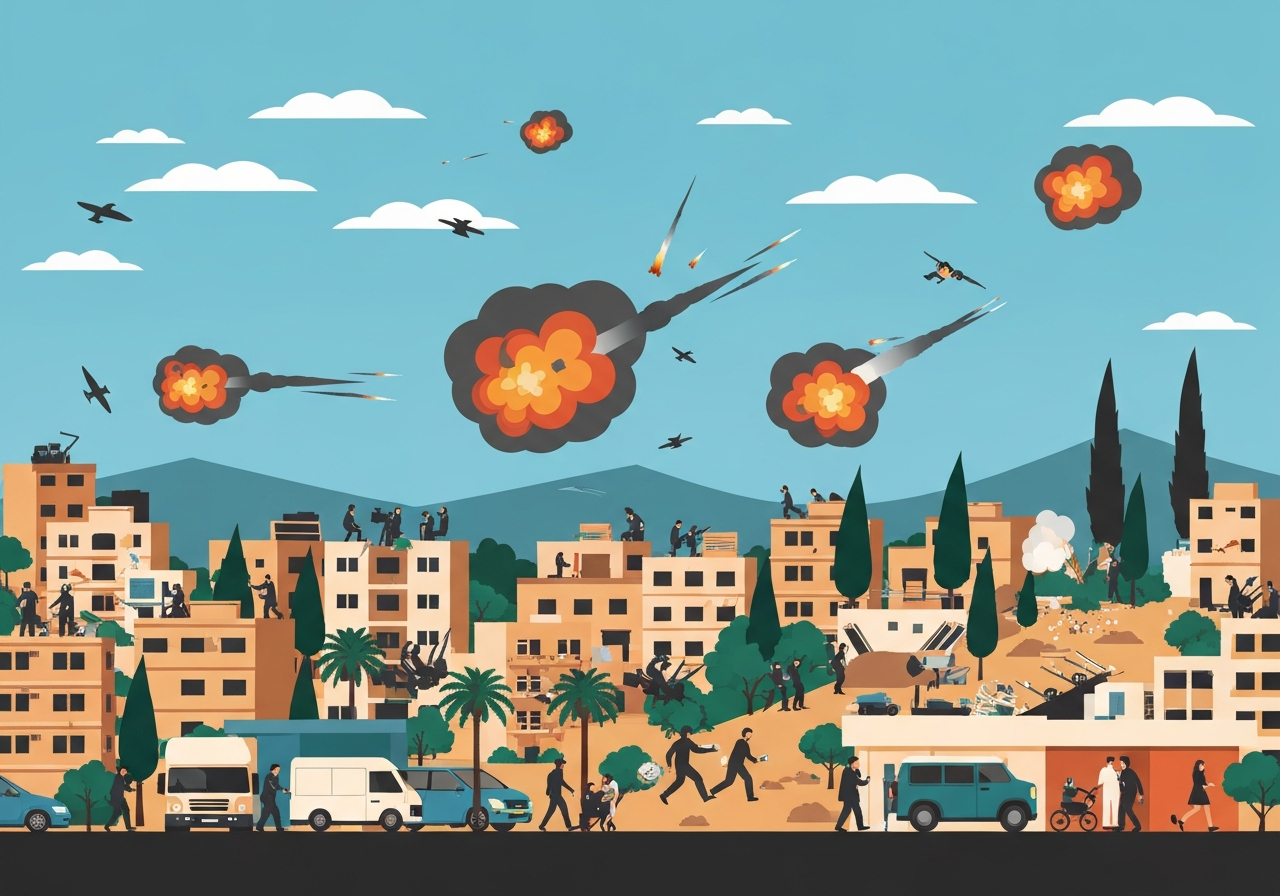
Lead: Israeli warplanes struck Beirut’s southern suburbs and targets across southern Lebanon late on Wednesday after Hezbollah launched successive rocket and drone attacks into northern Israel. Iran’s Islamic Revolutionary Guard Corps later said it joined Hezbollah in strikes that reportedly hit more than 50 Israeli targets, including military positions near Haifa, Tel Aviv and Beersheba. Lebanese authorities reported multiple deaths and dozens injured in Beirut and the south, while Israel said two people were wounded by incoming projectiles. The exchanges mark a sharp escalation in a conflict that began 10 days earlier and risks widening across the region.
Key Takeaways
- Israeli air strikes hit Beirut’s southern suburbs and southern Lebanon on Wednesday night and into Thursday, with Lebanese health officials reporting at least seven killed in a central Beirut strike and 17 wounded in southern suburbs.
- Hezbollah launched coordinated rocket volleys and drone swarms into northern Israel on Wednesday night, injuring two people; most projectiles were intercepted or fell in open areas.
- The Islamic Revolutionary Guard Corps (IRGC) said it participated alongside Hezbollah in a “joint and integrated” operation that targeted over 50 locations in Israel, naming military sites near Haifa, Tel Aviv and Beersheba.
- Israeli military officials warned of imminent, overwhelming action against Hezbollah and ordered northern border reinforcements, including redeployment of the Golani Brigade from Gaza to the north.
- Israeli strikes across Lebanon have, in less than 10 days of fighting, been linked to at least 634 deaths and 1,586 injuries; Lebanon reports more than 816,700 families registered as displaced.
Background
Fighting intensified after a flare-up that began 10 days earlier when Hezbollah fired rockets into Israel, prompting a retaliatory Israeli campaign. The current round occurs amid a broader regional confrontation that followed strikes attributed to Israel and the United States against Iran two weeks prior, which further destabilised the wider Middle East. Hezbollah, deeply embedded in Lebanese politics and society, has spent the period since its November 2024 ceasefire with Israel rebuilding some capabilities perceived to have been degraded during the previous 13-month war.
The Lebanese state faces constraints in confronting Hezbollah: the Lebanese Armed Forces remain relatively small and under-resourced compared with the Iran-backed militia, and Beirut has been cautious about provoking internal sectarian tensions. International actors, including France, have urged diplomatic efforts and pushed for humanitarian assistance as displacement and civilian harm grow. Israel and the United States have expressed scepticism that the Lebanese government can or will disarm Hezbollah effectively, leaving the prospect of direct military action as a visible option for Israeli planners.
Main Event
On Wednesday night, Hezbollah launched successive rocket barrages and drone swarms at northern Israeli towns; Israeli air-defence systems intercepted many of the incoming projectiles, and most that were not intercepted fell in open areas. Iran’s Revolutionary Guards later claimed participation, saying their missiles operated in concert with Hezbollah’s rockets and drones in a coordinated strike on more than 50 targets inside Israel, including military bases near Haifa, Tel Aviv and Beersheba.
Israel responded with sustained air strikes across southern Lebanon and the southern suburbs of Beirut, producing intense fires, collapsing structures, and widespread damage visible in video circulating on social media. A strike on the Ramlet al-Baida corniche — an area where displaced families had been sheltering — killed at least two people on the seaside walkway, and Lebanon’s health ministry reported seven fatalities in that strike overall.
The Israeli military said it was targeting missile launchers and other Hezbollah infrastructure in the south, warning civilians to distance themselves from affected areas and signalling potential escalation. In parallel, Lt Gen Eyal Zamir ordered reinforcements to the northern border, redeploying the Golani Brigade from Gaza to positions facing Lebanon — a move analysts say could presage larger ground operations.
Analysis & Implications
The immediate implication is a rapid broadening of the theatre of conflict: what began as exchanges across a 10-day period now includes deeper strikes in and around Lebanon’s capital and surface-to-surface launches coordinated with Iran. That coordination — if verified — represents a notable operational linkage between Tehran and Hezbollah, increasing both the scale and complexity of Israel’s security calculus. For Israel, the involvement of IRGC assets complicates targeting choices and raises the political stakes of any sustained siege or ground incursion.
For Lebanon, the consequences are severe and multifaceted. Large-scale displacement and damage to civilian infrastructure are accelerating a humanitarian crisis, straining public services and the ability of the Lebanese state to respond. The government’s limited capacity to rein in Hezbollah without igniting domestic unrest leaves international actors debating how to stabilise the situation without becoming direct participants.
Regionally, the strikes widen the risk of spillover. Gulf states, Syria and other actors are watching for signs the conflict could draw in additional proxies or state forces. Financial markets and oil-price-sensitive actors typically react to such escalations; sustained cross-border fighting or a ground invasion of Lebanon would heighten economic and refugee pressures across neighboring states.
Comparison & Data
| Metric | Last 10 days | Previous 13-month war (approx.) |
|---|---|---|
| Reported fatalities from Israeli strikes | At least 634 | Thousands (estimates varied) |
| Reported injuries | 1,586 | Thousands (estimates varied) |
| Registered displaced families in Lebanon | 816,700+ | Significant displacement previously, numbers varied |
The table summarises available official counts: in under 10 days Israeli strikes are linked to at least 634 deaths and 1,586 injuries, while more than 816,700 families have registered as displaced with Lebanese authorities. Past conflicts produced larger cumulative casualties over longer periods; the current data indicate a sudden spike in both civilian harm and displacement, raising immediate humanitarian needs.
Reactions & Quotes
Lebanese officials appealed for restraint and international intervention to halt the bombardment and protect civilians, while urging Hezbollah to stop cross-border fire. International partners called for de-escalation and humanitarian access to affected areas.
If Hezbollah is being dismantled, what is the evidence of operations against launch sites or seizures of weapons? Where is your military?
Danny Danon, Israel’s UN ambassador
Danon’s comment questioned the Lebanese government’s capacity and will to confront Hezbollah directly and echoed Israeli scepticism about Beirut’s ability to control non-state armed actors.
We carried out coordinated strikes with allied forces and struck more than 50 Israeli targets in response to aggression.
Islamic Revolutionary Guard Corps (statement via Fars/Tasnim)
The IRGC claim, released through state-linked Iranian news agencies, framed the action as integrated with Hezbollah operations; the scope and specific effects of those strikes remain under verification by independent sources.
Unconfirmed
- IRGC claims that more than 50 Israeli targets were struck are reported by state-linked Iranian agencies but lack independent verification of exact damage and target list.
- Reports that Hezbollah’s elite Radwan units are preparing for sustained defensive operations are based on local and analyst accounts; detailed force-strength figures and disposition remain unconfirmed.
- Statements implying imminent full-scale Israeli ground invasion reflect military posturing and troop movements but have not been corroborated by an official Israeli declaration of such an operation.
Bottom Line
The confrontation between Israel, Hezbollah and Iran has escalated from cross-border skirmishes to coordinated strikes and widespread aerial bombardment, bringing heavy civilian harm and mass displacement in Lebanon. The reported involvement of the IRGC alongside Hezbollah marks a potentially significant expansion in the operational linkage between Iran and Lebanon-based forces, increasing the likelihood of further Israeli countermeasures.
Humanitarian needs are growing rapidly, and the Lebanese state’s limited capacity to mediate or contain the fighting complicates prospects for an immediate ceasefire. International diplomatic engagement and urgent humanitarian assistance will be critical if the crisis is to be contained without further regional spread.
Sources
- The Guardian — (international news report)
- Fars News Agency — (Iran state-linked news agency reporting IRGC statement)
- Tasnim News Agency — (Iran state-linked news agency reporting IRGC statement)
- Lebanon Ministry of Public Health — (official health ministry updates)
- Israel Defence Forces (IDF) — (official military statements)