
Lead
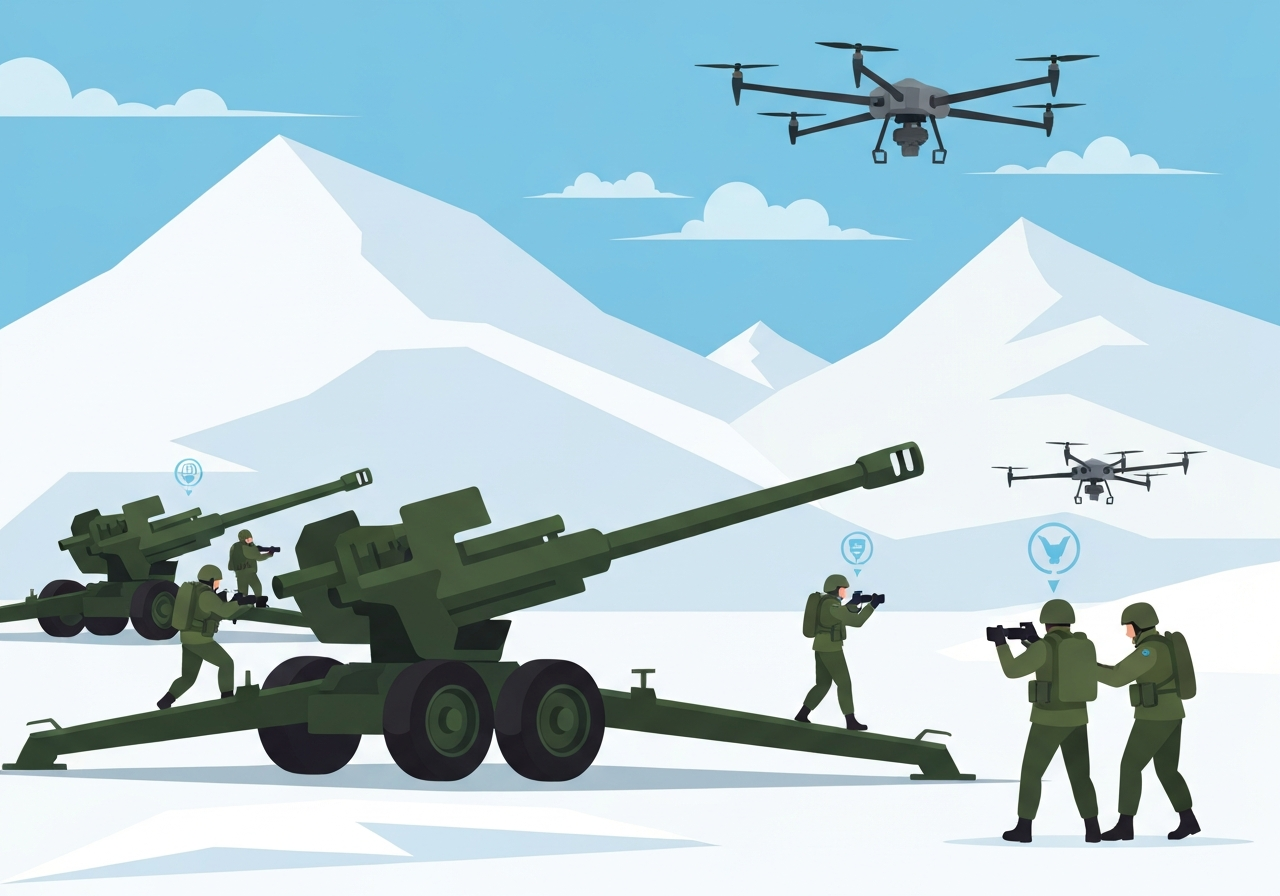
At the Cold Response 26 exercise in March 2026 near Setermoen, Norway, NATO artillery units have been training to integrate small drones into targeting workflows, drawing directly on lessons from Russia’s invasion of Ukraine. Commanders reported that cheap, expendable uncrewed aerial systems (UAS) have proven valuable for reconnaissance and hunting targets. However, NATO crews are discovering that many off-the-shelf drones struggle to perform in the Arctic’s extreme cold, wind and limited daylight. The result is a push to adapt tactics, hardware and logistics so drones can meaningfully support artillery in high-latitude operations.
Key takeaways
- NATO drills at Cold Response 26 in Setermoen, Norway (March 2026) trained British, Norwegian and U.S. artillery units on drone-assisted targeting and reconnaissance.
- British 29th Commando Regiment Royal Artillery personnel practiced directing fire from 105mm light howitzers using drone-derived targeting data.
- U.S. Marines at the exercise relied on M142 HIMARS for long-range fires while experimenting with drones to scout and refine shoot-and-scoot tactics.
- Commanders from Norway and the U.K. said lessons from Ukraine underscore the tactical value of cheap drones for spotting and targeting, not replacing artillery.
- Environmental limits were clear: many small UAS tested were designed for temperate zones and experienced reduced endurance, sensor performance and reliability in Arctic temperatures and winds.
- NATO officials are now balancing investments in hardened UAS, revised doctrine and logistics to sustain drone operations in the High North.
Background
Russia’s full-scale invasion of Ukraine accelerated a battlefield trend: wide use of low-cost commercial and purpose-built drones for surveillance, target acquisition and, increasingly, strike missions. Ukrainian forces and supporting Western advisers quickly proved that cheap, expendable UAS can supply near-real-time targeting to artillery and missile systems, changing engagement timelines and masking friendly maneuver. NATO planners have watched those developments closely and begun to adapt training and procurement priorities accordingly, with a particular eye on areas of strategic concern such as the Arctic. Growing Russian and Chinese activity in the High North has prompted alliance members to prepare forces that can operate in very cold, remote conditions.
Cold Response 26, led by Norway, is one of NATO’s recurring Arctic exercises designed to test readiness for frozen, mountainous and maritime environments. The event assembles units across the alliance to rehearse collective defense tasks, including artillery fires, logistics under cold-weather conditions and coordinated air-ground sensing. For artillery formations, the exercise has become a laboratory to combine traditional area fires with modern sensors — notably UAS — to tighten the sensor-to-shooter timeline. That blending of vintage firepower and contemporary reconnaissance reflects a broader shift in how conventional units expect to fight in the next decade.
Main event
At a firing range near Setermoen, British commandos from the 29th Commando Regiment Royal Artillery ran live-fire drills with 105mm light howitzers while using small drones to locate and designate targets. Soldiers practiced relaying coordinates and imagery from drone feeds to forward observers and gun crews, then adjusting fire based on aerial updates. Norwegian tracked howitzers and U.S. Marine HIMARS batteries ran complementary drills, each testing how aerial sensors change the tempo and accuracy of fires. Trainers emphasized that drones were used as targeting aids and force-multipliers rather than replacements for shells or rockets.
During sorties, troops found that battery life, GPS stability and camera clarity degraded in prolonged cold and gusting conditions, causing shorter flight times and intermittent telemetry. Operators also noted navigation challenges in feature-poor, snow-covered terrain where common visual cues are absent, and persistent high winds forced early recoveries. In spite of those limits, drone crews successfully detected mock targets at ranges that improved initial rounds-on-target times, demonstrating tangible improvements in acquisition speed. Units logged problems and adaptations, from battery pre-warming procedures to altered patrol patterns that reduce exposure to winds.
Leaders at the ranges stressed that artillery’s advantages remain: high-speed kinetic effect, resistance to many countermeasures and effectiveness across weather regimes. Marines and allied artillery officers framed drones as an enabler to extend situational awareness and reduce sensor-to-shooter latency, but they cautioned that UAS fragility and limited endurance in the Arctic constrain operational concepts. As a result, exercises focused equally on protecting forces from aerial observation as on using UAS for friendly advantage.
Analysis & implications
Operationally, integrating drones into Arctic artillery formations forces a re-think of doctrine, logistics and procurement. Units must field not only airframes and sensors, but also cold-hardened batteries, redundant comms paths and robust recovery plans for UAS that fail or crash in remote terrain. That increases sustainment demands compared with temperate deployments and favors systems designed for low-temperature performance, modular repairs and easy transport on snow and ice. Procurement decisions will likely tilt toward hardened small UAS or variants with rapid swap-out components rather than unmodified commercial quadcopters.
Tactically, drones shift how artillery crews find and engage targets by shortening the observe-orient-fire loop and by enabling more dispersed scouting ahead of fires. In an Arctic campaign, that capability could allow smaller units to surveil valleys and fjords without exposing gun lines to unnecessary observation. However, adversaries may adapt by hardening camouflage, developing counter-UAS sensors, or employing electronic and kinetic means to deny aerial observation. Thus, reliance on UAS must be paired with signature management and redundant targeting methods to avoid a single point of failure.
Strategically, NATO strengthening its ability to employ drones in the High North signals a response to perceived Russian and Chinese activity, and it may change escalation dynamics in the region. If alliance units can reliably use UAS for targeting and reconnaissance under Arctic conditions, they gain persistent awareness that complicates any opponent’s operations in those latitudes. Conversely, investment in Arctic-hardened UAS also opens a technology race: states and industries will compete to field longer-endurance, colder-weather platforms and countermeasures, with implications for procurement budgets and industrial cooperation across allies.
Comparison & data
| Capability | Small UAS (typical) | Artillery (105mm / HIMARS) |
|---|---|---|
| Weather resilience | Low–medium; endurance drops in cold/wind | High; shells/rockets function across climates |
| Detection/interception | High vulnerability to weather and countermeasures | Harder to intercept; delivers massed effect |
| Cost per sortie | Low (airframe), but high attrition increases total cost | Higher per round, but robust in adverse conditions |
| Sensor advantage | Provides real-time imagery and target refinement | Provides decisive kinetic effects once targeted |
The table summarizes qualitative trade-offs observed during exercises: drones add real-time sensing at relatively low unit cost but degrade faster in Arctic weather, while artillery remains reliable and lethal across conditions. That dynamic explains why commanders emphasize pairing UAS-derived targeting with traditional fires rather than substituting one for the other. Practically, the data point to priorities: invest in hardened sensors, redundant networks, and doctrine that uses both systems’ strengths.
Reactions & quotes
British artillery leaders underscored the enduring value of direct-fire munitions while acknowledging drones’ role in sharpening targeting. The comments were provided during the live-fire portion of Cold Response 26 where allied forces exchanged practices.
Artillery still provides a blunt, dependable effect when weather degrades sensors.
Maj. Robin McArthur, 29th Commando Regiment Royal Artillery
Norwegian officers highlighted increased drone issuance to subunits following observations from Ukraine, stressing training to use UAS for spotting under combat conditions. This is part of a national move to build distributed sensing across battalions.
We’ve begun equipping more subunits with UAS so they can gather targeting data and operate in contested conditions.
Maj. Kay-Arne Schjetne, Norwegian artillery battalion operations officer
U.S. Marines discussed both defensive and offensive uses of drones: reducing their own exposure and using UAS to identify positions for HIMARS. Marine leaders framed drones as a complement to shoot-and-scoot practices rather than a replacement for long-range fires.
Drones help us scout positions and improve tempo, but shoot-and-scoot doctrine remains central.
First Lt. Landon Foster, HIMARS platoon commander
Unconfirmed
- Claims that strike-capable inexpensive drones can fully replace artillery accuracy in Arctic operations remain unproven and lack operational data in cold-weather campaigns.
- Exact inventory plans for cold-hardened UAS across NATO members have not been publicly disclosed and vary by national procurement cycles.
- Reported performance metrics for specific UAS models in Arctic wind and temperature profiles cited by operators require formal testing to validate field impressions.
Bottom line
NATO’s Cold Response 26 showed that lessons from Ukraine about using cheap drones for targeting are being actively adopted by artillery formations, but the Arctic presents distinct technical and doctrinal hurdles. Commanders see UAS as force-multipliers for reconnaissance and target refinement rather than as substitutes for guns and rockets that remain effective across harsh conditions. Over the next several years, expect alliance investments to prioritize hardened small UAS, logistics innovations, and tactics that combine persistent sensing with mobile fires.
What to watch next: formal cold-weather testing results for UAS platforms, national procurement announcements for Arctic-capable sensors and batteries, and doctrine updates that describe how NATO units will protect themselves from increased aerial observation in the High North.