
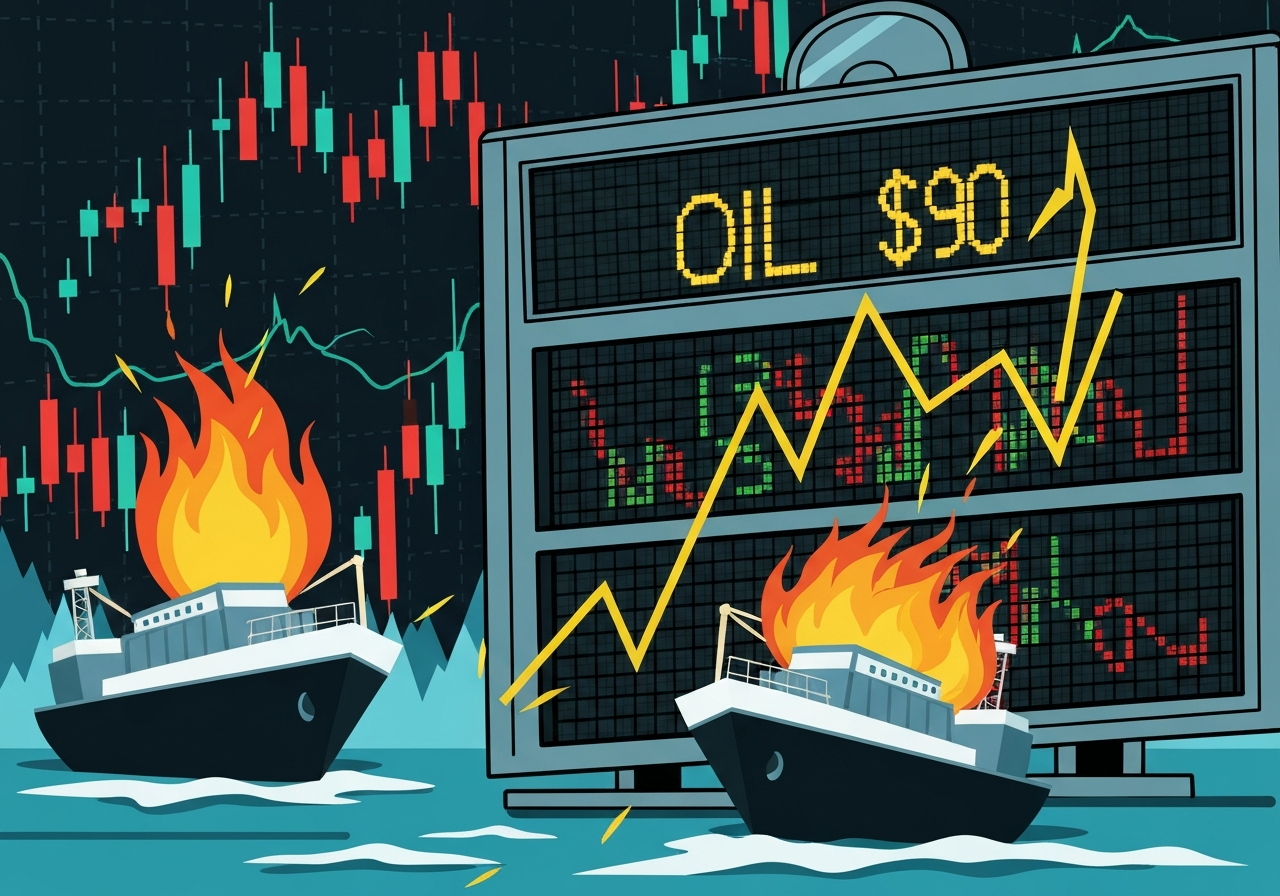
Lead: In early U.S. trading, stock futures slipped after oil futures climbed past $90 per barrel following reports of tanker attacks in international waters. The move pushed investors toward risk reduction and raised fresh supply concerns for crude markets. Market data platforms showed mixed liquidity while traders reassessed sector exposure. The immediate result was a cautious tone across equity futures and heightened attention to energy and maritime risk indicators.
Key Takeaways
- Crude oil futures topped $90 per barrel amid reports of tanker attacks, marking a renewed supply-risk premium in energy markets.
- U.S. stock futures moved lower in early trading as investors reduced exposure to risk assets and rotated positions.
- Real-time pricing and trade data cited in market feeds are provided by Nasdaq Last Sale, with ownership data from LSEG and estimates from FactSet.
- Market participants flagged potential shipping insurance and freight-cost implications that could influence energy and trade-sensitive sectors.
- Analysts warned that tighter physical supply or longer shipping delays could raise fuel costs downstream and add to inflationary pressure.
- Investor caution was amplified by thin pre-market liquidity, increasing the likelihood of larger intraday swings.
Background
Geopolitical incidents targeting tankers have historically translated into sharp, if sometimes short-lived, moves in oil prices. When transit routes or shipping hubs face security risks, markets quickly price in potential supply disruptions, higher freight costs and insurance surcharges. The shipping and energy industries are interconnected: even episodic attacks can raise operational costs and prompt contingency responses from shippers and oil traders.
Market structure today — with futures, ETFs and algorithmic execution playing larger roles — can magnify initial price moves. Traders monitor not only crude benchmarks but also shipping insurance indices and vessel-tracking reports to assess how long a disruption might affect delivered supply. Policy makers and energy firms typically weigh such incidents against inventories, refinery runs and strategic reserves when projecting longer-term impacts.
Main Event
Reports of attacks on one or more tankers emerged in the pre-market window, prompting immediate reassessment of near-term crude availability. Oil futures responded by moving above the $90-per-barrel threshold, a psychological level that often attracts heightened attention from both trading desks and media. The price move coincided with reduced willingness among some traders to initiate fresh long equity exposure ahead of clearer information about the incidents.
Equity futures, which reflect investors’ expectations for the open, registered declines as buy-side desks and program traders trimmed positions. The energy complex showed relatively stronger performance intraday as commodity desks priced in elevated risk premia, while industries sensitive to fuel costs began to factor in margin pressure if higher oil persisted.
Market-data vendors cautioned that real-time quotes may come from varying venues and that liquidity conditions were uneven in early trade. That fragmentation can widen bid-ask spreads and amplify headline-driven volatility, particularly when geopolitical developments are unfolding and verification remains partial.
Analysis & Implications
At face value, attacks on tankers increase the perceived probability of supply interruptions, driving a premium into crude prices. If vessel operations are curtailed or shippers reroute around risk zones, insurance and freight costs rise, which can effectively tighten delivered supply even if crude production remains unchanged. That dynamic tends to support higher prices for refined and transport fuels in affected regions.
For financial markets, the policy relevance is twofold. First, higher energy prices can feed into inflation measures, complicating central-bank communications if the move proves persistent. Second, elevated commodity volatility often triggers risk-off behavior, tightening financial conditions through equity weakness and potential equity-market repricing.
Sectorally, energy firms and commodity-related assets may outperform in the near term, while airlines, shipping lines and heavily freight-exposed manufacturers face margin pressure. Portfolio managers will balance tactical exposure to energy versus the broader economic implications of sustained higher fuel costs.
Comparison & Data
| Indicator | Recent Move / Note |
|---|---|
| Crude oil (futures) | Topped $90 per barrel (intraday) |
| U.S. equity futures | Lower in early trade (risk-off response) |
| Market data providers | Nasdaq Last Sale; ownership data from LSEG; estimates from FactSet |
The table presents the immediate market readings tied to the tanker-attack reports. Traders rely on consolidated feeds but also monitor vessel-tracking and insurance-rate indicators to assess whether price moves reflect temporary positioning or a more persistent supply shock.
Reactions & Quotes
Market platforms and the original publisher highlighted data-source and usage disclaimers as the story developed; those notices are part of routine risk management for real-time market reporting. Exchanges and data vendors emphasized that prices can vary across venues during episodes of heightened volatility.
Information in Investor’s Business Daily is for informational and educational purposes only and should not be construed as an offer, recommendation, solicitation, or rating to buy or sell securities.
Investor’s Business Daily (media)
That advisory underscores limits on interpretation of rapidly updating market data and reminds readers that authors may hold positions discussed in coverage.
Real-time prices by Nasdaq Last Sale. Real-time quote and/or trade prices are not sourced from all markets.
Nasdaq Last Sale / Investor’s Business Daily (data disclosure)
Data vendors noted that fragmented sourcing can affect quote completeness, a relevant caveat amid the fast-moving environment triggered by the shipping incidents.
Unconfirmed
- The precise number and identities of vessels affected remain unverified in open-source reports.
- Attribution of responsibility for the attacks has not been conclusively established in publicly available statements.
- The scale and duration of any disruption to delivered crude supplies are not yet confirmed by shipping or oil-company notices.
Bottom Line
The immediate market reaction was risk-off: futures softened as oil rose above $90 amid tanker-attack reports, reflecting a classic geopolitical-risk impulse. Whether the price move persists will hinge on verification of damage, shipping-route impacts and any secondary effects on freight and insurance costs.
Investors should monitor official maritime and energy-company updates, inventory reports and insurance-rate signals to distinguish a fleeting headline-driven move from a sustained supply-driven shift. For portfolio positioning, balancing near-term energy exposure with hedges against broader risk-off scenarios will be the prudent course as details continue to emerge.