
Lead
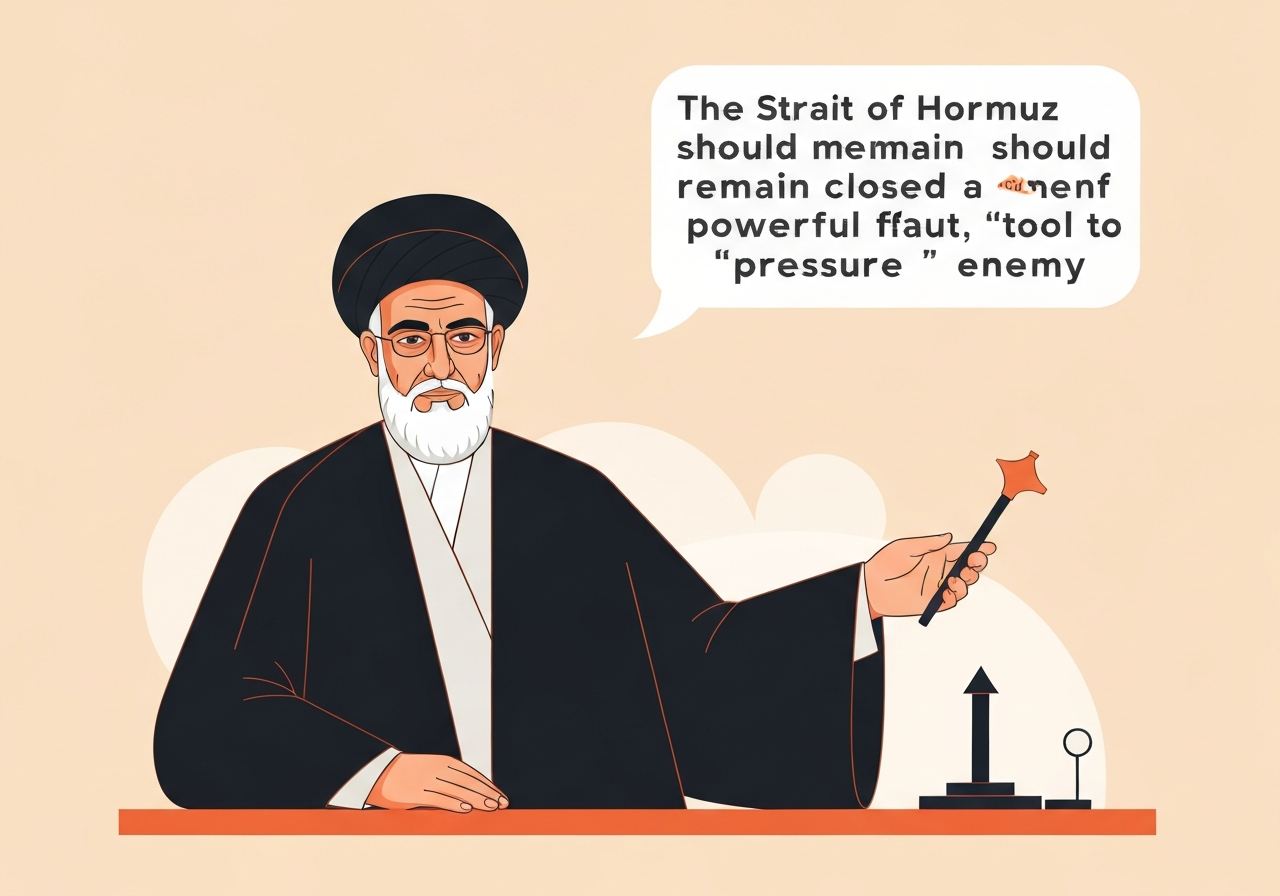
On Thursday, March 12, 2026, Iran’s newly appointed supreme leader, Mojtaba Khamenei, said the closure of the Strait of Hormuz should continue as a “tool to pressure the enemy,” marking his first public remarks since his March 9 appointment. In televised comments translated by Reuters, he also said U.S. military bases in the Middle East should close immediately and warned those bases would be attacked. State television read the statement, and global oil markets extended gains after the remarks. The shipping of oil through the Strait has effectively stopped since the war began in late February, a development Tehran says it will use to press adversaries.
Key Takeaways
- Mojtaba Khamenei made his first public statement as supreme leader on March 12, 2026, urging continuation of a Strait of Hormuz closure as leverage against adversaries.
- The new leader said U.S. military bases in the Middle East should close and warned they would be attacked if they remain, remarks broadcast on state TV and translated by Reuters.
- Oil shipments through the Strait have effectively halted since the conflict started in late February, and Iran warned that prices could reach $200 per barrel.
- The appointment followed the March 9 assassination of Ayatollah Ali Khamenei in U.S.-Israeli strikes that began in late February; Mojtaba Khamenei was reported injured in the same attack.
- Global oil prices rose on the statement as markets reacted to renewed regional risk and the prospect of prolonged disruption to seaborne flows.
- U.S. President Donald Trump publicly expressed disappointment in the clerics’ selection and questioned the new leader’s willingness to live in peace.
- Analysts say airstrikes alone are unlikely to remove Iran’s leadership, and there is no clear sign the U.S.-Israeli campaign is concluding, with exchanges intensifying this week.
Background
The current sequence stems from a dramatic escalation that began with coordinated U.S.-Israeli airstrikes in late February 2026, which Iranian officials say targeted the supreme leader’s compound and killed Ayatollah Ali Khamenei along with other relatives. Mojtaba Khamenei, 56, was reported injured in that attack and was named supreme leader by senior clerics on March 9. His elevation follows years operating largely out of the public eye, and analysts characterize him as more hard-line than his predecessor.
The Strait of Hormuz, a narrow waterway linking the Persian Gulf to the Gulf of Oman, has long been a strategic chokepoint for international energy shipments. Since the outbreak of hostilities, regular tanker transits have been disrupted; Tehran and its proxies have increasingly used strikes on shipping and nearby platforms as leverage. Regional actors, global energy markets and insurers have adjusted rapidly to the higher risk environment, and diplomatic channels have been strained as nations weigh responses.
Main Event
In the televised address on March 12, Mojtaba Khamenei framed the strait’s closure as an instrument to impose pressure on enemies, instructing that it be maintained until Iran’s objectives are secured. State media aired the remarks, which a Reuters translation rendered into English; oil markets reacted almost immediately with further price gains. Officials in Tehran also called for unity at home and pledged retribution for the deaths described as martyrs.
Khamenei’s comments included a demand that all U.S. military bases in the Middle East close immediately and an explicit warning that remaining bases “will be attacked,” language that raised concerns among U.S. and allied defense planners. Tehran simultaneously declared it would seek compensation from perceived adversaries or “destroy their assets accordingly,” adding ambiguity about whether that would mean targeted seizures, strikes or other measures.
The practical effect for shipping has been severe: operators report effective stoppages of routine oil exports via the Strait, citing safety and insurance refusals. Maritime insurance premiums and freight rates have surged, and several nations have begun contingency planning, including naval escorts and alternative routing discussions though geographic alternatives are limited.
Analysis & Implications
Strategically, keeping the Strait closed converts a geographic chokepoint into a bargaining chip. For Iran, control over transits elevates its diplomatic leverage by directly affecting global energy markets and supply chains. If closures or attacks persist, the resulting strain on energy supply would push prices higher and increase inflationary pressures in import-dependent economies.
Militarily, threats to U.S. bases broaden the scope of potential confrontation. Attacks on bases would represent a major escalation with clear risks of wider regional engagement. Defense planners must weigh force protection, rules of engagement, and the political will for sustained action if Iran follows through on its warnings.
Economically, a sustained disruption to seaborne flows through the Strait would accelerate shifts in shipping patterns, insurance models and long-term energy sourcing. Markets may accelerate investment in alternative routes, storage capacity, and strategic petroleum reserves, but those are costly and slow responses that do not remove near-term volatility.
Diplomatically, the episode complicates efforts by states seeking de-escalation. Some capitals may pursue discreet channels to reopen transit and negotiate compensation, while others could intensify military support for partners in the Gulf. The interplay between public threats and private diplomacy will shape whether the situation stabilizes or metastasizes into protracted confrontation.
Comparison & Data
| Item | Recent status |
|---|---|
| Supreme leader appointment | March 9, 2026 — Mojtaba Khamenei |
| Public statement on Hormuz | March 12, 2026 — closure to continue |
| Shipping through Strait | Effectively halted since late February 2026 |
| Price warning | Iran warned of $200 per barrel risk |
This compact table highlights the rapid sequence: a late-February campaign of strikes that culminated in an assassination, a succession decision on March 9, and a consequential public posture by the new leader on March 12. The tangible market effect—rising insurance and oil prices—has been felt in days, not weeks.
Reactions & Quotes
“The Strait of Hormuz must remain closed as a tool to pressure the enemy,”
Mojtaba Khamenei (state television, translated)
That line framed Tehran’s intent to use a strategic maritime chokepoint as leverage. The remarks were broadcast on state channels and quickly picked up by international wire services.
“Those bases will be attacked,”
Mojtaba Khamenei (state television, translated)
This direct threat against U.S. facilities escalates the rhetoric from prior weeks and prompted immediate diplomatic and military consultations in Washington and allied capitals.
“I don’t believe he can live in peace,”
U.S. President Donald Trump (Fox News)
President Trump publicly signaled disappointment at the clerics’ choice and framed the appointment as a continuation of confrontation, though U.S. policy objectives and next steps remain publicly ambiguous.
Unconfirmed
- Whether Iran intends the Strait closure to be temporary or a long-term bargaining position remains unclear and unconfirmed by formal policy documents.
- The specifics of how Tehran would “destroy assets” or seek compensation—whether through seizures, cyber actions, or kinetic strikes—have not been detailed and remain unverified.
- It is unconfirmed whether the White House’s public comments signal a shift toward regime change as an explicit objective of ongoing operations.
Bottom Line
Mojtaba Khamenei’s first public statements as supreme leader crystallize a strategy that leverages Iran’s control over a strategic maritime chokepoint to extract political and economic pressure. The announcement and associated threats raise the probability of further escalation that could draw in regional partners and global markets, particularly for energy.
For policymakers and markets, the near-term imperative is managing risk: protecting commercial shipping, calibrating military deterrence to avoid unintended escalation, and pursuing diplomatic channels to restore transit where possible. Over the medium term, sustained disruption would prompt structural market adjustments and a reassessment of energy and security strategies in the wider international community.