
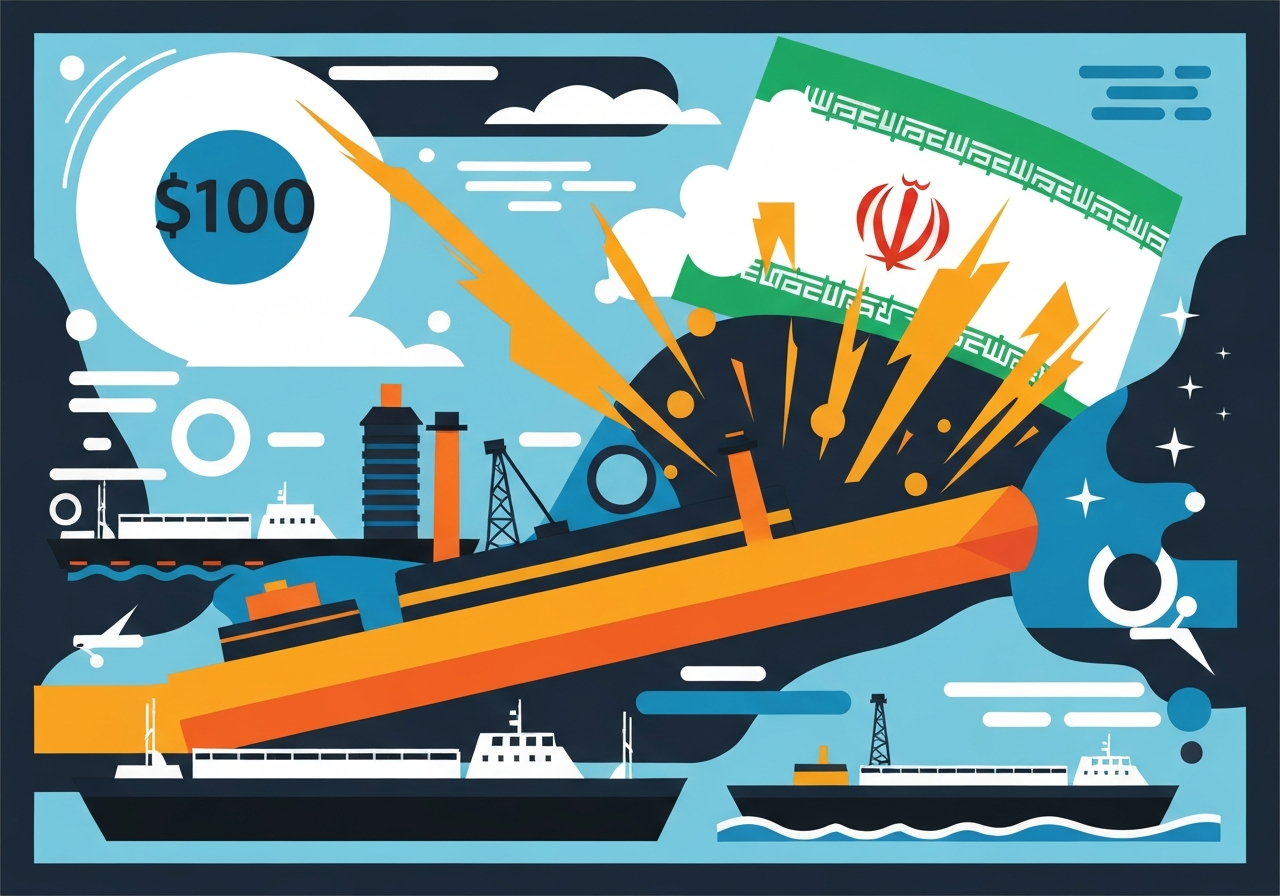
Lead: Brent crude hovered near $100 per barrel on Friday as the U.S.-Iran war moved into its third week, lifting energy-market anxiety worldwide. At 7:49 a.m. ET, Brent futures were $99.32 per barrel, down 1.13% from a session that saw prices above $100; U.S. West Texas Intermediate traded at $93.75, down 2.07%. The conflict’s disruption of shipments through the Strait of Hormuz, alongside policy responses such as a record IEA release and temporary U.S. waivers on some Russian exports, is keeping crude elevated and markets on edge.
Key Takeaways
- Brent crude stood at $99.32 per barrel at 7:49 a.m. ET on March 13, 2026, a 1.13% intraday drop after briefly closing above $100 the prior session.
- WTI was trading at $93.75 per barrel, down 2.07% intraday and poised for a weekly gain of roughly 5.8%.
- Brent futures have risen more than 9% this week following a 27.9% jump the previous week—the largest weekly increase since 2020.
- The U.S.-Iran war entered its third week, and foreign vessels in or near the Strait of Hormuz have been struck by ammunition amid a partial blockade of a key transit route.
- The International Energy Agency agreed to release a record 400 million barrels from emergency reserves as governments and markets seek to stabilize supply.
- President Donald Trump said the U.S. has “unparalleled firepower, unlimited ammunition, and plenty of time,” and later claimed Iran was “about to surrender” on a call with G7 leaders, according to Axios.
- Analysts warn of growing market nervousness: Barclays noted investors initially priced in a short conflict but are increasingly jittery, while EnQuest’s CEO warned of persistent, large supply losses comparable in market effect to the 1970s Arab embargo.
Background
The military confrontation between the U.S., Israel and Iran has intensified disruptions to Middle East oil flows. The Strait of Hormuz, through which roughly a fifth of globally traded oil flows in normal times, has experienced reduced traffic and reported strikes on vessels this week, raising fears of prolonged supply shortages. Historically, major disruptions in the Gulf—such as the 1970s Arab oil embargo—led to sustained sharp price rises and global economic shocks; market participants are drawing parallels as volumes tighten.
Global policy responses have been swift and atypical. The International Energy Agency approved a coordinated release of 400 million barrels from emergency reserves to offset supply loss, and the White House temporarily relaxed certain sanctions on Russian exports to ease market pressure. Traders and central banks are monitoring whether these measures are sufficient if the conflict endures and shipping routes remain impaired.
Main Event
On the trading floor Friday, Brent futures moderated after a spell above $100 on Thursday, reflecting both technical profit-taking and fresh policy measures aimed at bolstering supply. Yet the week’s gains—more than 9% for Brent and about 5.8% for WTI—underscore the depth of disruption priced into markets. Market participants cited persistent logistical disruptions and the elevated risk premium associated with fighting near a chokepoint for global energy flows.
President Donald Trump’s public remarks this week intensified attention. He said the U.S. possessed “unlimited ammunition” and “plenty of time,” and, per Axios, told G7 leaders he believed Iran was “about to surrender.” Tehran’s authorities publicly rejected that framing: Iran’s new supreme leader, Mojtaba Khamenei, used state television to vow continued resistance, indicating a protracted confrontation rather than an imminent capitulation.
Beyond statements, on-the-ground incidents have fed volatility. Multiple foreign vessels in or near the Strait of Hormuz were reported hit by ammunition this week, elevating insurance costs and spurring rerouting or delays for tankers. Energy executives and analysts say each day of constrained flows removes tens of millions of barrels of available supply from near-term markets, tightening an already fragile balance.
Analysis & Implications
Supply shock dynamics are now the dominant driver of oil pricing. With physical shipments disrupted and risk premia rising, the market is pricing in extended shortages rather than a short, contained flare-up. The IEA’s 400 million-barrel release is unprecedented and intended to cushion immediate shortages, but it cannot indefinitely replace sustained production and transit losses if the Strait of Hormuz remains compromised.
Macroeconomic implications include a higher risk of stagflation: rising energy costs combined with slowing growth can force central banks into difficult trade-offs. Barclays analysts warned that equities have so far absorbed some market stress—partly due to belief in a policy backstop—but that nervousness grows the longer disruptions persist, increasing the odds of hawkish repricing in interest rates and tighter financial conditions.
For energy firms and importers, the near-term picture is complex. Producers in stable regions can benefit from higher prices, but refiners and consuming countries face margin squeezes and inflationary pressure. Logistics insurers and charter rates will likely climb while shippers reroute around high-risk zones, increasing transit times and costs that ultimately pass through to consumers.
Comparison & Data
| Metric | Latest | Prior Week | Change |
|---|---|---|---|
| Brent (per barrel) | $99.32 (7:49 a.m. ET) | Closed > $100 (Thu) | +9% (this week), +27.9% (last week) |
| WTI (per barrel) | $93.75 | – | ~+5.8% (this week) |
| IEA coordinated release | 400 million barrels | – | Record emergency release |
Context: the table summarizes price levels and recent percentage moves. The previous week’s 27.9% Brent surge was the largest weekly increase since the pandemic shock of 2020; current-week gains reflect continued risk pricing despite policy efforts to release reserves and ease sanctions.
Reactions & Quotes
U.S. political signals have been stark and consequential for markets. Below are representative statements and their context.
Before the markets opened, President Trump framed the U.S. posture in combative terms, a tone markets interpreted as signaling a potentially extended campaign rather than a short punitive action.
“We have unparalleled firepower, unlimited ammunition, and plenty of time.”
President Donald Trump
Iranian military spokespeople pushed back with their own stark market-oriented warning.
“Get ready for oil to be $200 a barrel, because the oil price depends on regional security, which you have destabilised.”
Ebrahim Zolfaqari, Iran military command spokesperson (quoted via Reuters)
Energy-sector leaders stressed the scale of supply loss and the potential for a prolonged squeeze comparable to historic embargoes.
“Every day we see a delay, there’s another 20 million barrels [wiped off the market], and that will have an impact.”
Amjad Bseisu, CEO, EnQuest (CNBC interview)
Unconfirmed
- Axios reported that President Trump told G7 leaders Iran was “about to surrender”; that characterization of private diplomatic calls remains unverified by official transcripts.
- Attributions of specific vessel damage to named states or proxies are still being investigated and remain subject to confirmation by independent maritime authorities.
Bottom Line
Oil prices are reflecting a market that now sees a significant and potentially long-lived supply disruption rather than a brief shock. The IEA release and U.S. policy waivers provide short-term relief but cannot fully substitute for sustained throughput if the Strait of Hormuz remains insecure.
Investors and policymakers should watch three variables in the coming days: the security status of key shipping lanes, coordinated release/use of reserves, and central-bank responses to rising energy-driven inflation. Together these will determine whether current price moves solidify into a protracted period of higher energy costs with attendant global economic consequences.
Sources
- CNBC (news) — original reporting and market data on prices and interviews.
- Reuters (news agency) — reporting on vessel incidents and regional military statements.
- Axios (news) — reported details of President Trump’s call with G7 leaders.
- International Energy Agency (official/agency) — announcement and details on coordinated 400 million-barrel release.
- The White House (official) — statements on temporary waivers of certain export sanctions.
- EnQuest (corporate) — CEO comments on supply impacts, as reported on CNBC.
- Barclays Research (financial analysis) — market and investor sentiment note referenced in reporting.