
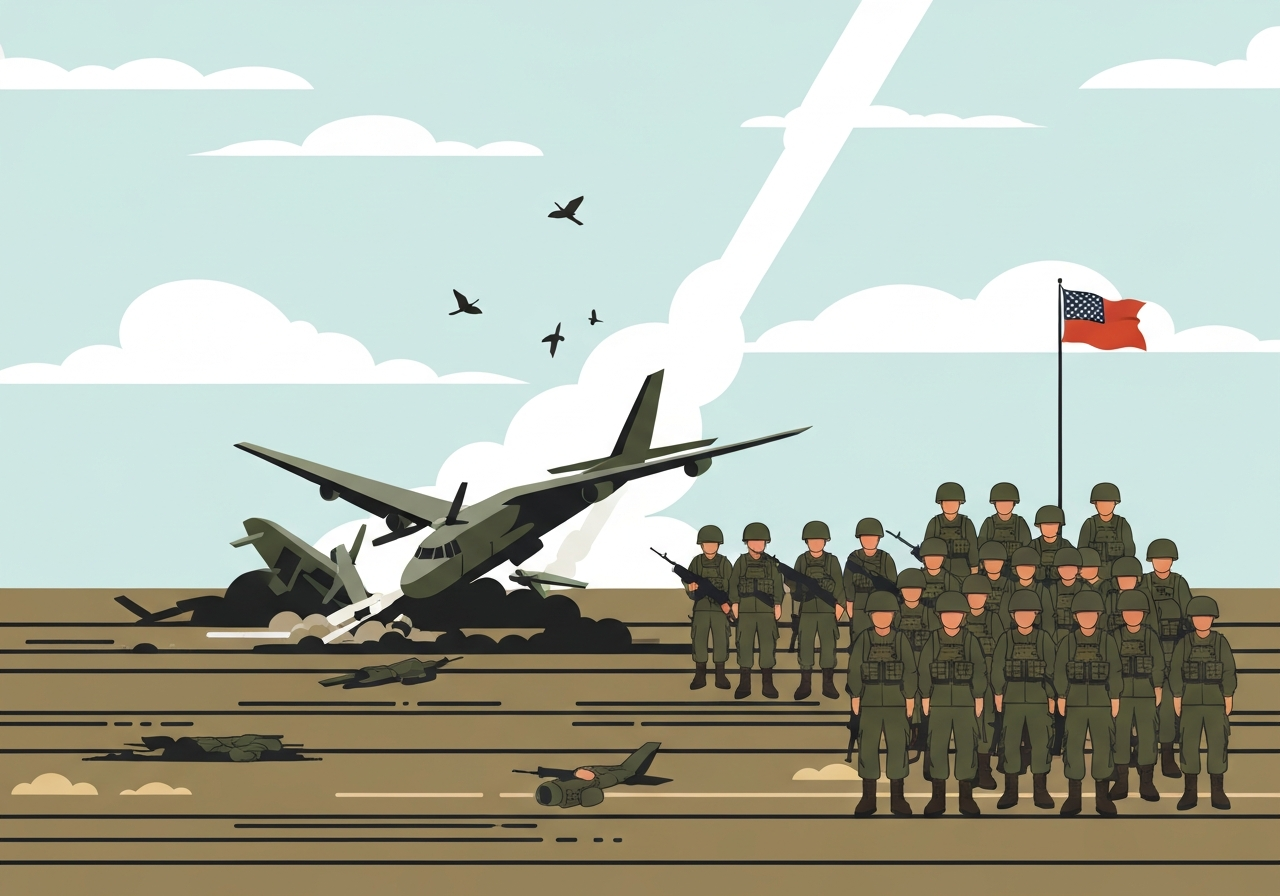
Lead: Six U.S. airmen were killed when a KC-135 refueling tanker crashed in western Iraq on March 13, 2026, during operations targeting Iranian forces, U.S. Central Command said. The other aircraft involved landed safely, and CENTCOM said the crash was under investigation and “not due to hostile or friendly fire.” Defense Secretary Pete Hegseth ordered about 2,500 Marines aboard the USS Tripoli to sail from Japan to the Middle East as U.S. and allied strikes on Iran intensified, while President Trump and Iranian leaders exchanged forceful public statements.
Key Takeaways
- Six U.S. airmen died in the March 13 crash of a KC-135 tanker in western Iraq; the incident is under investigation, CENTCOM said.
- The crash raises the U.S. death toll in the conflict to 13, according to Pentagon tallies.
- Defense Secretary Pete Hegseth ordered roughly 2,500 Marines aboard the USS Tripoli to deploy from Japan to the region to reinforce forces already in the Middle East.
- The Pentagon described the day as the heaviest round of strikes against Iranian targets since the operation began two weeks earlier.
- Iranian officials report at least 1,348 civilian deaths from the strikes; international monitors and oil agencies warn of major supply disruptions.
- Oil has risen to about $95 a barrel, a roughly 40% jump since Feb. 28, and an estimated 1,000 ships remain stranded in the Persian Gulf.
- UK Maritime Trade Operations logged 20 incidents affecting vessels in and near the Persian Gulf, Strait of Hormuz and Gulf of Oman in March.
Background
Over the preceding two weeks, the United States and allied partners have conducted sustained airstrikes and other operations targeting Iranian military infrastructure and capabilities. U.S. officials describe the campaign as focused on degrading Iran’s naval, missile and nuclear assets; Iranian authorities characterize the strikes as large-scale assaults that have hit civilian areas. The conflict has produced several U.S. aircraft losses; the downed KC-135 is the fourth U.S. aircraft reported lost since hostilities escalated.
The Strait of Hormuz and Kharg Island are central strategic flashpoints: Hormuz is a choke point for global oil flows, and Kharg is Iran’s principal oil-export terminal. Tehran has repeatedly used disruption of shipping as leverage, and officials in Washington have warned that Iran’s moves to block passage threaten global markets. That strategic geography has drawn in regional navies, commercial shipping operators and outside powers seeking bases and logistics points nearby, including deployments around Cyprus and increased air operations from U.K. territory.
Domestic politics in the United States and partner capitals shape operational choices. Statements from the White House and senior defense officials have at times diverged in tone and detail, creating public uncertainty about objectives. Allies such as the United Kingdom, France and Italy have repositioned naval assets, and logistics hubs in the eastern Mediterranean have become focal points for coordination and risk management.
Main Event
Central Command announced that a KC-135 aerial refueling tanker crashed in western Iraq on March 13; an accompanying aircraft completed a safe landing. CENTCOM said the crash occurred in friendly airspace and that preliminary information does not indicate hostile or friendly fire. An investigation was opened to determine mechanical, human or other causes. The aircrew were participating in operations tied to the broader campaign targeting Iranian military sites.
At the Pentagon, Defense Secretary Pete Hegseth called the fallen airmen “American heroes” and signaled a continuation and intensification of strikes, saying the U.S. would press to destroy Iran’s naval, missile and nuclear capabilities. As he spoke, the USS Tripoli prepared to sail from Japan with roughly 2,500 Marines, aircraft and additional ships to bolster U.S. forces in the region. Officials characterized the movement as reinforcement rather than the immediate preparation for a land invasion.
President Trump provided mixed public messaging: in interviews and on his social media platform he downplayed Kharg Island as a top target while also posting that U.S. raids had “totally obliterated every MILITARY target” there and warning of immediate retaliation if Iran interfered with shipping. Those public remarks came alongside Iranian statements promising continued retaliation and vowing to sustain pressure on the Strait of Hormuz.
Across the region, incidents continued to unfold: Iranian drone and missile attacks have struck Gulf states and nearby facilities, and debris from an intercepted drone caused a fire in Dubai’s International Financial Center. Lebanese authorities reported civilian casualties after Israeli strikes and retaliatory missile and drone activity by Hezbollah, underscoring the conflict’s spillover into neighboring states.
Analysis & Implications
The crash and the Marines’ deployment both deepen U.S. operational commitments and complicate political messaging. A loss of six airmen will intensify scrutiny of command decisions, maintenance practices and rules of engagement; the formal investigation will be central to assigning cause and potential corrective steps. At the same time, the movement of 2,500 Marines increases the U.S. footprint, improving options for forward presence, air operations and amphibious missions but raising the stakes for escalation.
Strategically, control and contestation of the Strait of Hormuz remain decisive for global energy security. Disruptions there have immediate economic consequences: higher crude prices, stalled shipments, and knock-on effects in industries such as fertilizer production. The International Energy Agency characterized the situation as the largest supply disruption in modern history, and market responses so far — a roughly 40% oil price rise since Feb. 28 — signal high vulnerability to further shocks.
Politically, public comments by senior officials that differ in tone or factual basis create friction between the White House and the Pentagon, and complicate international coordination. Claims about leadership casualties inside Iran, if unverified, can inflame domestic politics in Tehran and reduce space for de-escalation. Allies are balancing commitments: some are permitting limited use of bases for defensive missions while avoiding full participation in offensive operations, reflecting domestic political constraints.
Operationally, the risk of wider confrontation is tangible. Naval escorts, repositioned air assets and additional ground-ready troops reduce vulnerability for merchant shipping but also present more targets. The possibility of a ground operation to seize Kharg Island remains subject to competing military assessments and political approvals; such an operation would entail substantial logistical and casualty risks and likely provoke regional countermeasures.
Comparison & Data
| Metric | Reported Figure |
|---|---|
| U.S. service members killed (total) | 13 |
| Airmen killed in KC-135 crash | 6 |
| Iranian civilian deaths (reported by Iran) | 1,348 |
| Ships stranded in Persian Gulf | ~1,000 |
| Oil price (approx.) | $95 per barrel (≈ +40% since Feb. 28) |
The table summarizes figures reported by U.S. and international sources as of March 13, 2026. Numbers reported by different actors vary by methodology and access; Iranian civilian casualty totals come from Iranian authorities, while U.S. military counts are from Pentagon statements. Shipping and market data reflect commercial monitoring and IEA assessments; these indicators illustrate both humanitarian cost and economic ripple effects.
Reactions & Quotes
“American heroes, all of them. We will greet those heroes at Dover,”
Pete Hegseth, U.S. Secretary of Defense (statement at the Pentagon)
Hegseth used the Pentagon appearance to honor the fallen and to signal continued operations aimed at degrading Iranian military capabilities.
“No quarter, no mercy for our enemies,”
Pete Hegseth (remarks on the scope of strikes)
This phrase underscored the aggressive posture described by senior defense leadership and raised questions among some allies and observers about post-conflict stabilization.
“Our revenge will be never ending,”
Ayatollah Mojtaba Khamenei (Iranian official statement)
Iran’s public vow of retaliation emphasizes Tehran’s intent to use asymmetric levers, particularly threats to maritime transit through the Strait of Hormuz.
Unconfirmed
- Claims that Iran’s Supreme Leader Ayatollah Mojtaba Khamenei is “wounded and likely disfigured” were made publicly by U.S. officials but have not been substantiated by independent intelligence or on-the-ground confirmation.
- Reports suggesting the U.S. is imminently preparing a ground invasion of Kharg Island remain speculative; troop movements have been described by officials as reinforcement rather than invasion preparation.
- President Trump’s assertion that U.S. strikes “totally obliterated every MILITARY target” on Kharg Island while preserving oil infrastructure has not been independently verified.
Bottom Line
The crash that killed six airmen compounds a conflict already marked by heavy strikes, rising civilian tolls and major disruptions to global energy and shipping. The deployment of about 2,500 Marines increases U.S. capacity in the region but also raises the stakes politically and militarily, making clear decisions about objectives and exit conditions more consequential.
Investigations into the crash, transparent updates from U.S. and allied commands, and careful coordination with partners will shape whether the operation stabilizes or expands. Markets and supply chains will likely remain volatile while Iran retains the option to contest shipping through the Strait of Hormuz; policymakers and businesses should monitor troop movements, investigation findings and third-party confirmations of battlefield claims closely.
Sources
- Los Angeles Times (media report)
- U.S. Central Command (official statements)
- U.S. Department of Defense (official press releases)
- The Associated Press (news agency coverage)
- International Energy Agency (energy market analysis)
- UK Maritime Trade Operations (UKMTO) (maritime incident reporting)