
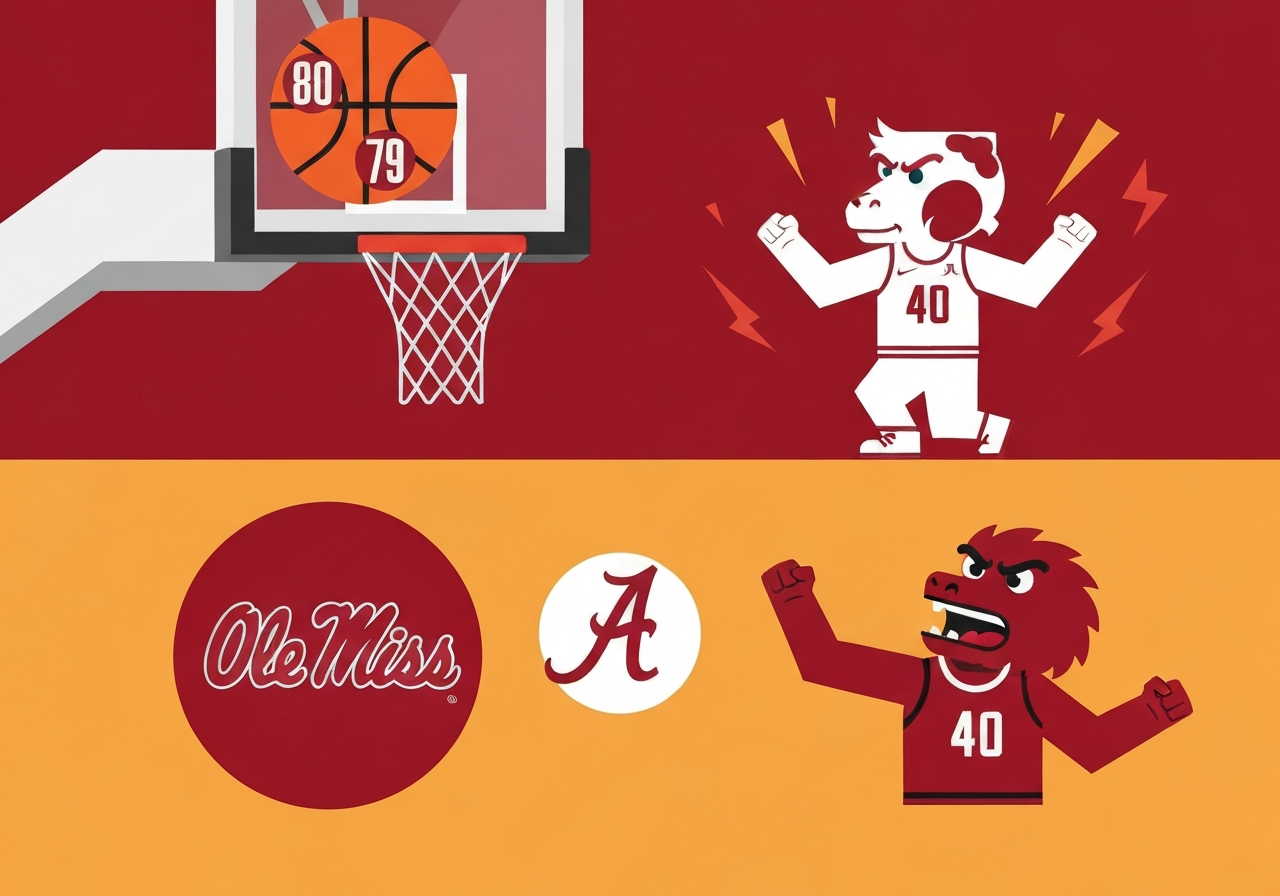
In the SEC Tournament quarterfinals on Friday, No. 15 seed Ole Miss edged No. 2 seed Alabama 80-79, knocking the Crimson Tide out of the conference bracket and handing Alabama a late-season wakeup call. The Rebels, playing their third game in three days, relied on a hot start and late resilience to hold off Alabama in a one-point thriller. Ilias Kamardine emerged as the decisive factor down the stretch, while Alabama’s final possession failed to produce a go-ahead basket. With Selection Sunday at 5 p.m. on Sunday, Alabama now returns to Tuscaloosa and awaits its NCAA Tournament placement.
Key takeaways
- Final score: Ole Miss 80, Alabama 79 in the SEC quarterfinals on Friday; Ole Miss was the No. 15 seed, Alabama the No. 2 seed.
- Hot first half: Ole Miss averaged roughly 1.5 points per possession in the first half and led 47-41 at the break.
- Second-half defense: Alabama restricted Ole Miss to about 0.917 points per possession after halftime but could not erase the halftime deficit.
- Ilias Kamardine key: Kamardine scored 14 second-half points and sank a falling-backward three at the shot-clock buzzer that shifted late momentum.
- Final possession: After an Ole Miss missed free throw with nine seconds left, Alabama grabbed the rebound but failed to convert a final look; Labaron Philon passed to Aiden Sherrell, who was unable to get a clean shot off.
- Fatigue narrative challenged: Despite playing three games in three days, Ole Miss appeared energized and continued the upset streak begun earlier in the tournament.
Background
The SEC Tournament serves as the conference’s automatic-bid pathway and a final arena for teams to influence NCAA seeding. Alabama entered as the league’s No. 2 seed and a projected high NCAA seed, while Ole Miss was seeded 15th and had already upset No. 10 Texas and No. 7 Georgia in consecutive days to reach the quarterfinal stage. Tournament formats often produce compressed schedules that test depth, conditioning and coaching adjustments; lower seeds that build momentum can overturn gaps in talent or seeding.
Alabama’s season-long strengths have included offensive efficiency and top-end individual talent, notably Labaron Philon. Still, vulnerability on certain defensive possessions and occasional off nights have kept the team from being fully settled heading into March. For Ole Miss, the back-to-back upset run reflected both confident shooting and a willingness to defend with effort on decisive possessions. Conference tournaments routinely elevate variance, and Friday’s quarterfinal followed that pattern.
Main event
Ole Miss came out aggressive and consistent offensively, forcing Alabama into an early reactive posture. The Rebels converted high-value looks and pushed tempo when appropriate, which translated into their near 1.5 points-per-possession mark in the opening 20 minutes. Alabama struggled to find stops and allowed several offensive rebounds and second-chance points that extended possessions in Ole Miss’s favor.
The Crimson Tide tightened defensively after halftime, trimming Ole Miss’s efficiency to roughly 0.917 points per possession in the second half. Alabama outscored the Rebels 38-33 after the break, narrowing the gap through spurts of improved half-court defense and transition scoring. Still, the halftime cushion Ole Miss built proved decisive; Alabama could not overcome the early damage despite a stronger second-half showing.
Ilias Kamardine supplied the pivotal late scoring for Ole Miss, finishing with a productive second half that included multiple contested baskets and a last-minute three that extended the lead. His ability to score through contact and create clean looks against Alabama’s scrambling defense forced the Tide to make difficult rotations in the closing minutes. On the final defensive stand, Ole Miss blocked passing lanes and contested the last shot attempt, preserving the one-point margin.
Analysis & implications
For Alabama, the loss raises questions about defensive consistency and late-game decision-making. The Crimson Tide had opportunities to seize the lead in the final moments but failed to generate a clean, high-percentage shot on the last possession. If selection committee seeding remains sensitive to conference-tournament outcomes, Alabama’s margin for error entering Selection Sunday may have narrowed.
Ole Miss demonstrated how momentum and matchup advantages can outweigh fatigue in a short tournament stretch. Playing three games in three days typically taxes rotation depth, but the Rebels countered with efficient offense and timely defensive plays. Their upset trajectory highlights the way single-elimination tournaments amplify small advantages and can elevate role players into central roles.
On a broader level, the game underscores the volatility of March basketball. Teams that rely heavily on top-end scoring must still execute defensive fundamentals in critical moments. For NCAA bracketology, wins like this one for Ole Miss can bolster resumes for at-large consideration or, at minimum, provide a strong end-of-season narrative for selection committees to weigh.
Comparison & data
| First Half | Second Half | Full Game | |
|---|---|---|---|
| Points per possession (Ole Miss) | ~1.50 | ~0.917 | — |
| Halftime score | Ole Miss 47, Alabama 41 | ||
| Second-half scoring | Alabama outscored Ole Miss 38-33 after halftime | ||
The numerical gap in first-half efficiency set the game’s tone. Alabama cut into that deficit after intermission but still trailed by a narrow margin when the final possession arrived. The data reflect that an early offensive burst can be more decisive than a late defensive rally when time and possessions are limited.
Reactions & quotes
Alabama coach Nate Oats framed the loss as a reminder of March intensity and the stakes of single-elimination play. He emphasized effort and focus as areas for immediate correction.
This is not easy in March; every team is fighting for its season, and we did not make the effort plays we needed tonight.
Nate Oats, Alabama head coach (postgame comments)
Labaron Philon described the final sequence and his decision-making while acknowledging the opponent’s defensive execution.
I tried to create the right look and give a teammate an opportunity; in that moment the other team made the play defensively.
Labaron Philon, Alabama forward
Ole Miss players and staff highlighted the collective belief that carried them through a compressed schedule and successive upsets.
We kept attacking and trusted our shots and each other through every possession.
Ole Miss postgame remarks
Unconfirmed
- Whether Alabama’s NCAA seed will drop because of this loss remains unresolved until the selection committee announces brackets on Sunday.
- The long-term health or fatigue impact of Ole Miss’s three-games-in-three-days stretch has not been independently verified beyond performance in this game.
- Any internal locker-room assessments or lineup changes Alabama may pursue before Selection Sunday have not been publicly confirmed.
Bottom line
Ole Miss’s 80-79 victory is a classic example of a lower seed leveraging momentum, efficient first-half offense and late-game poise to topple a higher seed in a single-elimination setting. Alabama showed resilience in the second half but arrived at a final-possession scenario without a clean, uncontested shot to win. The result will influence immediate narrative and possibly NCAA seeding discussions, and it spotlights the fine margins that decide March outcomes.
Both programs head into Selection Sunday with different takeaways: Ole Miss gains a marquee tournament win and momentum, while Alabama must answer questions about defensive consistency and late-game execution. For neutral observers, the game is a reminder that conference tournaments can reshape postseason expectations in a matter of minutes.