
Lead
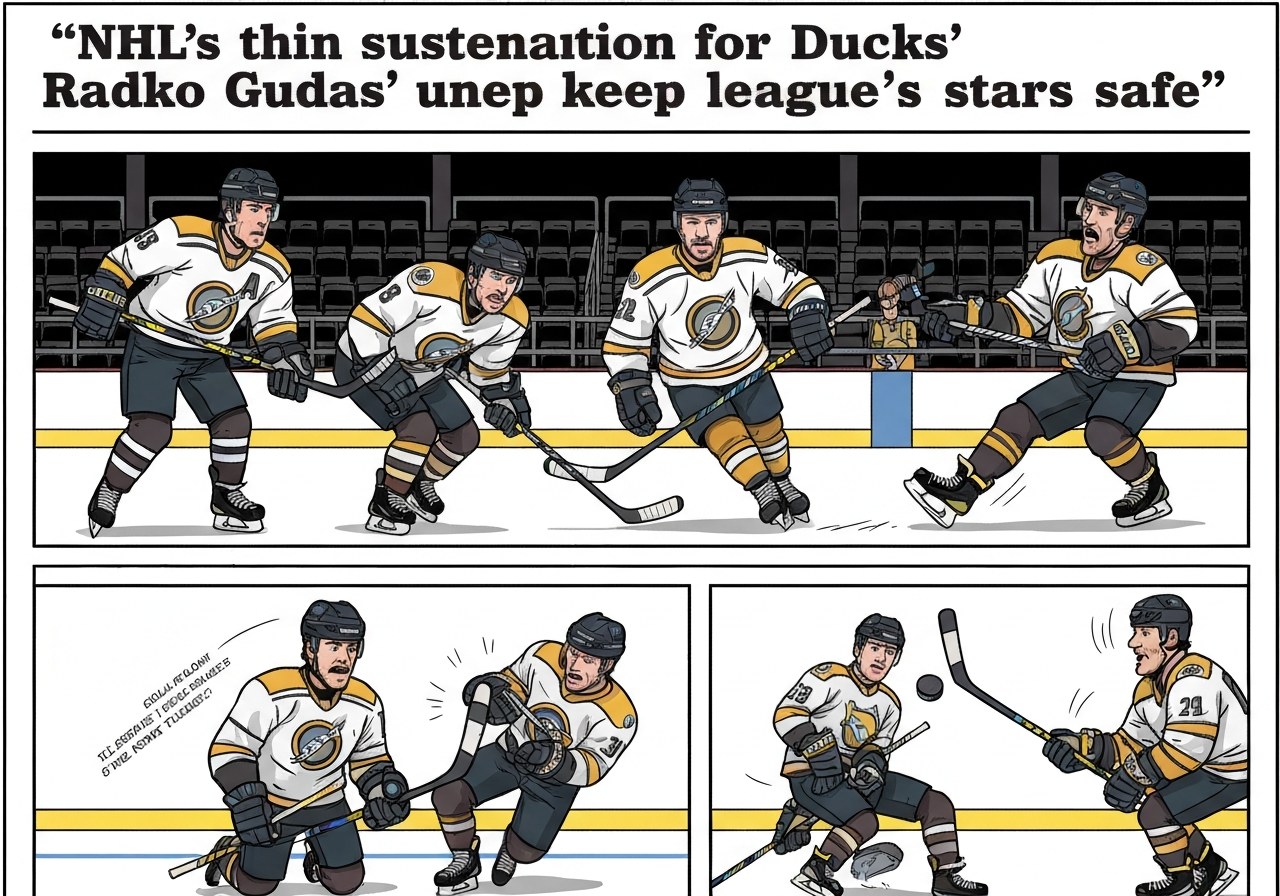
On the night of March 14, 2026, the NHL’s Department of Player Safety suspended Anaheim Ducks defenseman Radko Gudas for five games after a knee-on-knee collision with Toronto Maple Leafs captain Auston Matthews. Matthews, a former Hart Trophy winner and multiple 60-goal scorer, was diagnosed with a Grade 3 MCL tear and a quad contusion and has been ruled out for the Maple Leafs’ remaining 16 regular-season games. The five-game ban is Gudas’ fifth career suspension and raises his total games missed to 26. Many players, agents and observers called the penalty insufficient, saying it does little to deter repeat offenders.
Key Takeaways
- Radko Gudas received a five-game suspension on March 14, 2026, for a knee-on-knee hit on Auston Matthews.
- Auston Matthews sustained a Grade 3 MCL tear and a quad contusion and will miss the final 16 regular-season games.
- This is Gudas’ fifth career suspension, bringing his career games missed due to suspension to 26.
- Critics point to a past precedent: Matt Cooke was suspended seven playoff games in 2014 for a similar knee-on-knee incident, an action the league equated to a longer regular-season penalty.
- Agents representing elite players have publicly criticized the Department of Player Safety’s (DOPS) decision as insufficient to change dangerous behavior.
- George Parros has led DOPS for nearly nine years; observers say the department’s enforcement has softened since earlier, stricter regimes.
Background
The NHL’s disciplinary framework is administered by the Department of Player Safety, which reviews incidents and levies suspensions or fines. In the early 2010s, under Brendan Shanahan, the department moved toward clearer explanations and stiffer penalties for repeat offenders, including use of video explanations to justify decisions. That approach faced resistance from some owners and general managers, who argued longer suspensions carried competitive and financial costs for their teams.
After Shanahan’s departure, enforcement standards evolved under subsequent leadership and the department’s posture softened in practice, critics say. The league balances player safety, competitive fairness and legal exposure, creating a system that often appears inconsistent when compared case by case. Repeat offenders with extensive histories — like Gudas — present a particular challenge because the goal of deterrence can clash with reluctance among stakeholders to impose long absences.
Main Event
During a game between the Anaheim Ducks and Toronto Maple Leafs on March 14, 2026, Radko Gudas made contact with Auston Matthews that the NHL characterized as a knee-on-knee collision. The league’s written decision said Gudas “had the onus to ensure that he makes an approach that allows him to deliver a legal, full bodycheck,” and concluded the play warranted a five-game suspension.
Toronto later disclosed that Matthews suffered a Grade 3 medial collateral ligament tear and a quad contusion and would miss the remainder of the regular season — 16 games — with possible offseason evaluation to determine whether surgery is required. Team and league officials described the contact as “forceful and dangerous.”
Gudas, a veteran defenseman known for a hard-nosed style and prior disciplinary history, now faces his fifth suspension; prior to this incident he had been suspended four times for a total of 21 games. The decision to impose five games immediately drew sharp reactions from Matthews’ camp and from other player representatives, who said the penalty fell short of what is needed to deter similar hits.
Analysis & Implications
The five-game suspension spotlights a long-running tension in the NHL: how to protect marquee players while preserving the game’s physical character. A single five-game absence for a repeat offender with a lengthy record rarely functions as a strong deterrent, particularly when the injured player loses a significant portion of a season. Teams whose stars are sidelined by such hits face both competitive and commercial consequences.
Comparisons to the Matt Cooke case in 2014 amplify the argument that standards have softened. Cooke’s seven-game playoff suspension was effectively weighted more heavily because playoff contests are considered higher value; using DOPS’ own valuation, that discipline was treated as significantly harsher than a short regular-season ban. If similar incidents now attract lighter penalties, the perception grows that repeat dangerous plays carry diminishing consequences.
The institutional context matters. George Parros, who has led DOPS for nearly nine years, operates under directives set by NHL ownership and senior management. Observers note that longstanding managerial culture and internal resistance from teams unwilling to accept long absences for key players help constrain how aggressive DOPS can be. Without external pressure — from players’ association actions, broad public outrage, or legal exposure — policy drift toward leniency is likely to continue.
Comparison & Data
| Player | Incident Suspension | Prior Suspensions (count/games) | Total Games Missed After Incident |
|---|---|---|---|
| Matt Cooke (2014) | 7 playoff games (equivalent ~14 regular-season games) | 5 suspensions / 27 games | 34 (approx., using playoff equivalence) |
| Radko Gudas (2026) | 5 regular-season games | 4 suspensions / 21 games | 26 games |
The table frames how two comparable knee-on-knee incidents were penalized. Cooke’s 2014 ban occurred in the playoffs and was thus implicitly treated as more punitive; by contrast, Gudas’ five regular-season games carry less immediate competitive weight. The numeric gap helps explain why agents and players view the recent suspension as inadequate.
Reactions & Quotes
Agents for top players were vocal within hours of the announcement, saying the five-game ban does not signal that the league is prioritizing the safety of its highest-value athletes. The reaction reflects concern inside player circles that the current system does not sufficiently protect stars from repeat dangerous plays.
“This punishment is insufficient given the injury and the player’s history.”
Judd Moldaver, agent for Auston Matthews
Moldaver and others framed their criticism as a call for stronger deterrence. Their comments underline that representation for elite players expects more severe disciplinary outcomes when a star suffers a season-ending or near–season-ending injury.
“Repeat offenders need consequences that change behavior — five games will not do that.”
Unidentified player agent
League spokespeople reiterated that disciplinary decisions follow established criteria including intent, history, and the result of the play. The NHL emphasized that its ruling followed those guidelines even while acknowledging the seriousness of Matthews’ injury.
Unconfirmed
- Whether Auston Matthews will require offseason surgery for his Grade 3 MCL tear remains undecided and will be determined after further medical evaluation.
- Whether the Gudas suspension will prompt a formal policy review or changes in DOPS’ approach to repeat offenders is not confirmed; league leadership has not announced any procedural changes as of publication.
Bottom Line
The five-game suspension handed to Radko Gudas has reignited debate over whether the NHL’s disciplinary system can adequately protect elite talent. Given the numbers — a star losing 16 games and a repeat offender adding to a long suspension history — many stakeholders see the ruling as too tepid to change conduct across the league.
Absent a clear, sustained push for tougher, consistent enforcement from owners, the players’ association, and public pressure, the current equilibrium is likely to persist: sporadic, case-by-case penalties that struggle to deter repeat dangerous plays. For now, the incident stands as another data point in a pattern critics say shows the system favoring short-term competitive concerns over stronger long-term deterrents.
Sources
- The New York Times — News report and analysis
- NHL Player Safety (X / official department feed) — Official announcement of suspension
- Toronto Maple Leafs (team site) — Team injury and roster information