
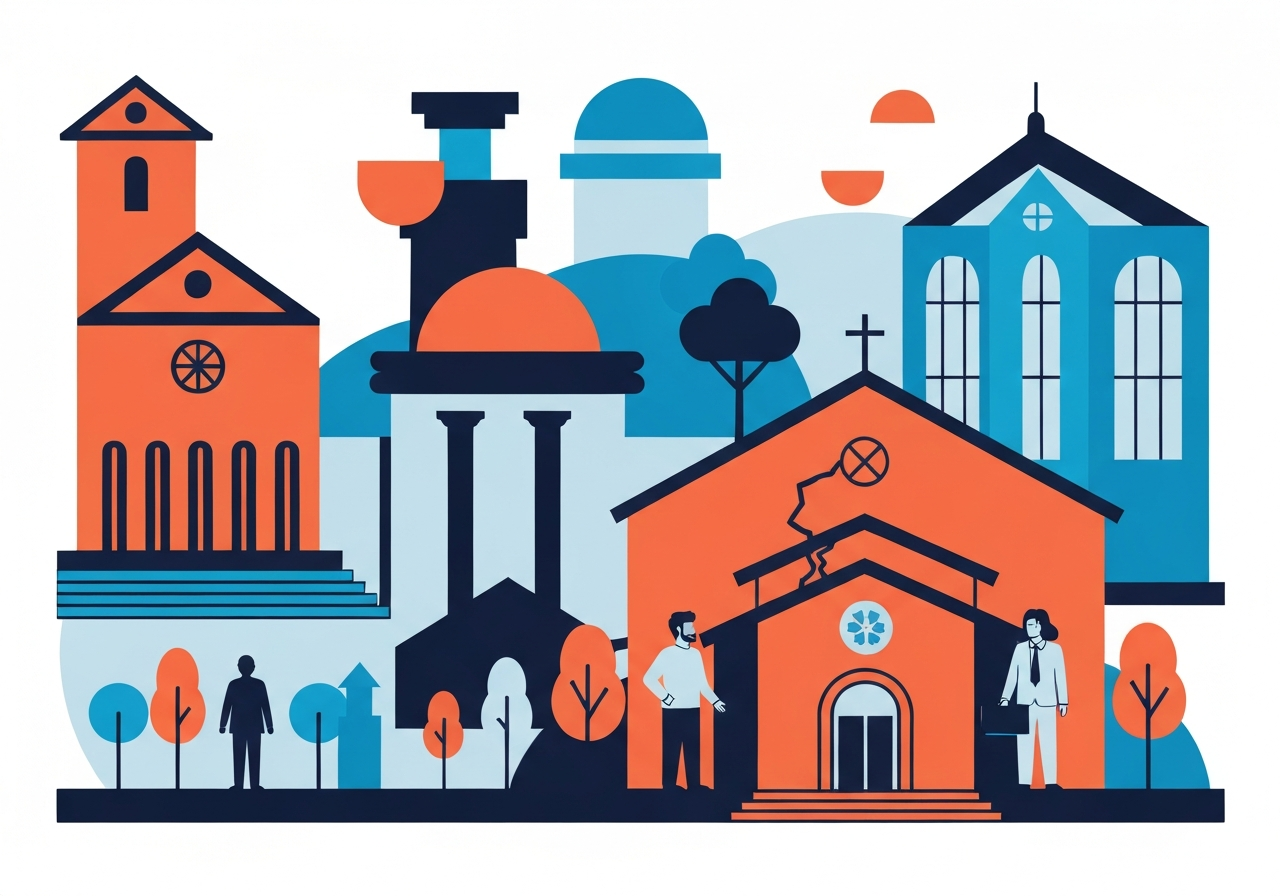
On March 14, 2026, more than 100 preschool children and their teachers evacuated Temple Israel in West Bloomfield, Michigan, after fire and smoke spread during an antisemitic attack. They were taken across the street to the Shenandoah Country Club, a gathering place for the local Chaldean (Iraqi American Christian) community, whose staff provided shelter, snacks and care until families reunited. The following evening the club opened its halls to the synagogue for a joint Shabbat service that combined grief, solidarity and defiance. Local leaders framed the episode as both a humanitarian response and a test of long-standing neighborhood ties amid rising regional and global tensions.
Key Takeaways
- On March 14, 2026, an antisemitic attack at Temple Israel in West Bloomfield forced the evacuation of more than 100 preschoolers and their teachers; they sheltered at Shenandoah Country Club.
- Shenandoah Country Club, a Chaldean community hub, provided food, candy and a gathering space and hosted a Shabbat service the next evening.
- Rabbi Paul Yedwab described the club as a “command center” and shelter; Hassan Yazbek, the club general manager, emphasized neighborly duty.
- Detroit-area Jewish, Arab and Muslim communities have lived side by side for more than a century, but relations have been strained since Oct. 7, 2023, and the subsequent Middle East conflicts.
- Contextual figures cited in reporting include the Oct. 7, 2023 Hamas attack that killed over 1,000 people and took more than 200 hostages, and Israeli strikes that have reportedly killed more than 67,000 Palestinians.
- Recent American-Israeli strikes on Iran and Iran’s reprisals have widened the region’s violence; reports indicate more than 2,000 deaths connected to those exchanges so far.
- The local response highlighted intercommunity solidarity even as national and international events have heightened fears and divided opinion.
Background
For more than a century, neighborhoods in and around Detroit have included Jewish, Arab and Muslim residents who typically lived in close proximity with limited friction. Over decades community institutions — synagogues, churches, cultural clubs and small businesses — forged everyday ties that helped sustain coexistence. That equilibrium began to fray after Oct. 7, 2023, when Hamas carried out an assault on Israel that U.S. and international reports say killed over 1,000 people and led to more than 200 hostages being taken. The attack triggered a prolonged and bloody war in Gaza; media reporting and humanitarian agencies cite more than 67,000 Palestinian fatalities from Israeli strikes.
In recent weeks, a series of strikes involving the United States, Israel and Iran — and reciprocal Iranian retaliation — has expanded hostilities beyond Israel and Gaza, with reports of more than 2,000 deaths tied to those exchanges. Those international developments have sharpened divisions among U.S. communities with ties to the region, occasionally producing protests, counterprotests and spikes in targeted incidents. Law enforcement and civic leaders in Michigan had been monitoring tensions and preparing community outreach plans even before the Temple Israel attack.
Main Event
The incident at Temple Israel unfolded on March 14 when fire and smoke filled portions of the building following what authorities and community leaders described as an antisemitic attack. More than 100 preschool-aged children and their teachers evacuated under urgent conditions and, to avoid on-street exposure, crossed into the Shenandoah Country Club directly opposite the synagogue. Staff at the club quickly organized a space for the children, provided food and treats, and coordinated reunification with parents as emergency responders secured the site.
By the following evening, Shenandoah’s facilities hosted a Shabbat service attended by members of the synagogue and representatives of the Chaldean community. The gathering combined solemn remembrance with communal resilience: prayers were said, leaders spoke, and attendees emphasized mutual support. Rabbi Paul Yedwab said the club had become ‘‘our shelter, our home’’ during the crisis, signaling a close institutional response between the two communities.
Shenandoah general manager Hassan Yazbek framed the response in personal terms, telling reporters, ‘‘We treat our neighbors as we treat ourselves. These are our brothers and sisters.’’ Local organizers said the club’s role was logistical as well as symbolic: it functioned as an incident hub for families, volunteers and clergy while law enforcement continued its investigation. Authorities have described the episode as motivated by antisemitism, and an active probe into the assault and the fire remains underway.
Analysis & Implications
The immediate cross-community aid at Shenandoah demonstrates how local institutions can blunt the human costs of targeted violence and limit community fragmentation. When neighborhood organizations respond rapidly to shelter and care for victims, they not only meet urgent needs but also provide a public counter-narrative to fear — one that emphasizes shared responsibility over division. That effect matters in metro areas like Detroit where daily interactions across faith and ethnic lines are common and economically intertwined.
At the same time, the attack underscores how international conflicts can reverberate inside U.S. communities, inflaming emotions and sometimes triggering localized violence. The Oct. 7, 2023 events and subsequent regional military exchanges have generated fresh waves of protest and antagonism that complicate law enforcement and civic outreach. Policymakers and community leaders face the dual task of addressing security concerns while preserving channels for interfaith dialogue that have historically reduced tensions.
Economically and politically, recurring targeted incidents can strain neighborhood commerce, depress local investment, and influence voter perceptions about safety and social cohesion. For immigrant and minority institutions such as the Chaldean clubs and neighborhood synagogues, sustained attacks or even the perception of threat can force costly security upgrades and alter communal programming. Conversely, visible acts of mutual aid can strengthen civic ties and produce durable partnerships for violence prevention and emergency response.
Comparison & Data
| Event | Reported Fatalities/Impact | Notes |
|---|---|---|
| Oct. 7, 2023 Hamas attack | Over 1,000 killed; >200 hostages | Trigger for the recent regional escalation |
| Israeli strikes in Gaza | Reportedly >67,000 Palestinian fatalities | Figure cited in reporting on broader conflict |
| Recent U.S.-Israel/Iran exchanges | Reportedly >2,000 deaths | Includes deaths tied to regional strikes and retaliation |
The figures above are drawn from reporting on the wider Middle East conflict and are included to provide context for the Michigan episode. While the local attack is a distinct criminal incident, community leaders and analysts note that macro-level violence often raises the likelihood of localized hate incidents. Tracking both sets of data helps civic authorities calibrate outreach, policing and interfaith programming.
Reactions & Quotes
“Shenandoah opened itself to Temple Israel to be the command center, to be our shelter, to be our home.”
Rabbi Paul Yedwab
Rabbi Yedwab framed the club’s role as central to immediate relief and community solidarity, crediting its staff with rapid coordination for children and families.
“We treat our neighbors as we treat ourselves. These are our brothers and sisters.”
Hassan Yazbek, Shenandoah Country Club general manager
Yazbek characterized the gesture as rooted in long-standing neighborhood relationships and emphasized the Chaldean community’s commitment to support.
Unconfirmed
- Precise identity and motive of the attacker(s) beyond the characterization of the incident as antisemitic remain under investigation and unverified in public reports.
- Any direct operational link between the local assailants and foreign organizations or governments has not been established publicly.
- Whether the attack represented a planned escalation targeting the synagogue specifically, versus a spontaneous or opportunistic act, is not yet confirmed.
Bottom Line
The Temple Israel incident exposed both vulnerability and resilience: a violent act threatened young children and disrupted a long-established pattern of neighborhood life, yet the swift intervention by Shenandoah Country Club prevented further immediate harm and produced a public demonstration of cross-community solidarity. The episode highlights how local institutions can absorb shock, provide practical care and send a message that communal bonds still matter.
Going forward, the Michigan case will test whether short-term solidarity can translate into longer-term protective measures — improved communication between faith groups, coordinated safety planning, and expanded civic programs to address the spillover effects of international conflicts. Authorities’ investigation into the attack will determine legal outcomes; community leaders must now decide how to convert this moment of mutual aid into durable safeguards against future violence.
Sources
- The New York Times — national newspaper reporting on the Temple Israel attack and community response (media).