
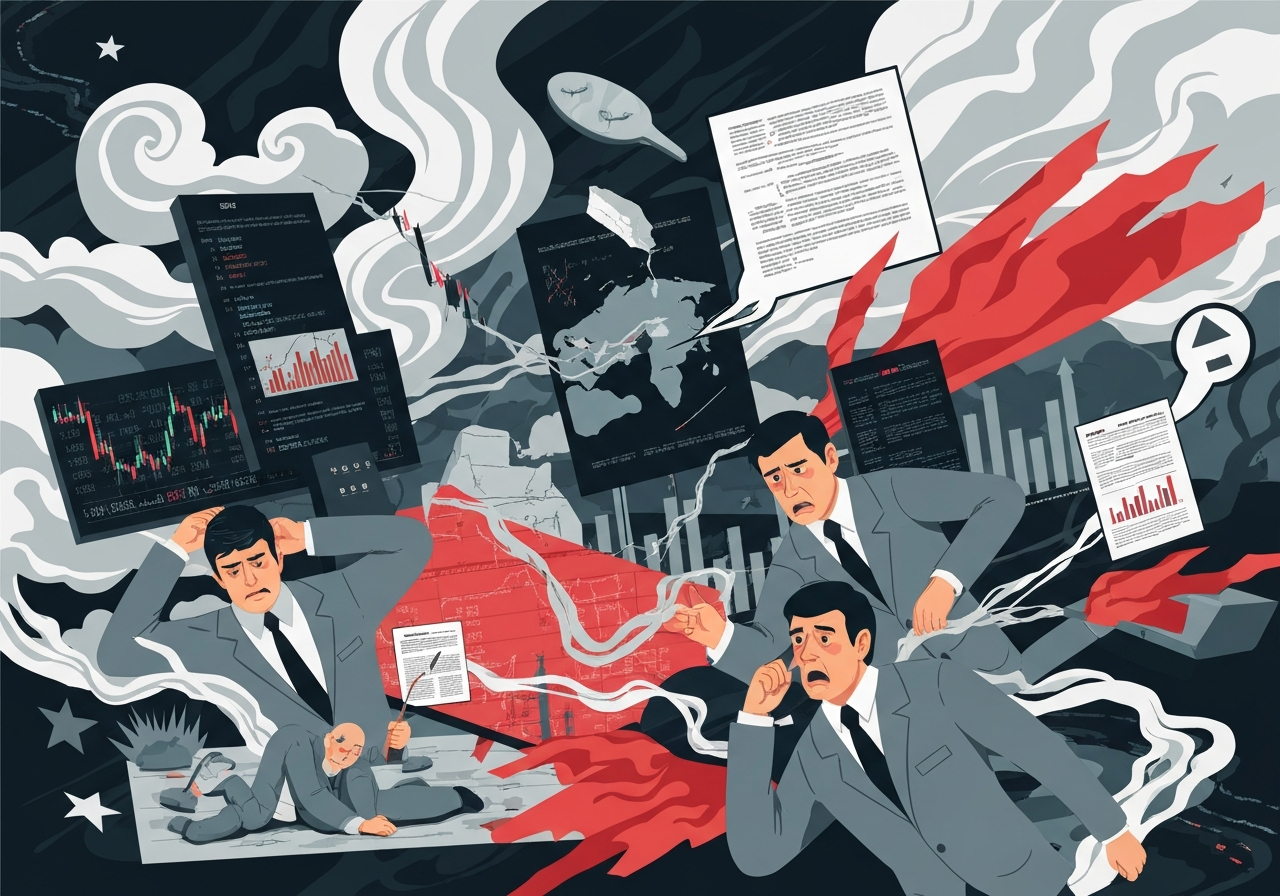
Lead: The US–Iran war that began three weeks ago has not yet triggered broad market panic, but strategists warn that sentiment could shift quickly. The S&P 500 is down roughly 3% year-to-date and about 5% below its all-time high, while Brent crude has surged after oil flows through the Strait of Hormuz were disrupted. Alpine Macro’s chief geopolitical strategist Dan Alamariu projects that a wave of “peak war panic” is most likely within one to three weeks if supply disruptions persist. President Donald Trump said he is not prepared to accept a ceasefire deal whose terms he deems insufficient, prolonging uncertainty.
Key Takeaways
- S&P 500: down ~3% year-to-date and ~5% off its record high, indicating limited market panic so far.
- Oil moves: crude prices have risen more than 40% since the conflict began and are up nearly 70% YTD, with Brent likely to stay above $100/bbl if the Strait of Hormuz remains closed.
- Supply shock: analysts estimate about 15 million barrels per day of Gulf production is at risk after Iran’s effective blockade of the Strait of Hormuz.
- Strategic reserves: IEA members agreed to release 400 million barrels, but daily draw rates fall far short of replacing lost flows.
- Military actions: U.S. strikes hit Kharg Island and Washington is deploying 2,500 Marines to the region, raising escalation risks.
- Timeframe: Alamariu sees a plausible end within two months but warns the conflict could run longer, with peak market fear arriving in 1–3 weeks.
- Structural risk: prolonged Strait-of-Hormuz closure could push oil toward $150–$200/bbl in stressed scenarios, per industry analysts.
Background
The crisis intensified after Iran’s de facto blockade of the Strait of Hormuz disrupted a material share of global oil flows. That waterway normally carries a substantial portion of Middle East crude; estimates cited by analysts place lost throughput at roughly 15 million barrels per day. The disruption followed a series of strikes and counterstrikes that have damaged military and energy infrastructure, raising fears of a broader Middle East conflagration.
Historically, major geopolitical disruptions to oil flows produce a delayed peak in panic — often several weeks in — as markets reassess inventories, shipping routes and spare capacity. The 2022 Russian invasion of Ukraine produced a sharper initial spike in energy prices; this episode differs in scale and geography but shares the common mechanism of supply-side shock. Stakeholders include Tehran and Washington, Gulf producers, shipping firms, global traders and consuming economies that depend on steady flows for industry and agriculture.
Main Event
In the most recent developments, U.S. forces struck military facilities on Kharg Island, Iran’s principal oil export terminal, and announced a 2,500-Marine deployment to the region. Iranian strikes and threats continue to hamper transit through the Strait of Hormuz and have extended to targeting infrastructure in neighboring Gulf states. Reuters reported that third-party diplomatic efforts to initiate ceasefire talks were rebuffed by both U.S. and Iranian delegations.
President Trump told NBC News he is withholding agreement on a ceasefire because proposed terms are “not good enough,” and he emphasized any deal must be “very solid.” Iranian leaders, even amid heavy military losses, continue to present threats to shipping that sustain elevated oil prices. At the same time, Tehran shows no immediate appetite for terms that would let it avoid near-term economic pain, a dynamic that prolongs the standoff.
Analysts point to a widening set of escalation pathways: Iran’s Houthi allies in Yemen could try to block the Bab el-Mandeb, doubling disruptions to roughly an additional 5 mb/d of oil flows; strikes on desalination or port facilities could create humanitarian and trade crises; and forceful seizure of Kharg could cut Iranian export revenues while exposing occupying forces to missile and drone attacks. Each scenario carries distinct market and geopolitical consequences.
Analysis & Implications
Market reaction to conflict typically lags the onset of hostilities because investors first assess immediate damage, then reevaluate the likely duration and economic fallout. With the S&P down only modestly so far, many participants remain in a risk-on posture; but continued or expanded disruptions to oil and shipping would likely flip that stance into a coordinated risk-off move. Alamariu’s projection that peak panic could arrive within one to three weeks reflects historical patterns in which oil-driven shocks crescendo several weeks into a conflict.
Energy markets are acting as the transmission mechanism to broader financial conditions. If Brent remains above $100 a barrel for an extended period, energy-importing regions would face heightened inflationary pressure and possible demand destruction later in the adjustment process. Europe is particularly exposed because of its reliance on stable shipping routes for industrial inputs and fertilizer, and rising commodity costs could feed through to consumer prices and growth metrics.
Policy responses — such as strategic reserve releases and coordinated sanctions or naval operations — can blunt price spikes but rarely replace sustained daily flows. The IEA’s 400-million-barrel agreement will alleviate short-term strains but cannot offset a multi-week or multi-month closure of chokepoints like Hormuz and Bab el-Mandeb. Markets therefore face both cyclical volatility and the prospect of structural supply shifts if shipping routes are rerouted or infrastructure remains degraded.
Comparison & Data
| Metric | Value / Note |
|---|---|
| S&P 500 YTD change | ~-3% |
| S&P 500 from high | ~-5% |
| Oil change since war began | +>40% |
| Oil change YTD | ~+70% |
| Estimated Gulf supply at risk | ~15 million barrels/day |
| IEA strategic release | 400 million barrels (total) |
The table summarizes the principal market indicators referenced by analysts: equity moves remain modest while energy metrics show material stress. Historical analogs suggest oil peaks about four to eight weeks into similar conflicts; this episode is entering week three, placing markets near the window where panic commonly intensifies.
Reactions & Quotes
Officials, strategists and industry figures have framed the event in stark terms and warned of cascading effects.
“The end is not in sight. The Strait of Hormuz is effectively closed, and markets are starting to price in a prolonged, uncertain endgame.”
Dan Alamariu, Alpine Macro (geopolitical strategist)
Alamariu used his firm’s note to caution investors that ongoing closures and allied interdictions could push markets from volatility trading into hedging for structural damage.
“I don’t want to make it because the terms aren’t good enough yet.”
Donald Trump, President (interview with NBC News)
Trump’s public stance on ceasefire terms signals U.S. reluctance to accept a mediated agreement without conditions that Washington deems satisfactory, prolonging diplomatic uncertainty.
“Supply volumes at risk this time are dimensionally bigger—and real. US$200/bbl is not outside the realms of possibility in 2026.”
Simon Flowers, Wood Mackenzie (industry analyst)
Flowers and other energy consultants warn that the scale of at-risk flows raises the probability of extreme price outcomes if the conflict is protracted.
Unconfirmed
- Reports of internal regime fractures in Tehran and specific power struggles related to Mojtaba Khamenei’s selection are circulating but lack independent verification.
- Claims that Houthi forces will imminently close the Bab el-Mandeb are plausible under escalation scenarios but remain unconfirmed as concrete operational orders.
- Warnings about deliberate attacks on desalination plants have been raised publicly by commentators but have not been substantiated by verifiable official evidence.
Bottom Line
The market has yet to price in the full extent of a prolonged supply shock: equities remain only modestly lower while energy metrics signal acute stress. If Iran and its proxies sustain closures of key shipping lanes or if escalation prompts larger Gulf producers to declare force majeure, investors should expect a swift repricing of risk that could produce a global risk-off episode.
For investors and policymakers the critical variables are duration and breadth: short, contained disruptions can be managed with reserves and rerouting; multi-strait or multi-month interruptions risk structural damage to trade flows, inflation and corporate earnings. In the near term, the next one to three weeks are pivotal — a period when analysts expect panic to peak if the conflict does not show credible signs of de-escalation.
Sources
- Fortune — news analysis and original report on market reaction and interviews (news organization).
- Reuters — news agency reports on diplomatic efforts and battlefield developments (news agency).
- International Energy Agency (IEA) — official statements and strategic reserve coordination (international agency).
- Wood Mackenzie — energy industry research and price scenario analysis (industry research).
- NBC News — interview coverage where presidential comments were reported (news organization).
- Alpine Macro — geopolitical research note and strategist commentary (research firm).