
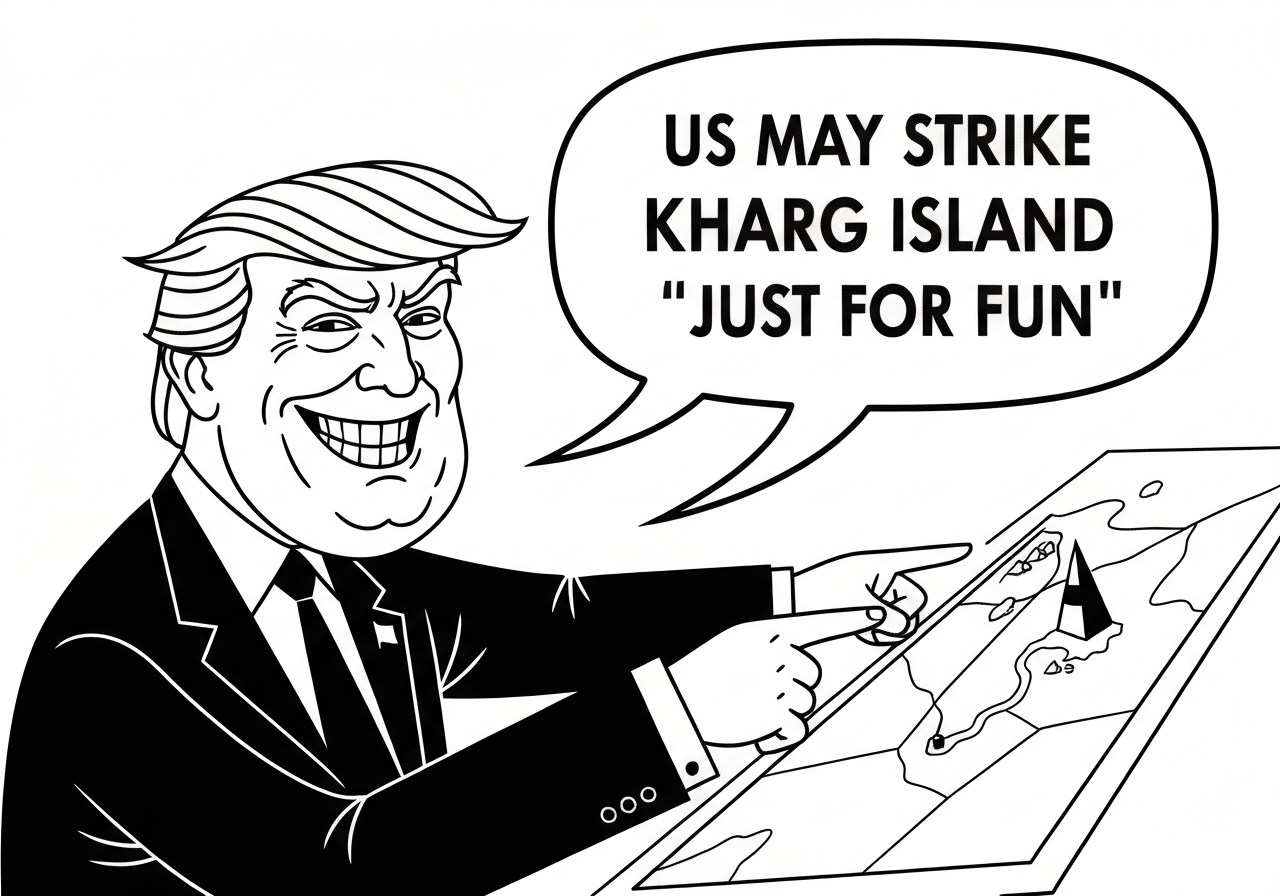
— Former US president Donald Trump said on Saturday that the United States may carry out additional strikes on Iran’s Kharg Island oil export hub ‘just for fun’, while suggesting Tehran was close to a deal that nonetheless offered ‘terms are n’t good enough yet’. His remarks came in a 30-minute telephone interview with NBC and in posts on Truth Social, and followed US strikes that Trump said had ‘totally demolished’ most of the island. He also questioned, without attribution, whether Iran’s new supreme leader ‘is even alive’ and said it remained unclear whether Iran had dropped mines in the Strait of Hormuz. The comments deepen international concern about the security of shipping and energy supplies amid the US‑Israeli campaign against Iran.
Key takeaways
- On 14 March 2026, Trump told NBC in a 30‑minute interview that the US ‘may hit’ Kharg Island ‘a few more times just for fun’, describing prior strikes as having ‘totally demolished’ most of the island.
- Trump said Tehran appears prepared to negotiate to end hostilities but claimed proposed terms were ‘not good enough yet’, signalling conditions for any de‑escalation remain unsettled.
- He raised an unverified question about Iran’s new supreme leader’s status, saying the leader ‘is even alive’, a claim for which no evidence was provided in the interview.
- Trump stated it was not clear whether Iran had laid mines in the Strait of Hormuz and said the US would ‘sweep’ the strait, anticipating some partner nations would join the effort to keep oil flowing.
- On Truth Social, Trump wrote that the US had ‘beaten and completely decimated Iran, both Militarily, Economically, and in every other way’, and renewed calls for other countries to help secure the Hormuz passage.
- The remarks mark a rhetorical shift toward inviting multilateral participation despite earlier stating Operation Epic Fury had been a largely unilateral show of force with Israeli cooperation.
Background
Kharg Island has long been Iran’s principal oil export terminal, serving as a loading point for crude bound for global markets. Damage to the island or disruptions in the Strait of Hormuz can ripple through international energy markets because a significant share of Middle Eastern seaborne oil transits that waterway. Tensions between the United States and Iran escalated after Operation Epic Fury, a US and Israeli military campaign against Iranian targets that the US has portrayed as necessary to degrade Tehran’s capabilities.
Since those strikes, Washington has framed parts of its policy as both pressure and deterrence, arguing that disruption to shipping and energy supplies demands attention from importers worldwide. Former president Trump has for years argued that the US bears a disproportionate burden protecting global sea lanes and has used that theme to press allies and rival importers alike to contribute more to maritime security. The current remarks must be read in that continuity as well as in the immediate context of ongoing strikes and diplomatic outreach.
Main event
During the NBC interview, Trump reiterated that the US could strike Kharg Island again, saying previous actions had ‘totally demolished’ much of the facility and adding that ‘we may hit it a few more times just for fun’. He described talks with Tehran as preliminary and unsatisfactory, framing any pause or settlement as contingent on harsher terms than those he believed Iran offered. The interview ran some 30 minutes and included questions about maritime threats and the state of Iran’s leadership.
Separately on Truth Social, Trump posted that the United States had ‘beaten and completely decimated Iran, both Militarily, Economically, and in every other way’, and urged countries reliant on oil transiting the Strait of Hormuz to take responsibility for securing the passage while promising US assistance ‘A LOT’. He framed this as a pivot to a team effort, saying coordination should have been the norm and now ‘will bring the World together toward Harmony, Security, and Everlasting Peace’.
On maritime security, Trump said it was not yet clear whether Iran had placed mines in the Strait of Hormuz and that US forces would conduct strong sweeping operations, expecting some countries to join because their oil flows were affected. His public comments followed recent naval and aerial activity in the region and come amid widespread concern among importers and shipping firms about continuing disruptions to crude and tanker traffic.
Analysis & implications
Trump’s remarks raise three interconnected issues: the risk of further kinetic escalation, the legal and diplomatic implications of offensive strikes on energy infrastructure, and the challenge of organizing a credible multinational response to protect commercial shipping. A stated willingness to conduct additional strikes, even couched in cavalier language, can increase the likelihood of miscalculation between state and non‑state actors operating in a congested maritime theatre. That risk is heightened where lines of command and attribution are contested and where collateral damage could affect third states and neutral shipping.
Energy markets are sensitive to statements about Kharg Island because the terminal’s capacity matters to seaborne exports. Even the threat of additional strikes or maritime mines can raise tanker insurance costs, redirect cargoes, and pressure governments to release strategic reserves. Encouraging other countries to secure the Strait of Hormuz may ease some burden on US forces, but effective coalition operations require clear rules of engagement, shared intelligence, and legal frameworks governing interdiction and minesweeping.
Politically, the comments reflect a rhetorical balancing act: asserting strength while inviting partners to share burdens. For allies and rivals alike, the credibility of US protection depends on consistent policy signals. If Washington pursues periodic unilateral strikes while simultaneously asking partners to step up maritime duties, coordination challenges and political friction are likely, particularly among nations wary of being entangled in a broader regional conflict.
Comparison & data
| Item | Context / Date |
|---|---|
| Trump NBC interview | 30‑minute call, 14 March 2026 |
| Truth Social post | 14 March 2026; called for multilateral action |
| Operation Epic Fury | Ongoing US‑Israeli campaign; sequence began earlier in 2026 |
The table highlights the immediate timeline: the interview and social‑media post occurred on 14 March 2026 and follow a campaign of strikes labelled Operation Epic Fury. While the specific physical damage to Kharg Island is described by Trump as extensive, independent verification of the island’s condition and of any mine‑laying in the strait remains outstanding. Analysts will watch whether other navies publicly commit assets to minesweeping or convoy protection in the coming days.
Reactions & quotes
Responses to Trump’s comments were swift in political and commercial circles, with diplomats and energy traders flagging the potential for market and security repercussions. Below are the principal public remarks from the immediate sources.
We may hit it a few more times just for fun.
Donald Trump — NBC interview, 14 March 2026
This remark, made in the televised interview, intensified concerns about further strikes on Kharg Island and prompted questions about targeting criteria and civilian risk mitigation.
The United States of America has beaten and completely decimated Iran, both Militarily, Economically, and in every other way.
Donald Trump — Truth Social post, 14 March 2026
That social media post was framed as both a boast and a call for other countries to take responsibility for securing the Hormuz passage, while promising extensive US assistance.
Unconfirmed
- Whether Iran laid mines in the Strait of Hormuz remains unverified by independent maritime authorities or neutral observers.
- Claims about the new Iranian supreme leader’s health or status are unsubstantiated in public reporting and lack official confirmation.
- Any plan for further strikes on Kharg Island beyond verbal statements has not been confirmed by independent military sources or official US government releases.
Bottom line
Trump’s public comments on 14 March 2026 inject fresh uncertainty into an already volatile regional security environment. His suggestion of additional strikes combined with calls for multilateral protection of the Strait of Hormuz creates both an operational problem and a diplomatic opportunity: partners can either step forward to share the burden and reduce unilateral action, or they can hesitate, increasing the risk that the US pursues further independent military measures.
For governments, shipping companies and energy markets, the key near‑term watchpoints are verification of maritime incidents in the Hormuz corridor, any formal commitments from other navies to minesweeping or convoy protection, and whether US policy shifts toward sustained coalition operations or intermittent unilateral strikes. Independent verification and clear diplomatic channels will be essential to avoid miscalculation and limit harm to civilians and global trade.
Sources
- The Guardian — media / news report summarising Trump remarks and regional context