
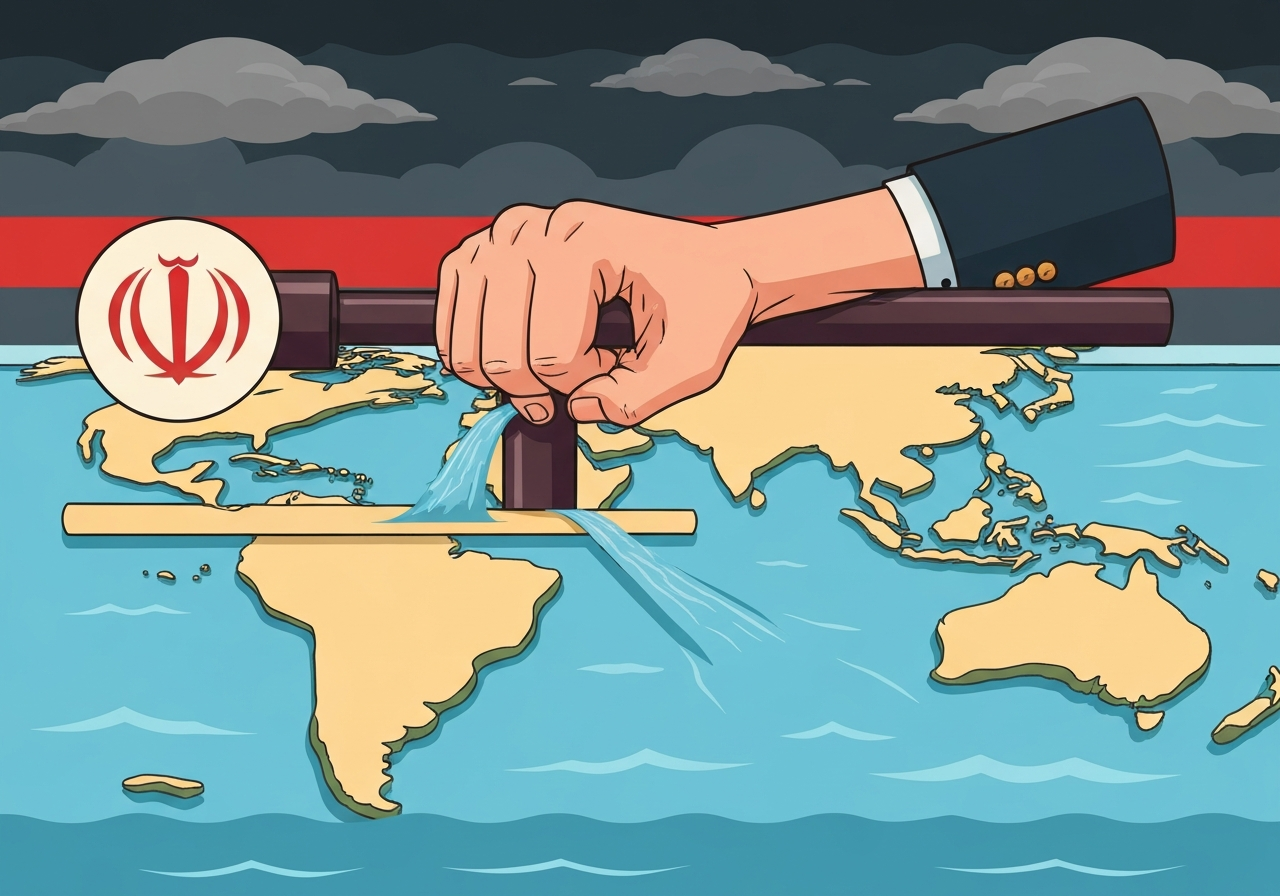
On March 19, 2026, maritime traffic through the Strait of Hormuz — the choke point for much of the world’s oil and gas exports from the Persian Gulf — remained at a near-standstill weeks after the United States and Israel launched strikes against Iran. Iran, which borders the narrow waterway, has restricted transit so that only vessels explicitly approved by Iranian authorities appear to be able to pass. The interruption has coincided with attacks on regional energy infrastructure and cuts to Gulf crude output as storage reaches capacity, contributing to a sharp uptick in oil and gas market volatility. Global energy and shipping markets face heightened disruption as the closure persists and alternative routes remain limited.
Key Takeaways
- By March 19, 2026, traffic through the Strait of Hormuz was described as a near-standstill, occurring weeks after US and Israeli strikes on Iran.
- Iran has effectively limited passage to vessels it authorizes, closing the route to most commercial traffic along a critical export corridor.
- Attacks on Middle Eastern energy infrastructure have accompanied the transit collapse, adding to supply concerns for oil and gas markets.
- Producers in the Gulf have announced cuts or managed output as storage tanks approach capacity, tightening available crude volumes for export.
- Oil and gas prices have surged amid the combined effects of the transit collapse, infrastructure attacks, and production adjustments.
Background
The Strait of Hormuz is a narrow maritime passage between the Persian Gulf and the Gulf of Oman that handles a large share of seaborne exports of crude oil and liquefied natural gas from Gulf producers. For decades it has been a strategic flashpoint because a significant portion of world hydrocarbon trade transits the channel; even brief disruptions can ripple through global markets. Tensions escalated in early 2026 after a series of strikes by the United States and Israel against Iranian targets, prompting Tehran to respond with measures that restrict maritime movement. Regional actors, including Gulf producers and international navies, have long balanced deterrence, commercial flow and the prevention of escalation in these waters.
Commercial shipping through Hormuz normally depends on a mix of private carriers, oil majors, and national tankers, with navies providing escorts in periods of heightened risk. Previous incidents, such as the 2019 tanker seizures and missile strikes earlier in the decade, showed how rapidly traffic patterns and insurance costs can change. Gulf states, international energy companies and insurers now face the operational challenge of rerouting cargoes, idling tankers, or storing crude domestically, all while monitoring diplomatic efforts to de-escalate the situation.
Main Event
In the weeks leading up to March 19, 2026, the U.S. and Israel conducted strikes on Iranian facilities, a move that Tehran publicly framed as requiring a reassessment of security for its coastline and maritime approaches. Iranian authorities then signaled controls over passage through the Strait of Hormuz; according to shipping industry notices, only vessels cleared by Iranian agencies have been granted transit. The practical effect has been a dramatic slowdown in licensed transits and an operational bottleneck for vessels awaiting clearance or choosing alternate longer routes around the Arabian Peninsula.
On the water, commercial captains and charterers report increased delays and uncertainty over scheduling. Some tankers have been rerouted around the southern tip of Africa — a journey that adds weeks and materially raises freight costs — while others are waiting in anchorage off Gulf ports or seeking to discharge into local storage. Gulf crude producers, facing fuller storage tanks and complications in export logistics, have announced or implemented production adjustments to manage the immediate oversupply at shore terminals.
Market reaction was fast. Oil and natural gas benchmarks moved higher as traders priced in reduced seaborne flows and the risk of further physical disruption. Energy infrastructure that sustained recent attacks is being inspected and repaired, but the combination of damage, precautionary shutdowns and reduced export capacity has kept upward pressure on prices and insurance premiums for vessels operating in the region.
Analysis & Implications
The effective closure of Hormuz by Iran reshapes short-term global energy flows. Because a material portion of seaborne Gulf exports passes through this single choke point, even temporary restrictions force cargoes onto much longer routes, raise shipping costs, and exert upward pressure on benchmark prices. Higher fuel prices feed into inflationary pressures worldwide, complicating central bank policy choices and industrial planning in energy-importing countries.
Geopolitically, the move amplifies regional tensions and places naval forces — including coalition elements — in a delicate position: the need to keep commerce moving without triggering a wider military escalation. Naval escorts and convoying can lower some risks for individual ships, but escorts do not remove the strategic leverage that controls over the strait confer to Iran. Any direct engagement with Iranian forces risks rapid escalation given the density of military and commercial traffic in a confined area.
Economically, Gulf producers’ ability to curtail output or use alternative storage will determine how prolonged the supply shock becomes. If storage constraints force deeper production cuts, markets could stabilize as available exports shrink; alternatively, temporary storage and re-routing may only delay and redistribute pressure, keeping volatility elevated. Longer-term, companies and states may accelerate investments in overland pipelines, northern export routes, or destination diversification to reduce dependence on Hormuz.
Comparison & Data
| Indicator | Pre-March 2026 | As of March 19, 2026 |
|---|---|---|
| Transit status | Open to commercial traffic | Near-standstill; only approved vessels moving |
| Export routing | Direct via Hormuz | Rerouting or anchorage; longer voyages considered |
| Market impact | Normal freight and insurance levels | Higher freight, rising insurance, price volatility |
The table summarizes the qualitative shift between normal operations before the strikes and the near-standstill described on March 19, 2026. While specific numbers for daily transits and cargo volumes fluctuate and can lag reporting, the directional change is clear: a move from routine throughput to heavily restricted movement with immediate cost consequences for shippers and energy buyers.
Reactions & Quotes
Authorities in Tehran framed the measures as necessary to safeguard national security and maritime approaches in the wake of strikes on Iranian territory.
Iranian authorities (official statement, paraphrased)
U.S. officials warned that restrictions on Hormuz pose a risk to global energy supplies and called for de-escalation through diplomatic channels while monitoring maritime security.
U.S. government (statement, paraphrased)
Industry analysts said the practical effect will be higher freight costs and insurance premiums, with some cargoes forced onto routes that add weeks to voyage times.
Energy and shipping analysts (paraphrase)
Unconfirmed
- Whether Iran’s restrictions are uniform across all vessel types or selectively applied to flagged or destination-specific ships remains unclear.
- The precise duration that U.S. and Israeli strikes will influence Tehran’s maritime posture is unknown; diplomatic developments could change the status quickly.
- The exact quantitative impact on daily seaborne export volumes through Hormuz has not been independently verified in open-source public shipping tallies as of March 19, 2026.
Bottom Line
The situation in the Strait of Hormuz on March 19, 2026 represents a significant, tangible disruption to a critical artery of global energy trade: Iran’s effective restriction of transit after strikes has placed immediate strain on shipping logistics and energy supply balances. Markets have already reflected part of this shock in higher oil and gas prices, while freight and insurance costs have risen for vessels operating in the region. Policymakers and industry participants now face a difficult trade-off between protecting commerce and avoiding further escalation.
Over the coming days and weeks, the most important variables will be whether diplomatic engagement reduces the security justification for the restrictions, how quickly damaged energy infrastructure is repaired, and how Gulf producers manage storage and production. For importers and markets, contingency planning — including alternative shipping arrangements and accelerated strategic stock releases if required — will shape the economic fallout.